WSJ’s CEO Council: Growth creates virtuous cycle

WSJ CEO Council

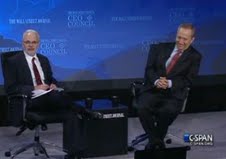
Summers talks with David Wessel at the Wall Street Journal’s CEO Council in Washington, DC on November 19, 2013.  Summers said, “Growth creates a virtuous cycle.” Summers told the CEOs, “The problem of the 21st century is the class divide and what it means for opportunity.” Read the transcript here.

MSNBC’s Morning Joe: Important to get this right

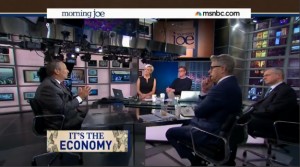
Morning Joe

Summers appeared on MSNBC’s Morning Joe on November 13, 2013. Talking about Obamacare he said, “It’s important to get this right.” Summers also discussed an “organized constituency” rooting for its failure and how flawed IT projects happen frequently in the private sector. Watch the video here.

CNBC: U.S. bent curve on health care costs

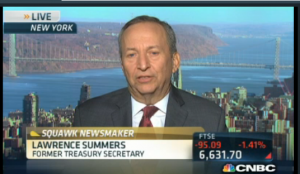
Since Obamacare  US bent curve on health costs  Larry Summers


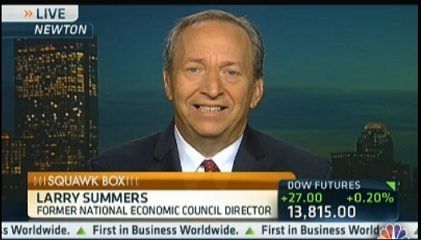
Summers told CNBC’s Squawk Newsmaker on November 13, 2013, “In the last three years since Obamacare was passed, we bent the curve on health care cost.” Watch the video here.

CNN: The President is right to be angry

Summers  Obama is  right to be angry

Summers talked with CNN’s Erin Burnett on Tuesday, November 12, 2013. Summers said the President is “right to be angry” about the rollout of the Affordable Care Act.  Watch the video here.

FORTUNE: Markets, Globalization, Technology

Fortune Magazine photo

Summers talks with Fortune Magazine’s David Kaplan for a Q&A on a wide range of topics including: markets, globalization, and technology — as well as Harvard and Silicon Valley in the November 18, 2013 issue.  Click here to read the story.

NPR: Can we accelerate the growth rate?

Summers_100

Summers talks with NPR’s Steve Inskeep on Morning Edition on October 29, 2013.  Summers tells Inskeep, “The most important question facing the American economy is can we accelerate the growth rate?”  Listen here.

CNBC: Growing economy resolves other problems

LHS on Closing Bell

Summers talks with CNBC’s Maria Bartiromo on Closing Bell on October 24, 2013. They discussed a wide range of topics, including the Obamacare, the global economy and Dodd-Frank. Summers tells Bartiromo “its wrong to be relying on monetary policy as the main driver of the economy.” Watch the video here.


Debt deal was “preempting the grotesque”

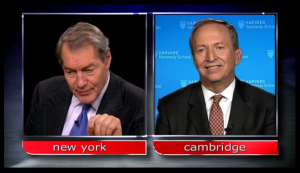
LHS on Charlie Rose


Summers talks with Charlie Rose on October 17, 2013 and says the debt deal was “preempting the grotesque.” Summers says going forward we need to focus on growth. Watch the video here.

Insufficient level of youth education stunts economic growth – Yalta European Strategy

LHS at YALTA

“It has been a truism for the last 200 years, that parents can expect their children to be better educated than them. This idea is now under threat,” said Larry Summers during a panel discussion on the current global economic issues, at the 10th Annual Meeting of Yalta European Strategy (YES) on September 20, 2013 in Ukraine. Watch the video here.


Imagine a Better World – Zeitgeist

Larry Summers at Zeitgeist

Larry Summers talks with Eric Schmidt, executive chairman of Google, at Zeitgeist – Imagine a Better World – on September 16, 2013 in Phoenix, Arizona. Summers said, “technological progress is immensely important for the potential it creates.” Watch the video here.


New York Forum – Africa

New York Forum - AfricaLarry Summers addressed the New York Forum Africa in Gabon on June 14, 2013, saying, “African growth depends on: peace, education, fair use of natural resources, good governance and technology. Watch the video here.

Tax reform can aid multinationals, cut deficit

July 7, 2013

Imagine a library where many books have been borrowed and are long overdue. There is a case for an amnesty to get the books back and move on. There is a case for saying that rules are rules and fines must be paid. But the worst strategy is to keep indicating that an amnesty may come soon without ever introducing it. And this is roughly where we are in our corporate tax debate.

No one is satisfied with the U.S. corporate tax system. Some argue the main problem is that, while corporate profits are extraordinarily high relative to gross domestic product, tax collections are relatively low. Many very successful companies pay little or nothing in taxes at a time when the budget deficit is a major concern, hundreds of thousands of defense workers are being furloughed and lotteries are being held to determine which children Head Start can no longer afford to help.

But others say the main problem is that the United States has a higher corporate tax rate than any other major country and, unlike other countries, imposes severe taxes on income earned outside its borders. This, they argue, unfairly burdens companies engaged in international competition and discourages the repatriation of profits earned abroad. The resulting patterns of investment are also said to benefit foreign workers at the expense of their U.S. counterparts.

With respect to tax reform, these perspectives seem to argue in opposite directions. The former points toward the desirability of raising revenue by closing loopholes; the latter seems to call for a reduction in corporate tax burdens. But while many can get behind the idea of “broadening the base and lowering the rate,” consensus tends to collapse over the means to broaden the base. A principal objective of many business-oriented reformers seems to be narrowing the corporate tax base by reducing the taxation of foreign earnings through movement to a territorial system.

Despite the tension between perspectives, the debate has landed us in so perverse a place that win-win reform would be easy to achieve. The central issue is the taxation of global companies. Under current law, U.S. companies are taxed on their foreign profits — with a credit for taxes paid to other governments — only when they repatriate these profits. Right now, U.S. companies are holding nearly $2 trillion in cash abroad. Businesses argue, with some validity, that current rules make it expensive to bring money home while not raising much revenue for the government. Tax relief, they assert, would help them bring money home, at a minimum benefiting their shareholders but also possibly leading to an increase in investment.

Critics counter that companies that have used what might politely be called aggressive accounting practices to locate income in low-tax jurisdictions should not be given further relief.

In the meantime, what’s a corporate treasurer to do? With the possibility of some kind of relief looming, there is every reason to delay repatriating earnings to the United States even if the company has no good use for the cash abroad. And so the debate encourages exactly what all sides can agree is desirable to avoid: corporate cash kept abroad to the detriment of companies and to no benefit for the U.S. fiscal situation.

A clear and unambiguous commitment that there will be no rate reduction or repatriation relief for the next decade would be an improvement over the current situation because companies would know that they will have to pay taxes on their foreign profits if they wish to make them available to shareholders and would no longer have an incentive to delay.

But this would not be the best outcome. As a very general rule, improvement is possible anytime tax rules are experienced by taxpayers as a substantial burden without generating substantial revenue for the government. Having taxpayers be burdened less and pay more can make them better off and help the fiscal situation. The United States should eliminate the distinction between repatriated and unrepatriated foreign corporate profits for U.S. companies and tax all foreign income (after allowances for taxes paid to other governments) at a fixed rate well below its current corporate rate, perhaps in the range of 15 percent.

A similar tax should be imposed on past accumulated profits held abroad.

Such a proposal could easily be designed to raise revenue relative to the current baseline, encourage the repatriation of funds and reduce the competitive disadvantage faced by U.S. multinationals operating abroad. It is about as close to a free lunch as tax reformers will ever get.

Wall Street Journal’s Seib & Wessel breakfast

Wall Street Journal Breakfast

Summers answered questions on austerity, China, Japan and Europe from the Wall Street Journal’s Gerald F. Seib, Washington bureau chief, David Wessel, economics editor and other Washington journalists at a Seib & Wessel breakfast on June 4, 2013 in Washington, DC.  View clips here.

Boom vs. Doom

NYT cover

In a New York Times Magazine cover story on May 5, 2013, reporter Adam Davidson writes, “serving both the Clinton and Obama administrations, Larry Summers did as much as any single person to design modern U.S. economic policy.” Read the article here.

Healthy Economic Growth in the US this Year

Bloomberg.AlHunt.4.5.2013

In an interview with Bloomberg’s Al Hunt on Friday, April 5, 2013, Summers said he expects healthy economic growth in the U.S. this year and next and doesn’t see a “need to panic” over a March employment report that shows slowing job creation. Watch the video here.

Learning from the Financial Crisis

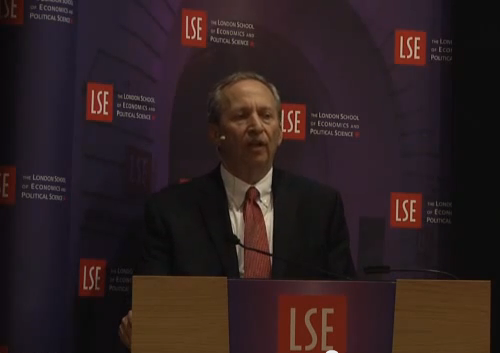
LSE.3.25.2013Larry Summers delivered a keynote address at the London School of Economics Financial Crisis Debate on March 25, 2013 in London, England. Summers discussed “ways in which I believe the crisis will force a substantial reconstruction of macro economics and ways in which I believe the crisis will, over time, redefine the role of central banks.” Watch the video here.

UK Economic Policy Illogical

BBC.3.25.2013

In an interview with Joe Lynam of the BBC’s Newsnight on March 25, 213, Summers talks about Cyprus, the Eurozone and the UK economy, saying “I have had some difficulty following the logic of British policy, I would have thought a loan guarantee is more or less the same thing as a loan.  Both expose tax payers to risk of loss.” Watch the video here.

The New Economy Built on Sharing

CBS.3.24.2013

On CBS Sunday Morning on March 24, 2013, Summers talks about the shared economy, saying “by bringing people together, by sharing our resources, we have a better economy.” Watch the video here.

Why Summers is Worried about Cyprus

CNBC.3.18.2013

In an conversation with CNBC’s Closing Bell with Maria Bartiromo and Bill Griffeth on March 18, 2013, Summers talks about the developing situation in Cyprus saying “the questions is, next time, will everyone be on much more of a hair-trigger than before?” Watch the video here.

Moving Forward with a Balanced Approach

CNBC.2.26.2013In a conversation with CNBC’s Squawk Box hosts, Joe Kernen and Andrew Ross Sorkin, on February 26, 2013, Summers called the sequestration a “self-inflicted wound from which we have nothing to gain.” Summers went on to say, “this should be brought to a conclusion with a balanced approach.” Watch the video here.