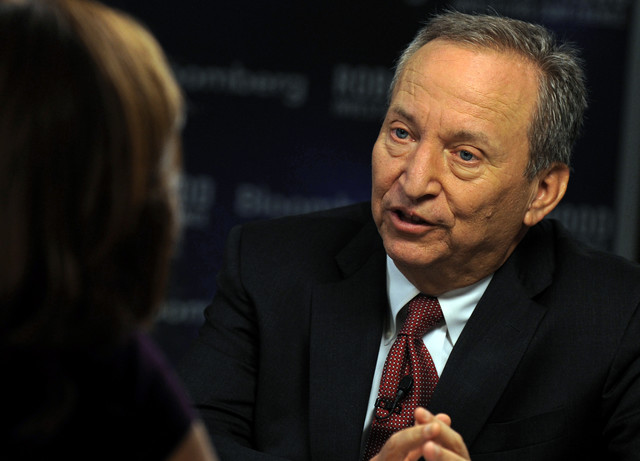
Pragmatic Imperative the World Stay Stable
In an interview with Bloomberg Television’s Peter Cook on April 25, 2014, Summers said, “Its a moral imperative, and also a pragmatic imperative, that the world stay stable and prosper together.” Read more
In an interview with Bloomberg Television’s Peter Cook on April 25, 2014, Summers said, “Its a moral imperative, and also a pragmatic imperative, that the world stay stable and prosper together.” Read more
In an interview with Greg Robb of Marketwatch on April 23, 2014, Summers talks about secular stagnation, bubbles and Thomas Picketty’s new book. He says, “My fear is that if we do achieve sustained growth based on current financial conditions, before long it would give rise to significant bubbles. That’s why I think we need a more investment-oriented approach to supporting growth and the reason why I put such emphasis on fiscal policy.” Continue reading
Summers talked with Chrystia Freeland on April 12, 2014 at the Institute for New Economic Thinking in Toronto, Canada. In his session, “Secular Stagnation? The Future Challenge for Economic Policy,” Summers provided some first thoughts on Thomas Piketty’s new book. Read more
Summers talked with Maria Bartiromo on her new show, ‘Sunday Morning Futures,’ on Fox News on March 30, 2014. Summers discussed Obamacare’s impact on the jobs market, corporate tax reform, secular stagnation, Japan, Europe and emerging markets. Summers told Bartiromo, “Japan is walking on a very narrow ledge.” Watch the video here.
Summers joined David Gergen at the 92Y in New York City on March 19, 2014 to discuss 21st Century Leadership. In his introduction, Gergen said, “Over time, people will look back and say in the late 20th century, Henry Kissinger was the guru people looked to on international affairs. Years from now, people will look and say, in the early 21st century, Larry Summers was the guru people looked to for understanding and enlightenment with regard to the economy here and internationally.” Click here to view the video.
Summers was in New York City on March 6, 2014 to talk with business and finance leaders about education and the economy and how Citizen Schools provides solutions to the most pressing education challenges. Summer’s told the audience, “I believe the battle for America’s future, and its legitimacy, will be won or lost in its public schools.” Read the full speech here.
In a speech to the National Association for Business Economics (NABE) on February 24, 2014, Summers said: “The American economy is changing, and our policy responses — especially with regard to interest rates as they relate to growth and full employment — need to be re-examined.” Read the full speech here.
Summers joined the board of the Center for Global Development as Chair on March 4, 2014. Summers said, “With almost half of the world—some 3 billion people—living on less than $3.00 a day, ensuring that the benefits of technology and global integration are widely shared is one of the central challenges of the 21st century.” Read the full article here.
Summers talked with USA Today’s Paul Davidson on February 24, 2014 about income inequality. Summers said, “I think globalization and technological change are raising the rewards to the most entrepreneurial and able among us. But they’re pulling away from everyone else. And that creates a real challenge to social cohesion.” Read the full article here.
Summers talked with CNBC’s Squawk on the Street on February 24, 2014. Summers said the crisis in Ukraine will be a “very important test for Europe.” Summers went on to say, “the challenges are going to be getting something in place quickly so that the Ukrainian people see real benefits to working cooperatively with Europe and the West.” Watch the video here.
Summers talked with Fareed Zakaria on CNN’s Global Public Square about economic policy and developing countries on Sunday, February 14, 2014. Summers said, “The Fed recognizes that low demand, growth, and employment are the greatest threats to U.S. economic health.” Watch the video here.
Summers talked with NPR’s Jeremy Hobson on February 11, 2014 for Here & Now about the US economy, the debt ceiling, emerging markets, income inequality and the minimum wage. Summers tells Hobson the minimum wage today is “substantially lower than when that fiery liberal Ronald Reagan was President.” Listen to the interview here.
Summers appeared on the Charlie Rose Show after the State of the Union on January 28, 2014 saying, “I give the President high marks.” Summers told Charlie Rose, “Big things often happen without huge pieces of legislation: North American energy independence and bending the healthcare cost curve.” Watch the video here.
At the World Economic Forum in Davos, on January 24, 2014, Summers was joined by Bill Gates, Linah Mohohlo and Jim Yong Kim for an event to discuss a report by The Lancet Commission on Investing in Health, chaired by Summers. The report points to the possibility of achieving dramatic gains in global health by 2025 through a grand convergence around infectious, child, and maternal mortality; major reductions in the incidence and consequences of non-communicable disease and injuries; and the promise of universal health coverage. A brief video on convergence launched the event. Watch the video here.
Summers talk with CNBC’s Squawk Box hosts on Thursday, January 23, 2014 at the World Economic Forum in Davos. Summer said, “America succeeds by raising everybody up.” Watch the video here.
On January 4, 2014, Summers participated on a panel, Macroeconomics of Austerity, at the American Economic Association annual meeting in Philadelphia. During the panel, Summers said that extraordinary times call for extraordinary measures and not a blind perseverance on a given course that may have worked in the past. Watch the video here.
On December 11, 2013, Summers talked with Charlie Rose about a the budget deal, income inequality, growth, Obamacare, education and academic boycotts. Summers called the budget deal “not a grand bargain but a little deal.” Watch the video here.
Prompted by the 20th anniversary of the 1993 World Development Report, a Lancet Commission revisited the case for investment in health and developed a new investment framework to achieve dramatic health gains by 2035. The Report, chaired by Summers, takes stock of the remarkable progress made over the last 20 years and highlights the potential for historic achievement over the next generation. Watch opening remarks here.
“So, my lesson from this crisis, and my overarching lesson, which I have to say I think the world has under-internalized, is that it is not over until it is over, and that time is surely not right now, and cannot be judged relative to the extent of financial panic. And that we may well need, in the years ahead, to think about how we manage an economy in which the zero nominal interest rate is a chronic and systemic inhibitor of economic activity holding our economies back below their potential.” Read the transcript here.
Summers spoke with Stephanie Ruhle on Bloomberg Television’s “In the Loop” from the Robin Hood Foundation’s investors conference on November 21, 2013 in New York City. Summers said, “Its been a long time since rapid, healthy growth.” Watch the video here.