Constructive for the Fed to be Data Dependent

Summers appeared on BloombergGo! on February 18 and outlined steps that can be taken to help the U.S. avoid recession and improve the global economy.  Summers said, “Its constructive for data-dependent Fed to delay hikes.” Read more

Growth Prospects for US Economy, Chicago Booth

Click here to watch the full session.
https://media.chicagobooth.edu/Mediasite6/Play/40669d3081b845ffae32b1602214da701d

Increasingly Convinced of the Secular Stagnation Hypothesis

Foreign Affairs has just published my latest on the secular stagnation hypothesis.  I am increasingly convinced that it captures what is going on in the industrialized world and that the risks of long term weakness on the current policy path are growing.

Unfortunately since I put forward the argument in late 2013, the data have been all too supportive.  Despite monetary policy being much more expansionary than was expected and medium term interest rates falling rapidly, growth and inflation throughout the industrial world have been much lower than anticipated.  This is exactly what one would expect if structural factors were increasing saving propensities relative to investment propensities.

Bond markets are now saying that neither inflation rates approaching 2 percent targets or real interest rates substantially above zero are on the horizon anytime in the foreseeable future.  Growth forecasts are being revised downwards in most places and there is growing evidence in the United States that inflation expectations are becoming unanchored to the downside.

I would put the odds of a US recession at about 1/3 over the next year and at over ½ over the next 2 years.   There is a substantial chance that widening credit spreads, a strengthening dollar as Europe and Japan plunge more deeply into the world of negative rates, and lower inflation expectations will be tightening financial conditions even as recession looms.  And while there is certainly scope for QE, for forward guidance and possibly for negative rates it is very unlikely that the Fed can take steps that are nearly the functional equivalent of 400 basis point cut in Fed funds that is normally necessary to respond to an incipient recession.

If I am right in these judgements, monetary policy should now be focused on avoiding an economic slowdown and preparations should be starting with respect to the rapid application of fiscal policy.  The focus of global coordination should shift from clichés about structural reform and budget consolidation to assuring an adequate level of global demand.   And policymakers should be considering the radical steps that may be necessary if the US or global economy goes into recession.

Of course, real time economic theorizing is problematic and I cannot be certain that I am reading the current situation accurately.  If the Fed succeeds in significantly raising rates over the next two years without a growth slowdown and if inflation accelerates to 2 percent, I will conclude that the secular stagnation hypothesis was overly alarmist in confusing cyclical elements with long term problems.  If on the other hand, the economy turns down even at current interest rates, secular stagnation will have to be taken more seriously by policymakers than is currently the case.


The Age of Secular Stagnation

Summers published an article title, “The Age of Secular Stagnation: What It Is and What to Do About It,” in the February issue of Foreign Affairs.  The article explores how expansionary fiscal policy by the U.S. government can help overcome secular stagnation problems and get growth back on track. Read more

It’s Time To Go After Big Money

The Mossavar-Rahmani Center for Business and Government at Harvard that I am privileged to direct has just issued an important paper by Senior Fellow Peter Sands and a group of student collaborators.  Sands’ paper makes a compelling case for stopping the issuance of high denomination notes like the 500 euro note and 100 dollar bill or even withdrawing them from circulation.

I remember that when the euro was being designed in the late 1990s, I argued with my European G7 colleagues that skirmishing over seigniorage by issuing a 500 euro note was highly irresponsible and mostly would be a boon to corruption and crime.  Since the crime and corruption in significant part would happen outside European borders, I suggested that to paraphrase John Connally it was their currency, but would be everyone’s problem.  And I made clear that in the context of an international agreement, the US would consider policy regarding the $100 bill.  But because the Germans were committed to having a high denomination note, the issue was never seriously debated in international fora.

The fact that – as Sands points out — in certain circles the €500 is known as the “Bin Laden” confirms the arguments against it.  Sands’ extensive analysis is totally convincing on the linkage between high denomination notes and crime. He is surely right that illicit activities are facilitated when a million dollars weighs 2.2 pounds as with the €500 note rather than more than 50 pounds as would be the case if the $20 was the high denomination note. And he is equally correct in arguing that technology is obviating whatever need there may ever have been for high denomination notes in legal commerce.

What should happen next?  I’d guess the idea of removing existing notes is a step too far.  But a moratorium on printing new high denomination notes would make the world a better place.  In terms of unilateral steps, the most important actor by far is the European Union.  The €500 is almost six times as valuable as the $100.  Some actors in Europe, notably the European Commission, have shown sympathy for the idea and ECB chief Mario Draghi has shown interest as well.  If Europe moved, pressure could likely be brought on others, notably Switzerland.

I confess to not being surprised that resistance within the ECB is coming out of Luxembourg (see also), with its long and unsavory tradition of giving comfort to tax evaders, money launderers, and other proponents of bank secrecy and where 20x as much cash is printed relative to GDP compared to other European countries.

These are difficult times in Europe with the refugee crisis, economic weakness, security issues and the rise of populist movements.  There are real limits on what it can do to address global problems.  But here is a step that will represent a global contribution with only the tiniest impact on legitimate commerce or on government budgets.  It may not be a free lunch, but it is a very cheap lunch.

Even better than unilateral measures in Europe would be a global agreement to stop issuing notes worth more than say $50 or $100.  Such an agreement would be as significant as anything else the G7 or G20 has done in years.  China, which is hosting the next G-20 in September, has made attacking corruption a central part of its economic and political strategy. More generally, at a time when such a demonstration is very much needed, a global agreement to stop issuing high denomination notes would also show that the global financial groupings can stand up against “big money” and for the interests of ordinary citizens.

Equitable Growth in Conversation

Summers talks with Heather Boushey, of the Washington Center for Equitable Growth, about how inequality affects economic growth and stability. The discussion explores secular stagnation—what it is, what problems it creates, and the issues for policymaking—as well as how inequality plays a role in the phenomenon.
Read more

No free lunches but plenty of cheap ones

February 7, 2016

Trade-offs have long been at the center of economics. The aphorism “there is no such thing as a free lunch” captures a central economic idea: You cannot get something for nothing. Among the many trade-offs emphasized in economics courses are guns vs. butter, public vs. private, efficiency vs. equity, environmental protection vs. economic growth, consumption vs. investment, inflation vs. unemployment, quality vs. quantity or cost and short-term vs. long-term performance.

Just as families with limited incomes have to make decisions about what they will and will not buy, societies face trade-offs. Economists are right when they emphasize the need to choose between competing objectives in designing policies.

Trade-off economics helps explain political gridlock. If all change produces winners and losers, and if democratic safeguards mean that veto power is promiscuously distributed, it is hardly surprising that relatively little change takes place.

Yet I am increasingly convinced that “no free lunch” oversimplifies matters and makes economics too dismal a science. It would be true in a world where all opportunities to make things better had been fully exploited — where, to use another cliché, there were no $100 bills lying on the street. But recent experience suggests that by improving incentives or making strategic investments, we can achieve apparently conflicting objectives to a greater extent than conventional wisdom would suggest.

Take U.S. health care. The traditional view was that policymakers had to weigh major trade-offs between cost, quantity and quality. The argument was that measures to reduce cost would also reduce quality of care, as hospitals and doctors denied expensive treatments to patients, were starved of resources and were spread thinner as demand for care rose.

Experience since 2010, when Obamacare was passed, shows how wrong the traditional view is. Coverage has been substantially expanded. Yet costs, which grew far more rapidly than gross domestic product for a half-century, have now moved into line with GDP growth, resulting in large savings to Medicare and private health insurance. No one fully understands why the health-care cost curve has bent, but most experts believe new approaches to reimbursement that reward success and penalize failure have played an important role. Such measures have, for example, led to dramatic reductions in the share of hospital patients who are readmitted soon after discharge.

Likewise, hospice-type approaches to end-of-life care, where the focus was shifted from cure to patient comfort, were expected to improve the patient experience and reduce costs by eliminating costly, unproductive interventions. There is now substantial evidence that they extend life expectancy as well. The moral of the story is not that there is never a trade-off between cost and quality. Rather, it is that innovations can greatly improve the terms of the trade by reducing costs and increasing quality.

A quite different example involves the alleged trade-off between equity and efficiency — specifically, the concern that redistribution hurts economic performance and stymies growth. It is true that tax increases produce at least some adverse incentives and that providing income-based government benefits involves implicit taxes. But matters are much more complex than a simple trade-off. Antitrust laws that attack rent-seeking promote both equity and efficiency, as do measures that increase educational opportunity. The rational strengthening of financial regulation reduces the incidence of financial crises, thus improving economic performance while promoting fairness by helping consumers. In demand-short economies, the greater equity achieved through more progressive taxation means more spending and fuller employment of resources. These examples do not deny trade-offs between equity and efficiency. They do, however, suggest that there is nothing ineluctable about them. Both can be enhanced through proper policy.

The idea that it is possible to achieve apparently conflicting objectives is not confined to public policy. Henry Ford, with his famous $5 workday, both made his workers better off and raised his profits. Ford’s example has been followed by Aetna , Walmart and others in recent months. Many companies report that an increased commitment to social responsibility makes them more profitable by increasing their attractiveness to workers and customers. Others have found that investments in energy efficiency are among the most profitable they can make. More generally, successful entrepreneurs provide a new, previously unavailable benefit to consumers, create opportunities for workers and earn profits for themselves.

Trade-offs should be seen not as constraints but challenges. There are plenty of very cheap lunches out there for those with the will to find them. Economics has much to contribute and much to gain from this search as well. It can become a cheerful science.

Money in Law and Literature

US economic statecraft & the global order

Summers spoke on June 28, 2016 at The Economic Statecraft Speaker Series at the Center for Strategic Studies. The forum highlights the strategic role of economics in foreign policy and explores the making of international economic policy. Read more

Will our children really not know economic growth?

Summers writes a review of Robert Gordon’s The Rise and Fall of American Growth: The US standard of living since the Civil War in the February issue of Prospect Magazine. Read more

Economy faces 1 in 3 chance of recession

Summers said the economy faces 1 in 3 chance of recession in a January 27, 2016 interview with Jeremy Hobson for NPR’s Here and Now. Read more

Assessing Global Economic Risks in 2016

Summers spoke at the Council on Foreign Relations Outlook 2016: Assessing Global Economic and Political Risks on January 26, 2016 with Richard Haass. Read more

Gundlach to Summers Side With Bond Market Against Fed Rate Path

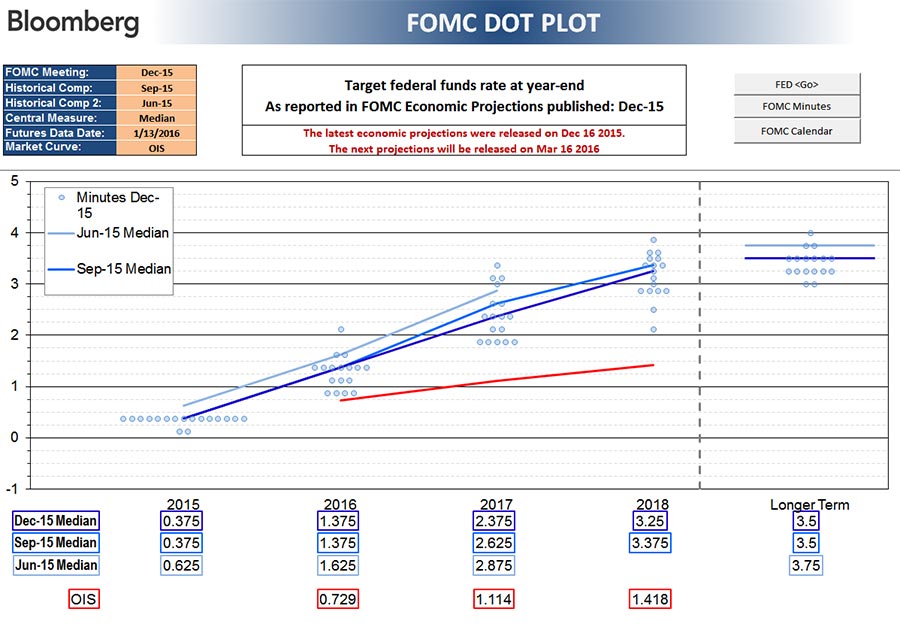
Jeffrey Gundlach and Larry Summers are joining derivatives traders in saying the Federal Reserve is too ambitious in its plans to raise interest rates against a backdrop of slowing global economic growth.

Gundlach, the co-founder of DoubleLine Capital LP, said moves by the central bank to raise rates are fighting non-existent inflation and hurting gross domestic product growth. Summers, the former Treasury secretary, said the economy can’t withstand the four rate increases that policy makers project this year.

FOMC

Turbulence in global financial markets emanating from China has fueled concern of a global slowdown as oil prices dropped to a 12-year low. That has traders and investors questioning the Fed’s stance that domestic inflation will rebound gradually as U.S. wages pick up. Derivatives traders are pricing in fewer than two quarter-point rate increases in 2016.

“I’d be surprised if the world economy can comfortably withstand four hikes,” Summers said Wednesday in an interview with Bloomberg TV. “Markets agree with me and that’s why, despite the statements that are being made, markets aren’t expecting four hikes.”

The benchmark 10-year note yield fell one basis point, or 0.01 percentage point, to 2.09 percent as of 5 p.m. New York time, according to Bloomberg Bond Trader data, after touching the lowest since October. The 2.25 percent security due in November 2025 rose 3/32, or $0.94 per $1,000 face amount, to 101 12/32.

‘Ugly Situation’

The extra yield that 10-year securities offer over two-year notes was at 118 basis points after touching the least since 2008. Longer-term yields tend to be more sensitive to the outlook for inflation, while short-term rates are more influenced by central-bank policy.

Traders are pricing in about a 36 percent chance the Fed will raise interest rates at or before its March meeting, down from 51 percent at the end of last year. The probability is based on the assumption that the effective Fed funds rate will trade at the middle of the new Federal Open Market Committee target range after the next increase.

“We could be looking at a really ugly situation during the first quarter of 2016,” Gundlach said during a market outlook webcast Tuesday. “It’s particularly more likely to happen if the Fed keeps banging this drum of raising interest rates against falling inflation.”

Policy Mistake

Gundlach’s $52.3 billion DoubleLine Total Return Bond Fund beat 94 percent of its peers during the past year, according to data compiled by Bloomberg. He correctly bet last year that interest rates would go sideways, oil would fall and China’s economic prospects were weakening.

Before the Fed raised rates last month, both Gundlach and Summers said any increase may be followed by a cut as a policy mistake would curtail long-term growth and inflation prospects. Summers warned that the Fed risked making an error that will be difficult to correct.

Treasuries returned about 1 percent this month, versus 0.9 percent for all of 2015, based on Bloomberg bond indexes.

Fed Officials

Policy makers this week have offered conflicting views about the central bank’s rate path amid tumbling oil prices and global market volatility. Boston Fed President Eric Rosengren said Wednesday that estimates for U.S. economic growth are falling, putting the central bank’s projected path for rate increases at risk.

By contrast, Richmond Fed President Jeffery Lacker said Tuesday that the U.S. and China’s economies are linked “less than you would think” and the Fed is likely to need at least four rate rises this year.

Dallas Fed President Robert Kaplan said he “would have a bias to want to move toward normalization” in an interview with Bloomberg TV on Wednesday. “It comes with some risk,” he said. “Every time we increase the federal funds rate, we’re going to have to watch and see what the impact is.”

Economy Can’t Withstand 4 Fed Hikes In 2016

Policy makers need to heed the message from global commodity and stock markets that “risks are substantially tilted to the downside,” said Summers on Bloomberg GO on January 13, 2016. Read more

‘Creeping Totalitarianism’ at Colleges

Summers decried a “creeping totalitarianism” on college campuses, calling out what he said is the growing preference for emotional comfort over academic inquiry in an interview with William Kristol. Read more

Global security and pandemic risk

I was privileged this morning to deliver keynote remarks at the release event for the Global Health Risk Framework Commission report on “The Neglected Dimension of Global Security: A Framework to Counter Infectious Disease Crises”.  The commission, convened by the National Academy of Medicine and chaired by Peter Sands, has delivered a very important report on what I think is the issue with the highest ratio of seriousness to policy preparation in the global system.  Indeed, for reasons I sketched in my remarks, I believe the threat to global well-being from pandemics over the next century is comparable to the threat from global climate change.

I began by expanding on why I think pandemics are such an important issue.  The global mortality rate from the flu pandemic of 1918 was 7000 times as large as from the recent Ebola outbreak.  AIDS profoundly changed the human experience in Africa.  No one knows the probability of a recurrence of these kinds of disasters.  History is too short to permit reliable estimates and in any event conditions are rapidly changing because of scientific improvements on the one hand, and huge increases in global interconnection on the other.

In the context of the Global Health 2035 report that Dean Jamison and I developed, we considered the economic benefit of mortality reduction using approaches derived from economic theory.  We noted that the well established fact that people demand higher pay to accept riskier jobs demonstrates that reduced mortality risk has economic value.  And we further showed that these benefits are very large relative to standard estimates of the economic impact of health interventions.

In related work, Dean and I with Victoria Fan calculate the potential cost of a 1918 flu recurrence, discounted by its chance of happening.  We expect to publish this work soon. On plausible assumptions we find an expected flu cost approaching $1 trillion a year going forward into the 21st century. This underscores the urgency of doing all that can be done to counter pandemic risks.

Eisenhower famously said that “in preparing for battle, I have always found that plans are useless but planning is indispensable”. So also with the pandemic threat, which is what makes the GHRF report so important.  I have three main takeaways from its consideration of the Ebola experience and its stock-taking of the current global architecture.

First, this is an area where the urgent has crowded out the profoundly important.  In too many countries, pressing near term needs and budgetary pressures have prevented the establishment of necessary infrastructures for public health. Such resilient health systems would be a high payoff investment even if catastrophe never comes and would be transformative if and when catastrophe comes.

Second, the international system needs to do more to clarify responsibilities and authorities when the next emergency comes and to put in place financial mechanisms for rapid action.  Given the nonlinear exponential character of pandemic processes this is of the highest urgency.

Third, there is a need for more and better science both ex-ante and ex-post after a pathogen is identified.  I will never forget my friend Barry Bloom, former Dean of Harvard’s School of Public Health, asking me how I would prefer to have spent money in the 1950s: on scholarships for iron lungs or on supporting Salk and Sabin.  There is much here that science could be doing but currently is not.  Given that profiting hugely in time of pandemic is unacceptable, markets provide insufficient incentives for gaps to be filled. As such, pre-emptive research is fundamentally important.


Heed the fears of the financial markets

Often markets are volatile at the end of the year – as many traders go on holiday and those with losses unload them – and then settle down as a new year begins. Not this year. U.S. and European markets closed significantly lower on Friday after a very rough week despite a very strong U.S. jobs report. The week’s economic news was dominated by dramatic declines in China’s stock market and currency; the week also saw a further plunge in oil prices even in the face of major tension between Iran and Saudi Arabia.

A week when bad market news repeatedly makes the front page raises the general question of how much forecasters and policymakers should look to speculative markets as indicators regarding future prospects. And it raises the more specific question of how alarmed policymakers should be about the prospect of a global slowdown, especially in light of the financial dramas playing out in China.

There is little question that markets are highly volatile relative to the fundamentals they seek to assess. Economist Paul Samuelson famously quipped 50 years ago, “the stock market has predicted nine of the last five recessions.” Former Treasury secretary Robert Rubin was right when he would regularly reassure anxious politicos in the Clinton White House that “markets go up, and markets go down” on days when a market move created either joy or anxiety. The best executives manage their company with an eye to long-run profitability, not daily stock price. And policymakers do best when they concentrate on strengthening economic fundamentals rather than on daily market fluctuations.

At the same time, because markets aggregate the views of a huge number of participants, and because they are constantly assessing the future (unlike economic statistics, which only reflect the past), they are like canaries in coal mines: very valuable in giving warning when conditions change. That is why several studies have shown that prediction markets do a better job of forecasting elections than pollsters and why Hollywood studios use such markets to judge the likely success of movies.

Policymakers who dismiss market moves as reflecting mere speculation often make a serious mistake. Markets were on to the gravity of the 2008 crisis well before the Federal Reserve was; to the unsustainability of fixed exchange rates in Britain, Mexico and Brazil while the authorities were still in denial; and to the onset of a slowdown or recession well before forecasters in countless downturns.

While markets do sometimes send false alarms and should not be slavishly followed, the conventional wisdom essentially never recognizes gathering storms. The Economist reports this week that, looking across all major countries over the past several decades, there were 220 instances in which a year of positive growth was followed by one of contraction. In its April forecasts during the growth year, the International Monetary Fund did not anticipate a coming recession on a single occasion!

Market signals should be taken especially seriously when they are long-lasting and coming from many markets, as is the case with current indications that inflation will not reach target levels within a decade in the United States, Europe or Japan. Especially ominous are moments when news fails to rally markets as would be expected such as with the U.S. stock market and Friday’s strong employment report or the decline of oil prices in the face of heightened Middle East tensions.

Last week we saw huge negative movements in Chinese markets and a large foreign market response. While it certainly could be the case that the Chinese developments reflect a combination of market psychology and clumsy policy responses, and that the strong response of world markets is an example of transient contagion, I doubt it.

Over the past year, about 20 percent of China’s growth as reported in its official statistics has come from its financial-services sector, which has mushroomed to the point where it is about as large relative to national GDP as in Britain, and Chinese debt levels are extraordinarily high. This is hardly a case of healthy or sustainable growth.

In recent years, China’s growth has come heavily from massive infrastructure investment; indeed, China put in place more cement and concrete between 2011 and 2013 than the United States did in the whole of the 20th century. This growth, too, is unsustainable, and even if it is replaced by domestic services, China’s contribution to demand for global commodities will fall way off.

Experience suggests that the best indicators of a country’s economic prospects are the decisions that its citizens make about keeping capital at home or exporting it abroad. The reason the renminbi is under pressure is that Chinese citizens are extremely eager to move their money overseas. But for the substantial recent depletion of China’s reserves, the renminbi would already have substantially depreciated.

Traditionally, international developments have had only a limited impact on the U.S. and European economies because their impact could be offset by monetary policy actions. Thus, the U.S. economy grew robustly through the Asian financial crisis as the Fed brought interest rates down. With rates essentially at zero in the industrial countries, however, this option is no longer available, and foreign economic problems are likely to have much more direct effects on economic performance.

Because of China’s scale, its potential volatility and the limited room for conventional monetary maneuvers, the global risk to domestic economic performance in the United States, Europe and many emerging markets is as great as any time I can remember. It is time for policymakers to hope for the best and plan for the worst.

The Core Problem, The International Economy

The International Economy founder and editor David Smick recently sat down with the former Treasury Secretary and Obama economic advisor to discuss the state of the world economy. Click here to read the full article.

A postscript to Delong and Krugman


P.S.

Brad is unpersuaded by my response.  He is broadly right in my view that models function both as discovery tools and as ways of organizing and codifying thought. The danger comes when too primitive a model is regarded as too powerful a discovery. Thus Krugman was right to recognize that first generation models of currency crises were an inadequate basis for making policy in response to many actual currency crises.

On the issue at hand my judgement is that excessive spending and fear of a sudden stop can push the IS curve back leading to contractionary capital outflows. I cite the work of Blanchard et al in support of this proposition. With a bit of political economy, the argument can be extended. Suppose countries in danger of high inflation are more likely to turn populist.  It was Keynes after all who introduced animal spirits and warned Roosevelt about business confidence.

Again, I don’t think any of this is of concern for the US right now and I think my track record in favor of fiscal expansion notably in my work with Brad is clear enough.

The point though is that responsible policy makers like Janet Yellen and Stan Fischer may sometimes come to judgements different from mine. I find it unhelpful and likely wrong to attribute this to a failure to understand and appreciate basic macroeconomics.

P.P.S.

Paul now offers some observations. He is right that we are not all very far apart. I agree with him that one needs more than attitude, one needs a logically consistent view of how the world works. As my response to Mike Spence and Kevin Warsh illustrates I too am impatient with fear mongering attitude as an approach to analysis.

We have I think two remaining disagreements. First, I am more willing than Paul to credit the possibility that people with substantial experience and even a track record of making money by predicting markets, have important insights even if they cannot speak the language of “models” in the way I teach in economics. Hyman Minsky is an example of a scholar whose warnings were ignored in part because they were not formalized not because they were incoherent or illogical.

Second, on the issue of confidence crises I think Paul is way too serene for reasons Blanchard’s work makes clear. If loss of confidence in their government or economy makes people less wealthy, they will spend less and that is contractionary. This objection may for some reason be wrong but I do not see why it should be dismissed apriori. This is a case where I think reliance on formalism may lead people astray.

Thoughts on Delong and Krugman blogs

Brad Delong and Paul Krugman accept my criticisms of Fed thought regarding their monetary policy strategy but disagree with my assertion that it reflects an excessive attachment to existing models and modes of thought.

Their argument is that standard IS-LM leads to the conclusion you should not raise rates in the present environment so no move away from orthodoxy is necessary to reach this conclusion.  I think the issue is more on the supply side than the demand side.  If I believed strongly in the vertical long run Phillips curve with a NAIRU around five percent and in inflation expectations responsiveness to a heated up labor market, I would see a reasonable case for the monetary tightening that has taken place.

Since I am not sure of anything about the Phillips curve and inflation is well below target I come down against tightening.  The disagreement does it seems to me come down to the Fed’s attachment to the standard Phillips curve mode of thought.  My disagreement is reinforced by other judgmental aspects that are outside of the standard model used within the Fed.  These include hysteresis effects, the possibility of secular stagnation, and the asymmetric consequences of policy errors.

I am sure Paul and Brad are right that a desire to be “sound” also influences policy.  I am not nearly as hostile to this as Paul.  I think maintaining confidence is an important part of the art of policy.  A good example of where market thought is I think right and simple model based thought is I think dangerously wrong is Paul’s own Mundell-Fleming lecture on confidence crises in countries that have their own currencies.  Paul asserts that a damaging confidence crisis in a liquidity trap country without large foreign debts is impossible because if one developed the currency would depreciate generating an export surge.

Paul is certainly correct in his model but I doubt that he is in fact. Once account is taken of the impact of a currency collapse on consumers’ real incomes, on their expectations, and especially on the risk premium associated with domestic asset values, it is easy to understand how monetary and fiscal policymakers who lose confidence and trust see their real economies deteriorate as Olivier Blanchard and his colleagues have recently demonstrated.  Paul may be right that we have few examples of crises of this kind but if so this is perhaps because central banks do not in general follow his precepts.

I do not think this is a pressing issue for the US right now.   But the idea that policymakers should in general follow the model and not worry about considerations of market confidence seems to me as misguided as the view that they should be governed by market confidence to the exclusion of models.