The economic consequences of a Trump win would be severe

On June 23, the UK will vote on whether to remain in the EU. On November 8, the US will vote on whether to elect Donald Trump as president. These elections have much in common. Both could lead to outcomes that would have seemed inconceivable not long ago. Both pit angry populists against the political establishment. And in both cases, polling suggests that the outcome is in doubt, with prediction markets suggesting a probability of between one in four and one in three of the radical outcome occurring.

It is interesting to contrast the way that financial markets are reacting to these uncertainties. The markets are highly sensitive to Brexit news: the pound and the British stock market move with every new opinion poll. Analysis of option pricing suggests that if Britain votes to leave the EU, sterling could easily fall by more than 10 per cent and the British stock market by almost as much. It is widely believed that the uncertainties associated with Brexit are consequential enough to affect the policies of the US Federal Reserve and other major central banks.

It would in all likelihood be economically very costly for Britain to leave the EU and would raise questions about the future cohesion of the UK. It would also threaten London’s role as a financial centre and curtail British exports to Europe.

What I find surprising is that US and global markets and financial policymakers seem much less sensitive to “Trump risk” than they are to “Brexit risk”. Options markets suggest only modestly elevated volatility in the period leading up to the presidential election. While every Fed watcher comments on the implications of Brexit for the central bank, few, if any, comment on the possible consequences of a victory for Mr Trump in November.

Yet, as great as the risks of Brexit are to the British economy, I believe the risks to the US and global economies of Mr Trump’s election as president are far greater. If he is elected, I would expect a protracted recession to begin within 18 months. The damage would be felt far beyond the United States.

First, there is a substantial risk of highly erratic policy. Mr Trump has raised the possibility of more than $10tn in tax cuts, which would threaten US fiscal stability. He has also raised the possibility of the US restructuring its debt in the manner of a failed real estate developer. Perhaps this is just campaign rhetoric. But historical research suggests that presidents tend to carry out their major campaign promises.

The shadow boxing over raising the debt limit in 2011 (where all participants recognised the danger of default) was central to the stock market falling by 17 per cent.

Second, in a world economy defined by global integration, Mr Trump’s economic nationalism is highly dangerous. Exports have been a major driver of the American economy in recent years. What would happen to exports if the US were to build a wall along its southern border and abrogate all its trade treaties? Withdrawal from trade agreements does not currently require congressional approval. If Mr Trump did even half of what he has promised, he would surely set off the worst trade war since the Great Depression.

Third, prosperity depends on a secure geopolitical environment. Requiring Japan and Korea to defend themselves and scaling back Nato is a prescription for emboldening China and Russia and promoting nuclear proliferation. A perception that the US is at war with Islam rather than with radical elements within Islam is an invitation to terrorism. In such an environment, investment and trade are unlikely to flourish.

Fourth, Mr Trump’s authoritarian style and cult of personality surely would take a toll on business confidence. He has proposed to bring back torture as a tool of US foreign policy and to change the law so he can sue and punish publications he does not like. The country was paralysed by Watergate and to a lesser extent the Iran-Contra scandal, both of which involved extralegal activity by the president’s staff and the abuse of power. Who will rest secure with President Trump controlling the Federal Bureau of Investigation and the Central Intelligence Agency?

Finally, there is the question of uncertainty and confidence. Improving business confidence is the cheapest form of stimulus. Creating an environment where every tenet of the rule of law, internationalism and consistency in policy is up for grabs would be the best way to damage a still fragile US economy. In no election in my lifetime has a major party candidate for president been so dangerous for the economy.

Markets are discounting the possibility of a Trump presidency. Let us all pray they are right.
A Lesson on Infrastructure from the Anderson Bridge Fiasco

Sometimes small stories capture large truths. So it is with the fiasco that is the repair of the Anderson Memorial Bridge, connecting Boston and Harvard Square. Rehabilitation of the 232-foot bridge began in 2012, at an estimated cost of about $20 million; four years later, there is no end date in sight and the cost of the project is mushrooming, to $26.5 million at last count. Read more

Why Americans don’t trust goverment

I have an Op-Ed in the Boston Globe today on infrastructure addressing the issue of quality rather than quantity of investment.  Rachel Lipson and I describe the fiasco that has emerged from what should have been a routine maintenance project on the Anderson Memorial Bridge over the Charles River next to my office.  Though the bridge took only 11 months to build in 1912, it will take close to 5 years to repair today at a huge cost in dollars and mass delays.

Investigating the reasons behind the bridge blunders have helped to illuminate an aspect of American sclerosis—a gaggle of regulators and veto players, each with the power to block or to delay, and each with their own parochial concerns.  Every actor – the  historical commission, the contractor, the environmental agencies, the advocacy groups, the state transportation department — is reasonable in his or her own terms, but the final result is wildly unreasonable.

At one level this explains why, despite the overwhelming case for infrastructure investment, there is so much resistance from those who think it will be carried out ineptly.  The right response is to advocate for reforms in procurement policies, regulatory policies and government procedures to make the investment process more efficient and effective.  This is all clear enough.

At another level, though, our story may illustrate phenomena that go way beyond infrastructure.  I’m a progressive, but it seems plausible to wonder if  government can build a nation abroad, fight social decay, run schools, mandate the design of cars, run health insurance exchanges, or set proper sexual harassment policies on college campuses, if it can’t even fix a 232-foot bridge competently.  Waiting in traffic over the Anderson Bridge, I’ve empathized with the two-thirds of Americans who distrust government.

Years ago as President of Harvard, I did various events with the late Boston Mayor Tom Menino.  I was always struck by his attention to the little things — while we waited at a playground, he would check the fence for holes, or when we visited a school, he would note the missing tiles.  At the time, it seemed odd and micromanaging.  Over time, though, I’ve come to appreciate what he intimately understood:  Faith in government’s ability to do big things depends on its success in executing on routine responsibilities.

We do not want to learn what we can get used to.  I’m sure once the historical commission had delayed the bridge for many months, there was an attitude of “What’s another couple?”  In a broader sense, the Anderson Memorial Bridge tale tees up a bigger question.  Where is the outrage?  Why didn’t the governor or the mayors of Boston and Cambridge act? What about the great free press?  We seem to be caught in a dismal cycle of low expectations, poor results and shared cynicism.

More than questions of personality or even those of high policy, the question of how to escape this trap should be a central issue in this election year.

What you need to know about the next recession

How should we respond to the next recession? That was the topic of an event held by the Brooking’s Hamilton Project where I spoke on Monday in Washington with White House budget director Sean Donovan. I argued a number of points that address issues of current concern.

First, I argued that the possible election of “Demagogue Donald” dwarfs congressional dysfunction as a threat to American prosperity. I argued that beyond lunatic and incoherent budget and trade policies Trump would for the first time make political risk of the kind usually discussed in the context of Argentina, China or Russia relevant to the USA. How else to interpret threats to renegotiate debt, prosecute insubordinate publications, and rip up treaties? Creeping fascism as an issue dwarfs macroeconomic policy!

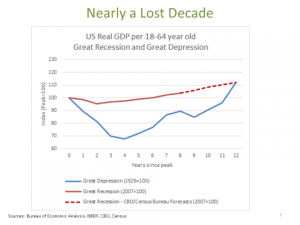
Second, I cautioned that while 2009 could have seen a repeat of 1929-1933 and that did not happen there are no grounds for complacency. As the picture below illustrates on current forecasts the economy will have performed as badly over the 2007-2018 period as it did over the Depression 1929-1940 period. The single most important issue for containing government debt burdens, increasing us national security, encouraging more generosity towards the poor and raising middle class standards of living is accelerating US economic growth.

Graph 1

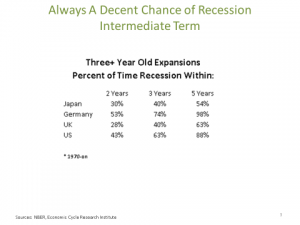
Third, I argued — following my secular stagnation thesis — that fiscal policy is now important as a stabilization policy tool in a way that has not been the case since the Depression. Historical evidence suggests a better than even chance of an officially declared recession in the next three years.graph 2


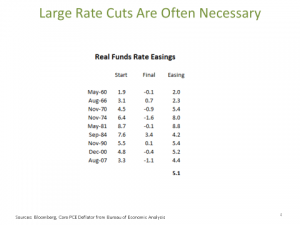
When recessions come, the Federal Reserve normally reduces real rates by four to five percentage points.

graph 3

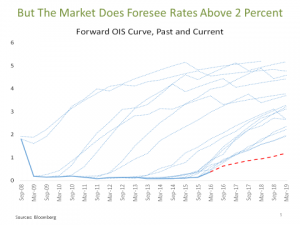
But there will in all likelihood be nothing like this amount of room when the next recession comes.

Graph 4

I say this with full awareness that the Fed has unconventional tools at its disposal in addition to simply lowering rates. But I think it very unlikely that more than 150bps of Fed funds equivalent additional stimulus is feasible. After all rates below minus 50 or 75 bps are impracticable in a society with cash and might actually hurt financial intermediation. Forward guidance is fine in principle but when the next recession comes expected forward rates will be very low far into the future. And QE is surely already hitting diminishing returns with the yield curve flattening and markets functioning without the illiquidity premia of the early recovery period. “Helicopter money” is basically a form of fiscal policy as I shall argue in a subsequent post and cannot be carried out autonomously by the central bank.

There is an additional case for fiscal policy. The economy as it now stands requires remarkably low interest rates to grow adequately. These rates are an invitation to leverage, to reaching for yield, to financial engineering and to bubbles. Raising rates significantly as many suggest without doing anything else risks recession. So the right strategy is to raise demand so as to make financially sustainable growth. This comes back to fiscal policy along with measures like tax, regulatory and immigration reform to spur private demand.

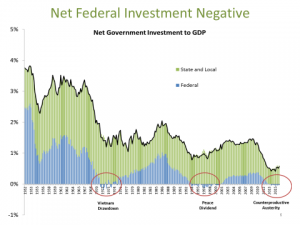
Fourth. I suggested a number of areas for expansionary fiscal policy both to make recession less likely and to respond when the next one comes. The decline in US infrastructure investment is indefensible in light of recent declines in interest rates, employment opportunities and materials costs.

Graph 5

Other areas in which fiscal support seems desirable include housing — where residential investment still lags badly — and support for social security. I referred to the economists argument going back to Paul Samuelson that pay as you go social security can help all generations in a world where growth rates exceed interest rates. Further it raises demand without enlarging government deficits.

As I expect to discuss in subsequent posts, much of what economists thought they knew about macroeconomic policy needs to be reassessed in light of events. Just as the events of the 1970s and emergence of stagflation throughout the industrial world, led to new policy paradigms, I believe that recent events will force us to develop new approaches to thinking about economic fluctuations and inflation which will, in turn, drive major changes in thinking about fiscal and monetary policy.


Europe is right to kill off the criminal’s favourite banknote

So-called Bin Ladens have an important role facilitating illicit activity
 
Most of the time I use this column to recommend policy changes that I believe would make the world a better place. This time I am saluting a policy change I believe will have significant benefits – one that carries with it important lessons.
The decision of the European Central Bank last week to stop producing €500 notes permanently is a triumph of reasonable judgment over shameless fearmongering. As Peter Sands, the former chief executive of Standard Chartered bank, wrote with several Harvard academics in a paper published this year, the ECB’s action will make the world a safer, fairer place and offers lessons for the future.
 
Almost everything in life, and in public policy, has both good and bad aspects. Cars provide great transport services but sometimes have devastating accidents. Liquid financial markets provide worthwhile benefits to savers and investors but can be driven to speculative excess. High denomination currency notes stand out as a case in which the good uses are dwarfed by the bad ones, and that is why they should be eliminated. Britain’s Serious Organised Crime Agency has estimated that, before their availability was curtailed in 2010, more than 90 per cent of demand in the UK for €500 notes came from criminals.
There is little if any legitimate use for €500 notes. Carrying out a transaction with 20 €50 notes hardly seems burdensome – and this would represent more than $1,000 in purchasing power. Meanwhile, 20 €200 notes would represent close to $5,000 in purchasing power.
Who in today’s world needs cash for a legitimate $5,000 transaction? Indeed, the ECB found in a study that 56 per cent of the EU public had never laid eyes on a €500 note. Cash transactions of more than €3,000 have, in fact, been made illegal in Italy; in France, the maximum is €1,000. Anyone who thinks that abolishing a high denomination note damages a country’s currency or its citizenry should note that the US and Canada have phased out the $1,000 note – and, in the case of the US, the $500 note – without noticeable complaint.
The ECB policy is at the gentle end of the reasonable spectrum of possible policies. Unlike in the US, no effort is being made to stop the use of existing notes as legal tender and the policy is being implemented only at the end of 2018.
Even after this measure, the ECB will continue to issue notes more than twice as valuable as the highest denomination notes issued anywhere else in the Group of Seven leading industrialised nations. And certainly there is no suggestion that eliminating cash would be desirable or is in conceivable prospect.
By contrast with normal commerce, €500 notes have an important role facilitating illicit activity, as suggested by their nickname: Bin Ladens. Measurement is obviously difficult but estimates by Friedrich Schneider of Johannes Kepler University Linz suggest that physical cash is used in 80 per cent of the global drug trade, 70 per cent of small arms trades, 50 per cent of human trafficking transactions and 50 per cent of transactions for human organs. Estimates by the International Monetary Fund and others of total money laundering consistently exceed $1tn a year. High denomination notes also have a substantial role in facilitating tax evasion and capital flight.
To be sure, it is hard to estimate how much crime will be prevented by the halt in production of €500 notes. It will surely impose some burdens on criminals and might interfere with some transactions. The main point is that even a small reduction in crime would more than justify the loss of any possible benefit that comes from the €500 note.
In this instance, Europe has taken the lead on a significant security issue. But its action should be seen as a beginning rather than an end in itself.
First, the world should demand that Switzerland stops issuing SFr1,000 franc notes. After Europe’s bold step, these notes will stand out as the hard-currency world’s highest denomination note by a wide margin. Switzerland has a long and unfortunate history with illicit finance. It would be tragic if it were to profit from criminal currency substitution.
Second, the question of the facilitation of criminal activity should be placed prominently on the agenda of the Group of 20 leading nations. There would be a strong case for stopping the production of notes with value greater than, perhaps, $50, and also for greater co-operation to assure that new financial technologies, such as bitcoin, do not become vehicles for facilitating illicit transactions.

The Fusion of Civilizations

In the May/June 2016 issue of Foreign Affairs, Summers and Mahbubani explore the case for global optimism.  The essay states, “Historians looking back on this age from the vantage point of later generations, however, are likely to be puzzled by the widespread contemporary feelings of gloom and doom. By most objective measures of human well-being, the past three decades have been the best in history. More and more people in more and more places are enjoying better lives than ever before.” Read more

Trump, China, Inversions and Austerity

Summers spoke at the International Monetary Fund on Wednesday, warning against austerity measures amid a tepid economy. Yahoo Finance sat down with him to get little more color on the economy and to find out what keeps him up most at night. Read more

Reflections the Recession, Higher-ed & the Economy

Harvard Magazine profiled a conversation with Summers on a variety of issues, including the recession, higher-ed and the economic environment.  Summers said, “Harvard will have to choose between its commitment to preeminence and its commitment to doing things in traditional ways.” Read more

Global trade should be remade from the bottom up

Since the end of the second world war, a broad consensus in support of global economic integration as a force for peace and prosperity has been a pillar of the international order. From global trade agreements to the EU project; from the Bretton Woods institutions to the removal of pervasive capital controls; from ex­panded foreign direct investment to increased flows of peoples across borders, the overall direction has been clear. Driven by domestic economic progress, by technologies such as containerised shipping and the internet that promote integration, and by legislative changes within and between nations, the world has grown smaller and more closely connected.

This has proved more successful than could reasonably have been hoped. We have not seen a war between leading powers. Global living standards have risen faster than at any point in history. And material progress has coincided with even more rapid progress in combating hunger, empowering women, promoting literacy and extending life. A world that will have more smartphones than adults within a few years is a world in which more is possible for more people than ever before.

Yet a revolt against global integration is under way in the west. The four leading candidates for president of the US — Hillary Clinton, Bernie Sanders, Donald Trump and Ted Cruz — all oppose the principal free-trade initiative of this period: the Trans-Pacific Partnership. Proposals by Mr Trump, the Republican frontrunner, to wall off Mexico, abrogate trade agreements and persecute Muslims are far more popular than he is. The movement for a British exit from the EU commands substantial support. Under pressure from an influx of refugees, Europe’s commitment to open borders appears to be crumbling. In large part because of political constraints, the growth of the international financial institutions has not kept pace with the growth of the global economy.

Certainly a substantial part of what is behind the resistance is lack of knowledge. No one thanks global trade for the fact that their pay cheque buys twice as much in clothes, toys and other goods as it otherwise would. Those who succeed as exporters tend to credit their own prowess, not international agreements. So there is certainly a case for our leaders and business communities to educate people about the benefits of global integration. But at this late date, with the trends moving the wrong way, it is hard to be optimistic about such efforts.

The core of the revolt against global integration, though, is not ignorance. It is a sense, not wholly unwarranted, that it is a project carried out by elites for elites with little consideration for the interests of ordinary people — who see the globalisation agenda as being set by big companies playing off one country against another. They read the revelations in the Panama Papers and conclude that globalisation offers a fortunate few the opportunities to avoid taxes and regulations that are not available to the rest. And they see the disintegration that accompanies global integration, as communities suffer when big employers lose to foreign competitors.

What will happen next — and what should happen? Elites can continue pursuing and defending integration, hoping to win sufficient popular support — but, on the evidence of the US presidential campaign and the Brexit debate, this strategy may have run its course. This is likely to result in a hiatus in new global integration and efforts to preserve what is in place while relying on technology and growth in the developing world to drive further integration.

The precedents, notably the period between the first and second world wars, are hardly encouraging about unmanaged globalisation succeeding with neither a strong underwriter of the system nor strong global institutions.

Much more promising is this idea: the promotion of global integration can become a bottom-up rather than a top-down project. The emphasis can shift from promoting integration to managing its consequences.

This would mean a shift from international trade agreements to international harmonisation agreements, where issues such as labour rights and environmental protection would take precedence over issues related to empowering foreign producers. It would also mean devoting as much political capital to the trillions that escape tax or evade regulation through cross-border capital flows as we now devote to trade agreements. And it would mean an emphasis on the challenges of middle-class parents everywhere who doubt, but still hope desperately, that their kids can have better lives than they did.

Economic Unease and America’s Slow Growth

On April 7, 2016, Summers talked with John Hockenberry of PRI’s the Takeaway for a series on the the state of the global economy.  The discussion included the sluggish economy, less energy driving investments, Sanders, Trump and the Broadway musical, Hamilton. Read more

Podcast with Product Hunt

Listen to my podcast on Product Hunt where I discuss my work in the government, academia, and investing in the tech sector.  I also talk about the future of higher education and President Obama’s legacy.

Data collection is the ultimate public good.

On Wednesday I spoke at a World Bank conference on price statistics.  While price statistics are not usually thought of as a scintillating subject, I got a great deal of satisfaction out of preparing and presenting my remarks.  In part this was because my late father Robert Summers focused his economic research on International price comparisons.  It was also because I am convinced that data is the ultimate public good and that we will soon have much more data than we do today.

I made four primary observations.

First, scientific progress is driven more by new tools and new observations than by hypothesis construction and testing.  I cited a number of examples: the observation that Jupiter was orbited by several moons clinched the case against the Ptolemaic system, the belief that all celestial objects circle around the Earth.  We learned of cells by seeing them when the microscope was constructed.  Accelerators made the basic structure of atoms obvious.

Second, if mathematics is the queen of the hard sciences then statistics is the queen of the social sciences.  I gave examples of the power of very simple data analysis. We first learned that exercise is good for health from the observation that in 1940s London bus conductors had much lower death rates than bus drivers.  Similarly data demonstrated that smoking was a major killer decades before the biological processes were understood.  At a more trivial level, Moneyball shows how data-based statistics can revolutionize a major sport.

Third, I urged that what “you count counts” and argued that we needed much more timely and complete data. I noted the centrality of timely statistics to meaningful progress towards Sustainable Development Goals.  In comparison to the nearly six year lag in poverty statistics, it only took the USA about three and a half years to win World War II.

Fourth, I envisioned what might be possible in a world where there will soon be as many smart phones as adults.  With the ubiquitous ability to collect data and nearly unlimited ability to process it will come more capacity to discover previously unknown relationships. We will improve our ability to predict disasters like famines, storms and revolutions.  Communication technologies will allow us to better hold policymakers to account with reliable and rapid performance measures.  And if history is any guide we will gain capacities on dimensions we cannot now imagine but will come to regard as indispensable.

This is the work of both governments and the private sector.  It is fantasy to suppose data, the ultimate public good, will come into being without government effort.  Equally, we will sell ourselves short if we stick with traditional collection methods and ignore innovative providers and methods such as the use of smart phones, drones, satellites and supercomputers. That is why something like the Billion Prices Project at MIT, which can provide daily price information, is so important. That is why I am excited to be a Director and involved with Premise – a data company that analyzes information people collect on their smartphones about everyday life, like the price of local foods – in its capacity to mobilize these technologies as widely as possible. That is why Planet Labs, with its capacity to scan and monitor environmental conditions, represents such a profound innovation.

The Fed is right to watch the data carefully

In March 31, 2016 interview with Jeremy Hobson of NPR’s Here and Now, Summers talked about the economy, the Fed and Donald Trump.  Summers said, “I am more enthusiastic about the message of caution than the message of adjustment.” Read more

If we really valued excellence, we would single it out.

Catherine Rampell’s column this week reminded me of an issue that has long interested me as an economist and as a president of Harvard.

I remember many years ago listening to some monetarist quote Milton Friedman one too many times with “inflation is always and everywhere a monetary phenomenon.”  I responded “what about grade inflation?”

I could never quite decide whether this was just a wisecrack or it captured something important.  The idea that it might well reflect is that inflation has much to do with different actors seeking to leapfrog each other and in the process setting off a spiral.

In any event, I think that the pervasiveness of top grades in American higher education is shameful. How can a society that inflates the grades of its students and assigns the top standard to average performance be surprised when its corporate leaders inflate their earnings, its generals inflate their body counts, or its political leaders inflate their achievements?

More than ethics classes this is a matter of moral education. And America’s universities are failing when “A” is the most commonly-awarded grade.  If we really valued excellence, we would single it out.

I did succeed in a small way as Harvard president in reducing the fraction of students graduating with honors from a ludicrous 90 percent to an excessive 55 percent.  I wish I had been able to do more. Even more I wish that today’s academic leaders would take up this issue.

The Future of Price Statistics

Summers spoke at The World Bank on March 30, 2016 at a seminar on the Future of Price Statistics: Innovation in Data Technology and Methods calling data the “ultimate public good.”  Summers said, “The one thing I can promise you is that vastly better data collection will produce benefits that we can foresee, but even greater benefits that no one can imagine. Read more

Vast double standard on American college campuses

It has seemed to me that a vast double standard regarding what constitutes prejudice exists on American college campuses.  There is hypersensitivity regarding prejudice against most minority groups but what might be called hyper-insensitivity with respect to anti-Semitism.

At Bowdoin College, holding parties with sombreros and tequila is deemed to be an act of prejudice against Mexicans.  At Emory, the chalking of an endorsement of the likely Republican Presidential candidate on a sidewalk is deemed to require a review of security tapes.  The existence of a college named after widely admired former US President has under the duress of a student occupation been condemned at Princeton.  At Yale,  Halloween costumes are the subject of administrative edict.  The dean of Harvard Law School has acknowledged that hers is a racist institution, while the Freshman Dean at Harvard College has used dinner placemats to propagandize the student body on aspects of diversity.   Professors acquiesce as students insist that they not be exposed to views on issues like abortion that make them uncomfortable.

All I have discussed in the past, this is in my view inconsistent with basic American values of free speech and open debate.  It fails to recognize that the a proper liberal education should cause moments of acute discomfort as cherished beliefs are challenged.

But, if comfort is elevated to be a preeminent value, the standard should be applied universally.  Unfortunately, there is a clear exception made on most university campuses for anti-Semitic speech and acts.

The State Department has made clear that it regards demonizing Israel or  “applying double standards by requiring of it a behavior not expected or demanded  of any other democratic nation” as anti-Semitism.   This makes obvious good sense.  Does anyone doubt that applying standards to African countries that were not applied to other countries or singling them out for sanction when other non-African countries were guilty of much greater sins would be deemed racism?

Instances of anti-Semitism by this standard are ubiquitous in American academic life.  Nearly a dozen academic associations have enacted formal boycotts of Israeli institutions and in some cases Israeli scholars.  Student governments at dozens of universities have demanded the divestiture of companies that do business in Israel or the West Bank.   Guest speakers and even some faculty in their classrooms compare Israel with Nazi Germany and question its right to continued existence as a Jewish state.

Yet, with very few exceptions, university leaders who are so quick to stand up against microagressions against other groups remain silent in the face of anti-Semitism.  Indeed, many major American universities including Harvard remain institutional members of associations that are engaged in boycotts of Israel.  The idea of divesting Israel is opposed only in the same way that divesting apartheid South Africa was opposed—as an inappropriate intrusion into politics, not as immoral or anti-Semitic.

That is why the recent statement of the University of California Regents is so welcome.  It is forceful and clear on anti-Semitism, while at the same time recognizing the importance of free speech.  It holds that “Anti-Semitism, anti-semitic forms of anti-Zionism and other forms of discrimination have no place at the University of California”.  Let us hope that similar statements will be made by the leaders of private and public universities across the country.

Corporate profits are near record highs. Here’s why that’s a problem.

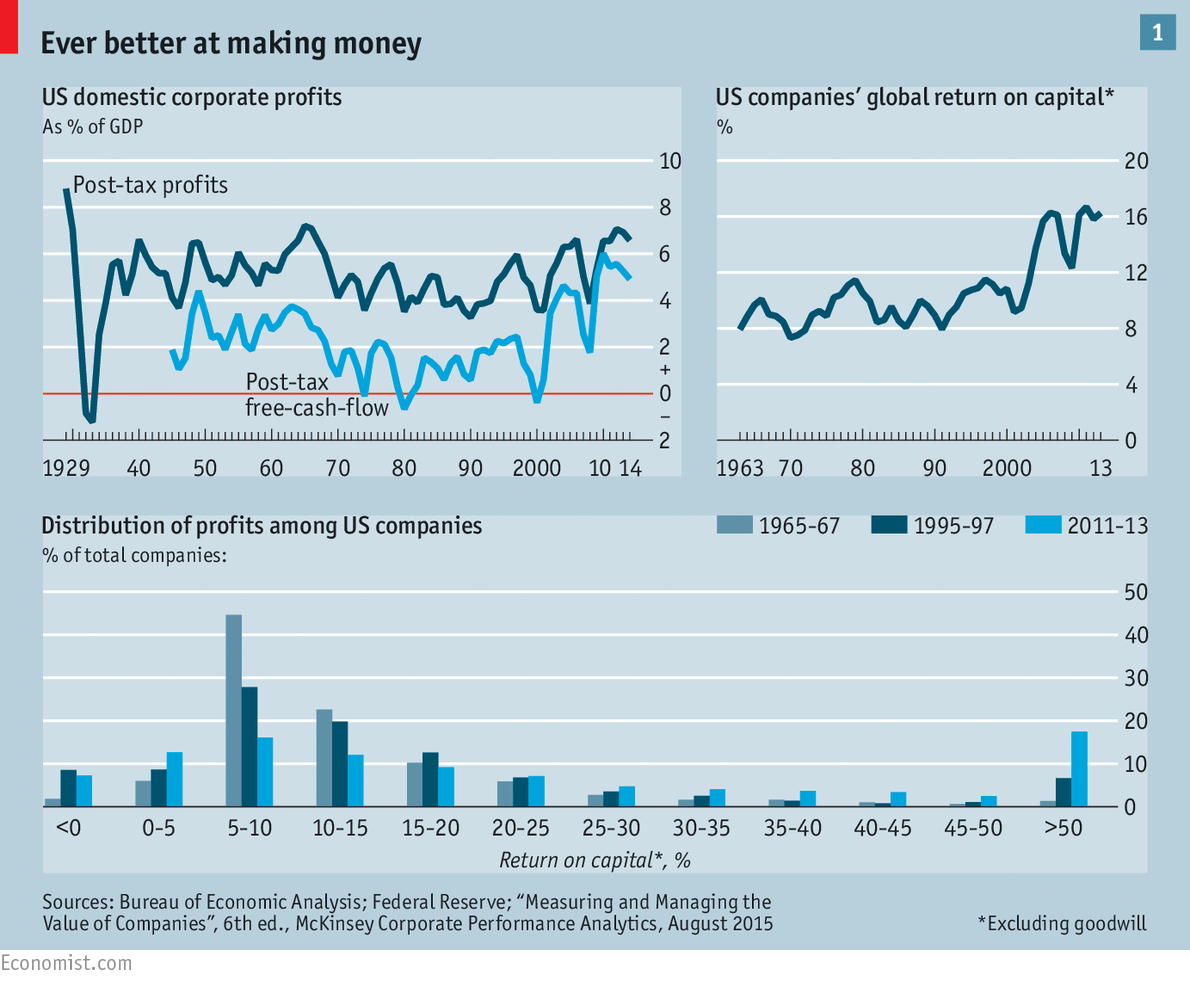
As the cover story in this week’s Economist highlights, the rate of profitability in the United States is at a near-record high level, as is the share of corporate revenue going to capital.   The stock market is valued very high by historical standards, as measured by Tobin’s q ratio of the market value of the nonfinancial corporations to the value of their tangible capital.  And the ratio of the market value of equities in the corporate sector to its GDP is also unusually high.

All of this might be taken as evidence that this is a time when the return on new capital investment is unusually high.  The rate of profit under standard assumptions reflects the marginal productivity of capital.  A high market value of corporations implies that “old capital” is highly valued and suggests a high payoff to investment in new capital.

This is an apparent problem for the secular stagnation hypothesis I have been advocating for some time, the idea that the U.S. economy is stuck in a period of lethargic economic growth.  Secular stagnation has as a central element a decline in the propensity to invest leading to chronic shortfalls of aggregate demand and difficulties in attaining real interest rates consistent with full employment.

Yet matters are more complex.  For some years now, real interest rates on safe financial instruments have been low and, for the most part, declining.  And business investment is either in line with cyclical conditions or a little weaker than would be predicted by cyclical conditions.  This is anomalous, as in the most straightforward economic models the real interest rate is the risk adjusted rate of return on capital.  And an unusually high rate of investment would be expected to go along with a high rate of return on existing capital.

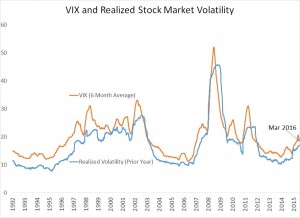
How can this anomaly be resolved?  There are a number of logical possibilities.  First, the riskiness associated with capital investment might have gone up and so higher rates of return could be simply compensating for higher risk rather than implying attractive investments.  There are two major problems with this story.  One is that available proxies for risk are not especially high in recent years.  The chart below depicts realized stock market volatility and the VIX measure of expected volatility as implied by options.  Another problem is that if capital returns have become far more uncertain, then the stocks should have become less attractive in recent years rather than more.  In the last 7 years, the stock market has risen to 250 percent of its spring 2009 levels.

VIX and Realized Stock Mkt Volatility


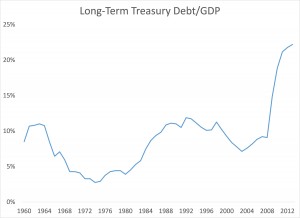
A second explanation could be that a heightened demand for liquidity and a shortage of Treasury instruments, perhaps created by quantitative easing programs, has driven down bond yields, widening the spread between the rate of profit and these yields.  This story does not provide a natural explanation for the relatively weak behavior of business investment.  Further as Sam Hanson, Robin Greenwood, Joshua Rudolph and I pointed out in earlier work, the market is today being asked to absorb an abnormally high rather than an abnormally low level of long term Federal debt.

Long Term Treasury


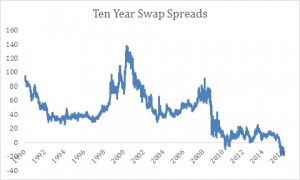
On top of that, if Treasuries were in short supply, one would expect that they would have their yield bid down relative to market synthesized safe instruments.  Yet the so-called swap spread is actually negative and Treasury yields (vs swaps) are unusually high relative to history.

Ten Year Swaps


Third, it could be that higher profits do not reflect increased productivity of capital but instead reflect an increase in monopoly power.  If monopoly power increased one would expect to see higher profits, lower investment as firms restricted output, and lower interest rates as the demand for capital was reduced.  This is exactly what we have seen in recent years!

Is the increased monopoly power theory plausible?  The Economist makes the best case I have seen for it noting that (i) many industries have become more concentrated (ii) we are coming off a major merger wave (iii) there is some evidence of greater profit persistence among major companies (iv) new business formation has declined (v) overlapping ownership of companies that compete has become more common with the rise of institutional investors, (vi) leading technology companies like Google and Apple may be benefiting from increasing returns to scale and network effects.

The combination of the fact that only the monopoly power story can convincingly account for the divergence between the profit rate and the behavior of real interest rates and investment, along with the suggestive evidence of increases in monopoly power makes me think that the issue of growing market power deserves increased attention from economists and especially from macroeconomists.


A world stumped by stubbornly low inflation

Here is a thought experiment that illuminates the challenges currently facing macroeconomic policymakers in the US and the rest of the industrial world.

Imagine that in a brief period inflation expectations around the industrial world, as inferred from both the markets for indexed bonds or inflation swaps, rose by nearly 50 basis points to a level well above the 2 per cent target with larger increases foreseen at longer horizons.

Imagine that at the same time survey measures of inflation expectations, such as those calculated by the University of Michigan and New York Federal Reserve in the US, were rising sharply.

Imagine also that commodity prices were soaring and that the dollar experienced a decline seen once every 15 years.

Imagine that the market estimate of future monetary policy in the US was far tighter than the Federal Reserve’s own policy projections.

Imagine that measures of gross domestic product growth were accelerating with increasing signs of a worldwide boom.

Imagine too that no serious efforts were under way to reduce deficits.

Finally, suppose that officials were comfortable with current policy settings based on the argument that Phillips curve models predicted that inflation would revert over time to target due to the supposed relationship between unemployment and price increases.

I think it is fair to assert that in this hypothetical circumstance there would be pervasive concern that policy was behind the curve. There would be fears that much was at risk as inflation expectations were becoming unanchored and that a substantial set of policy adjustments were appropriate.

The key point is that allowing not just a temporary increase in inflation but a shift to abovetarget inflation expectations could be very costly.

At present we are living in a world that is the mirror image of the hypothetical one just described. Market measures of inflation expectations have been collapsing and on the Fed’s preferred inflation measure are now in the range of 1-1.25 per cent over the next decade.

Inflation expectations are even lower in Europe and Japan. Survey measures have shown sharp declines in recent months. Commodity prices are at multi-decade lows and the dollar has only risen as rapidly as in the past 18 months twice during the past 40 years when it has fluctuated widely.

The Fed’s most recent forecasts call for interest rates to rise almost 2 per cent in the next two years, while the market foresees an increase of only about 0.5 per cent.

Consensus forecasts are for US growth of only about 1.5 per cent for the six months from last October to March. And the Fed is forecasting a return to its 2 per cent inflation target on the basis of models that are not convincing to most outside observers.

Despite the apparent symmetry, the current mood is nothing like the one posited in my hypothetical example.

While there is certainly substantial anxiety about the macroeconomic environment, as judged from the meeting of the Group of 20 big economies in Shanghai last week, there is no evidence that policymakers are acting strongly to restore their credibility as inflation expectations fall below target.

In a world that is one major adverse shock away from a global recession, little if anything directed at spurring demand was agreed. Central bankers communicated a sense that there was relatively little left that they can do to strengthen growth or even to raise inflation. This message was reinforced by the highly negative market reaction to Japan’s move to negative interest rates. No significant announcements regarding non-monetary measures to stimulate growth or a return to target inflation were forthcoming, either.

Perhaps this should not be surprising. In the 1970s it took years for policymakers to recognise how far behind the curve they were on inflation and to make strong policy adjustments.

Policymakers continued to worry about a supposed lack of demand long after it was an important problem. The first attempts to contain inflation were too timid to be effective and success was achieved only with highly determined policy. A crucial step was the abandonment of the idea that the problem was structural in nature rather than driven by macroeconomic policy.

Today’s risks of embedded low inflation tilting towards deflation and of secular stagnation in output growth are at least as serious as the inflation problem of the 1970s. They too will require shifts in policy paradigms if they are to be resolved.

In all likelihood the important elements will be a combination of fiscal expansion drawing on the opportunity created by super low rates and, in extremis, further experimentation with unconventional monetary policies.

Trump’s rise illustrates how democratic processes can lose their way

While comparisons between Donald Trump and Mussolini or Hitler are overwrought, Trump’s rise does illustrate how democratic processes can lose their way and turn dangerously toxic when there is intense economic frustration and widespread apprehension about the future. This is especially the case when some previously respected leaders scurry to make peace in a new order — yes Chris Christie, I mean you.

The possible election of Donald Trump as President is the greatest present threat to the prosperity and security of the United States.  I have had a strong point of view on each of the last ten presidential elections, but never before had I feared that what I regarded as the wrong outcome would in the long sweep of history risk grave damage to the American project.

The problem is not with Trump’s policies, though they are wacky in the few areas where they are not indecipherable. It is that he is running as modern day man on a horseback—demagogically offering the power of his personality as a magic solution to all problems—and making clear that he is prepared to run roughshod over anything or anyone who stands in his way.

Trump has already flirted with the Ku Klux Klan and disparaged and demeaned the female half of our population.  He vowed to kill the families of terrorists, use extreme forms of torture, and forbid Muslims from coming into our country.  Time and again, he has claimed he will crush those who stand in his way; his promised rewrite of libel laws, permitting the punishment of The New York Times and Washington Post for articles he does not like, will allow him to make good on this threat.

Lyndon Johnson’s celebrated biographer, Robert Caro, has written that while “power doesn’t always corrupt…[it] always reveals.” What will a demagogue with a platform like Trump’s who ascends to the presidency do with control over the NSA, FBI and IRS?  What commitment will he manifest to the rule of law? Already Trump has proposed that protesters at his rallies “should have been roughed up.”

Nothing in the way he campaigned gave Richard Nixon a mandate for keeping an enemies list or engaging in dirty tricks.  If he is elected, Donald Trump may think he has such a mandate.  What is the basis for doubting that it will be used?

To be sure there are precedents in American politics for Trump. Precedents like Joe McCarthy, George Wallace, and Huey Long.  Just as Trump does, each mined the all too rich veins of prejudice, paranoia and excess populism that lie beneath American soil.  Yet even at their highest points of popularity, none of these figures looked like plausible future Presidents.  One shudders to think what President Huey Long would have done during the Depression, what President Joe McCarthy would have done at the height of the Cold War, or what President George Wallace would have done at the end of the turbulent 1960s.

My Harvard colleague, Niall Ferguson, suggests that William Jennings Bryan is the right precursor for Trump. This comparison seems unfair to Bryan who was a progressive populist but not a thug, as evidenced by the fact that he ended up as Secretary of State in the Wilson Administration.  Trump’s election would threaten our democracy.  I doubt that democracy would have been threatened if Bryan had beaten McKinley.

Robert Kagan and others have suggested that Trump is the culmination of trends under way for decades in the Republican Party.  I am no friend of the Tea Party or of the way in which Congress has obstructed President Obama.  But the suggestion that Trump is on the same continuum as George W. Bush or even the Republican congressional leadership seems to me to be quite unfair.

Even the possibility of Trump becoming President is dangerous.  The economy is already growing at a sub-two percent rate in substantial part because of a lack of confidence in a weak world economy.  A growing sense that a protectionist demagogue could soon become President of the United States would surely introduce great uncertainty at home and abroad. The resulting increase in risk premiums might well be enough to tip a fragile US economy into recession.  And a concern that the US was becoming protectionists and isolationist could easily undermine confidence in many emerging markets and set off a financial crisis.

The geopolitical consequences of Donald Trump’s rise may be even more serious. The rest of the world is incredulous and appalled by the possibility of a Trump presidency and has started quietly rethinking its approach to the United States accordingly.  The US and China are struggling over influence in Asia.  It is hard to imagine something better for China than the US moving to adopt a policy of ‘truculent isolationism.’  The Trans-Pacific Partnership, a central element in our rebalancing toward Asia, could collapse.  Japan would have to take self-defense, rather than reliance on American security guarantees more seriously.  And others in Asia would inevitably tilt from a more erratic America towards a relatively steady China.

Donald Trump’s rise goes beyond his demagogic appeal. It is a reflection of the political psychology of frustration – people see him as responding to their fears about the modern world order, an outsider fighting for those who have been left behind. If we are to move past Trumpism, it will be essential to develop convincing responses to economic slowdown.

The United States has always been governed by the authority of ideas, rather than the idea of authority.  Nothing is more important than to be clear to all Americans that the tradition of vigorous political debate and compromise will continue.  The sooner Donald Trump is relegated to the margins of our national life, the better off we and the world will be.


In defense of killing the $100 bill

By Peter Sands and Lawrence Summers

Our advocacy for ending the printing of high denomination notes — first in a working paper by Peter and colleagues and, later in a post by Larry — have been attacked on the ground that this proposal represents an infringement on liberty (for example, see here and here).  Most prominently, the Wall Street Journal  concludes an editorial with the remarkable assertion “Beware politicians trying to limit the way you can conduct private economic business.  It never turns out well.”

There are two levels of illogic here.  First, even the most ardent libertarian recognizes the need for antifraud statues, limits on what can be contracted, and requirements of tax withholding, so the general principle that government should not affect the conduct of private business is absurd.

Second, it is surely a stretch to assert that ceasing government’s active effort to circulate and print 500 euro notes or $100 bills constitutes a government infringement on the conduct of private economic business.  Do the Journal editors believe that liberty was constrained by the US decision in the 1960s to stop printing $1000 dollar bills or to stop issuing bearer bonds?  Surely it is not a government’s obligation to provide every means of payment or store of value that someone might choose to use.   Nor, it should be emphasized, did the abolition of the $1000 put us on any kind of slippery slope to monetary perdition.

Our advocacy for the elimination of high denomination notes is based on a judgment that any losses in commercial convenience are dwarfed by the gains in combatting criminal activity, not any desire to alter monetary policy or to create a cashless society.  We take no position on the desirability of negative interest rates but are convinced by the arguments of JPMorgan,  Miles Kimball and others that significantly negative rates can, if desired, be maintained without any limitation on currency through bank withdrawal fees.  And we believe that for the foreseeable future there will be a role for cash in modern economies though we would not be surprised if in many contexts its transactions costs come to exceed those of various electronic payment schemes.

No ATMs in Europe offer 500 euro notes and very rarely do American ATMs offer $100 bills, so we are highly skeptical that legitimate commerce for the vast majority of law abiding citizens will be impacted.  Only the affluent will be affected at all and we do not think that giving a grandchild five $20 dollar bills rather than a single $100 or tipping a caddy with three $50 bills is too great an inconvenience relative to the benefit of inhibiting criminal activity.

There are 30 US $100 bills in circulation for every man woman and child, and more than 300 billion euro in 500 euro notes.  As Peter’s paper documents, the vast majority of this currency is involved with activity that is at a minimum problematic, and often criminal. This inference for Europe is supported by the observation that high denomination note issuance relative to GDP is nearly 20 times as high in Luxembourg, a traditional haven for illicit activity, relative to the rest of Europe.

We agree with the philosophical position of the Wall Street Journal that governments should do only what is necessary and that excessive government activity is dangerous.   That is why we favor an end to the further printing of high denomination notes.

Peter Sands is a Senior Fellow at the Mossavar-Rahmani Center for Business and Government at the Harvard Kennedy School and the former Chief Executive Officer at Standard Chartered Bank.

Lawrence Summers is a professor at and past president of Harvard University. He was treasury secretary from 1999 to 2001 and an economic adviser to President Obama from 2009 through 2010. He serves as an advisor or board member to a number of financial technology and payments companies.