Trump’s economic plans could cripple government for a generation

Listen to The Axe Files, a podcast with David Axelrod, about growing up in a family of renowned economists, what did and did not cause the financial crisis in 2008, and the economic implications of Trump’s policy proposals.

Most sweeping change in currency policy in the world in decades 

By Natasha Sarin and Lawrence H. Summers

One of us (Larry) has long advocated the abolition of the $100 note in the US context and the 500 euro note (aka the Bin Laden) in the European context.  We assumed the next step after the ECB’s announcement that the 500 euro note would be phased out would be discussion of the $100 bill and of the particularly pernicious 1000 Swiss franc note.

Like everyone else, we were surprised by the dramatic action taken by Indian Prime Minister Narendra Modi to demonetize the existing 500 and 1000 rupee notes.  This is by far the most sweeping change in currency policy that has occurred anywhere in the world in decades.

First, it impacts notes that are in widespread use, being valued at 7.34 and 14.68 dollars respectively.  While it might be argued that since India is much poorer than the United States $15 in India is equivalent to $100 in the United States, the reality is that most Americans in the top 1 percent of the income distribution do not handle $100 bills on even a weekly basis whereas 500 rupee notes are very widely used in India.

Second, and more fundamental, actions like those taken by the ECB or those proposed for the US end the creation of new high denomination notes.  They do not contemplate declaring what has been legal tender to no longer be legal tender essentially overnight  It is the imminent prospect of notes currently held becoming worthless that has created such alarm and disruption in India.  Small and medium-sized merchants have seen their shops (which transact mostly in cash) deserted and ordinary Indian citizens have spent the last week in line outside banks hoping to be able to exchange their cash holdings for legal tender.

We recognize that many of those who hold large quantities of cash in India have come by their wealth in corrupt or illegal ways.  So, the temptation to expropriate is understandable.  After all, as the argument goes, anyone who came by their wealth legally has nothing to fear from coming forward and exchanging old notes for new ones.

Most free societies would rather let several criminals go free than convict an innocent man.  In the same way, for the government to expropriate from even a few innocent victims who, for one reason or another, do not manage to convert their money is highly problematic.  Moreover, the definition of what is illegal or corrupt is open to debate given commercial practices that have prevailed in India for a long time.

There are also questions of equity and efficacy.  We strongly suspect that those with the largest amount of ill-gotten gain do not hold their wealth in cash but instead have long since converted it into foreign exchange, gold, bitcoin or some other store of value.  So it is petty fortunes, not the hugest and most problematic ones, that are being targeted.

Without new measures to combat corruption, we doubt that this currency reform will have lasting benefits.  Corruption will continue albeit with slightly different arrangements.

On balance, nothing in the Indian experience gives us pause in recommending that no more large notes be created in the United States, Europe, and around the world.  We were not enthusiastic previously about the idea of withdrawing existing notes from circulation because we judged the costs to exceed the benefits. The ongoing chaos in India and the resulting loss of trust in government fortify us in this judgement.

Winning an election does not entitle one to upend basic values

I will never again use the term “political correctness.” Whatever rhetorical value the term may have once had is far more than offset by what has been unleashed in the name of resistance to it since the presidential election.

I have made no secret over the years of my conviction that the sensitivities of individuals or members of various group should not be permitted to chill free speech on college campuses. I have the scars to show for speaking out against overdoing the idea of microaggression, the regulation of Halloween costumes and the prosecution of students for taking part in sombrero parties – all of which have struck me as “political correctness” run amok.

But the events of the last week are giving me pause about that term and its usage and the complex issues underlying it. It’s not that I now think speech codes are wise or that we should stamp out microaggressions wherever they are perceived.    Rather, my reaction is to the way the President-elect has been heard during the campaign and the terrifying events his election has set off.

The widespread perception is something like this.  Mr. Trump has vowed to ban Muslims from entering the country and to force deportation of Mexicans. He has ridiculed the disabled. He has accepted without criticism the enthusiastic support of the Ku Klux Klan and other hate groups that were previously on the fringes of society. He has invoked standard anti-Semitic tropes in his political advertising. And he has made clear that he believes grabbing and groping women is appropriate behavior.

Black students, gay students, Hispanic students, Muslim students, disabled students, female students – all of them now fear that the basic security and acceptance on which they relied is at risk. Help lines are flooded with calls.  Those who seek to count hateful incidents report an upsurge.  I cannot convince myself that that fear is irrational.  Personal experience has brought home to me the pervasive change since the election.    Painted swastikas have defaced the middle school that my twin daughters attended and the college another daughter now attends. At a different university where my daughter studies all the black freshman were sent emails with pictures depicting lynchings.

In the face of all this, the President-elect and his staff condemn those who march in protest over his election but as of yet have not forcefully condemned those overt acts of racism, sexism and bigotry the election has stimulated.  They have allowed, without adequate response and rejection, the celebration of victory to metastasize into something dark and evil.  It is surely wrong to hold the President-elect personally responsible for all the words and deeds of all who support him.  Equally, the President-elect has a moral obligation to stand up for tolerance and against intolerance whatever its source.

The fight for academic freedom and for ideological diversity on college campuses should and will go on.  But given what opposition to “political correctness” has licensed, it time to retire the term.

More importantly, democracy does not mean electocracy. Winning an election does not entitle one to upend our basic values. The refusal to tolerate blatant racism, bigotry and misogyny are beyond compromise.  The first obligation of anyone currently in a leadership position is not to find common ground with our new President-elect now that the ballots have been counted and the election is over. It is instead to once again make it possible for all who live in our country to feel safe.


A badly designed US stimulus will only hurt the working class

Not even US presidents with political mandates can repeal the laws of economics

November 13, 2016

Following a brief market plunge, the President-elect’s speech on Tuesday night was more conciliatory than many expected and emphasised his commitment to infrastructure investment. Investors have, on balance, concluded that the combination of a shift to very expansionary fiscal policy and major reductions in regulation in sectors ranging from energy to finance to drug pricing will raise demand and reflate the American economy.

The result has been a rise in real interest rates and inflation expectations, along with a strong stock market and a strong dollar. Experience suggests, however, that initial market responses to major political events are poor predictors of their ultimate impact.

The late MIT economist Rudiger Dornbusch made an extensive study of the results of populist economic programmes around the world, finding that while they sometimes had immediate positive results, over the medium- and long-term they were catastrophic for the working class in whose name they were launched. This could be the fate of the Trump programme given its design errors, implausible assumptions and reckless disregard for global economics.

I have long been a strong advocate of debt-financed public investment in the context of low interest rates and a decaying US infrastructure, so I was glad to see Mr Trump emphasise it. Unfortunately, the plan presented by his advisers, Peter Navarro and Wilbur Ross, suggests an approach based on tax credits for equity investment and total private sector participation that will not cover the most important projects, not reach many of the most important investors, and involve substantial mis-targeting of public resources.

Many of the highest return infrastructure investments — such as improving roads, repairing 60,000 structurally deficient bridges, upgrading schools or modernising the air traffic control system — do not generate a commercial return and so are excluded from his plan. Nor can the non-taxable pension funds, endowments and sovereign wealth funds that are the most promising sources of capital for infrastructure take advantage of the program.

I am optimistic regarding the efficacy of fiscal expansion. But any responsible economist has to recognise that, past a point, it can lead to some combination of excessive foreign borrowing, inflation and even financial crisis. As Dornbusch showed, in emerging markets this can happen quite quickly. In the US the process would take longer.

Even without taking account of the likely costs of the infrastructure plan (which the Trump team badly underestimates) or the proposed defense build-up, the Trump tax reform proposals are too expensive. Many, like the proposed abolition of the estate tax, will only benefit the high-saving wealthy.

While drastic changes in the proposed domestic programme are necessary for it to work, the general direction of increasing public investment, reforming taxes and adjusting regulation is appropriate. The same cannot be said of Mr Trump’s global plan, which rests on a misunderstanding of how the world economy operates.

Consider the immediate effects of Mr Trump’s victory. The Mexican peso has depreciated about 10 per cent relative to the dollar over fears of new protectionist policies, and many other emerging market currencies have also fallen sharply. The impact of this change is to raise the cost of anything the US exports to Mexico and to lower the cost of anything Mexico exports to the US.

It will also make Mexico and other emerging markets much cheaper relative to the US for global companies. So US workers, particularly in manufacturing, will see increased pressure.

The plan seems to assume that we can pressure countries not to let their currencies depreciate, as suggested by the intention to have the new treasury secretary name China as an exchange rate manipulator. This is ludicrous. While there are reasonable arguments that China manipulated its exchange rate for commercial advantage in the past, the reality is that for the past year the country has intervened to prop up its exchange rate. The same is true of most emerging markets. Not even US presidents with political mandates can repeal the laws of economics.

Populist economics will play out differently in the US than in emerging markets. But the results will be no better. All with a stake in the global economy must hope that now, as has happened often in the past, a US president faced with the responsibility of governing preserves the valid core of campaign economic plans while making major adjustments.

The writer is Charles W Eliot university professor at Harvard and a former US Treasury secretary


Voters sour on traditional economic policy

It is hard to escape the conclusion that the world is seeing a renaissance of populist authoritarianism

October 9, 2016

As the world’s finance ministers and central bank governors came together in Washington last week for their annual global financial convocation, the mood was sombre. The spectre of secular stagnation and inadequate economic growth on the one hand and ascendant populism and global disintegration on the other led to widespread apprehension. Unlike in 2008 when the post-Lehman crisis was a preoccupation or 2011 and 2012 when the possibility of the collapse of the euro system concentrated minds, there was no imminent crisis.

Instead, the pervasive concern was that traditional ideas and leaders were losing their grip and the global economy was entering into unexplored and dangerous territory.

International Monetary Fund growth forecasts released before the meeting were again revised downwards. While recession does not impend in any large region, growth is expected at rates dangerously close to stall speed. Worse is the realisation that the central banks have little fuel left in their tanks.

Recessions come intermittently and unpredictably. Containing them generally requires 5 percentage points of rate cutting. Nowhere in the industrial world do central banks have anything like this kind of room even making allowance for the effects of unconventional policies like quantitative easing. Market expectations suggest that it is unlikely they will gain room for years to come.

After seven years of economic over-optimism there is a growing awareness that challenges are not so much a legacy of the financial crisis as of deep structural changes in the global economy. There is increasing reason to doubt that the industrial world is capable of simultaneously enjoying reasonable interest rates that support savers, financial stability and the current financial system and adequate economic growth at the same time. Saving has become overabundant, new investment insufficient and stagnation secular rather than transient.

It can hardly come as a great surprise that when economic growth falls short year after year and when its beneficiaries are a small subset of the population, electorates turn surly. They lose confidence in traditional policy approaches and their advocates.

Looking back at the political traumas of 1968 when there were people in the streets in many countries, it is clear that there was something going on beyond specific issues like Vietnam in the US.

In the same way as with Brexit, the rise of Donald Trump and Bernie Sanders, the strength of rightwing nationalists in many European countries, Vladimir Putin’s strength in Russia and the return of Mao worship in China, it is hard to escape the conclusion that the world is seeing a renaissance of populist authoritarianism.

These developments are mutually reinforcing. Weak economics promotes angry politics which raises uncertainty leading to even weaker economics. And so the cycle starts again. People have lost confidence both in the competence of economic leaders and in their commitment to serving the wider public rather than the global elite.

A number of traditional economic leaders in the public and private sector seemed to be making their way through the traditional grief cycle — starting with denial, moving to rage, then to bargaining and ultimately to acceptance of new realities.

It is untenable to ignore public sentiment. Nor, as 60 years of experience with populist policy cycles in Latin America demonstrates, is economic nationalism a viable strategy. Rather the challenge is to find a path forward in which international co-operation is supported and enhanced. This should focus on the concerns of a broad middle class rather than of global elites.

Concretely, this means rejecting austerity economics in favour of investment economics. At a time when markets are pointing to the problem over the next generation as being inadequate rather than excessive inflation, central bankers need to spur demand and co-operate with governments.

Enhancing infrastructure investment in the public and private sector should be a fiscal policy priority.

And the focus of international economic co-operation more generally needs to shift from opportunities for capital to better outcomes for labour. The achievement of this objective will require substantially enhanced co-
operation with respect to what might be thought of the as the dark side of capital mobility — money laundering, regulatory arbitrage, and tax avoidance and evasion.

These are a few ideas. The general point should be clear. Few things will be as important for the success of the next president as the restoration of confidence in the global economy.


Four things the Fed should do now to help the economy

On Tuesday, I spoke in Houston at a forum sponsored by the Dallas Federal Reserve. Inevitably given that I was at the Fed, the topic turned to monetary policy.  On monetary policy, President Kaplan asked what I thought the Fed should be doing and saying.  I suggested four modifications to its current posture.

First, it should acknowledge that the neutral rate is now close to zero and it may well remain under 2 percent for the foreseeable future.  With the economy growing at below 2 percent over the last year, total hours of work essentially flat for the last 6 months, and with long term inflation expectations declining there is no reason to think we are currently much below the neutral rate.  And given that the neutral rate has been trending downwards since well before the financial crisis we have no basis for being confident that it will not continue declining, and certainly no basis for supposing it will increase.

Second, it should acknowledge at least to itself that it has damaged its credibility by repeatedly  holding out the prospects of much more tightening than the market anticipated, being ignored by the market, and then having the market turn out to be right.  It should recognize output and inflation and unemployment would all be closer to their target levels today and in their forecasts if rates had not been increased last December.  It should move to bring its stated plans more in line with external expectations regarding how much tightening the economy can tolerate.

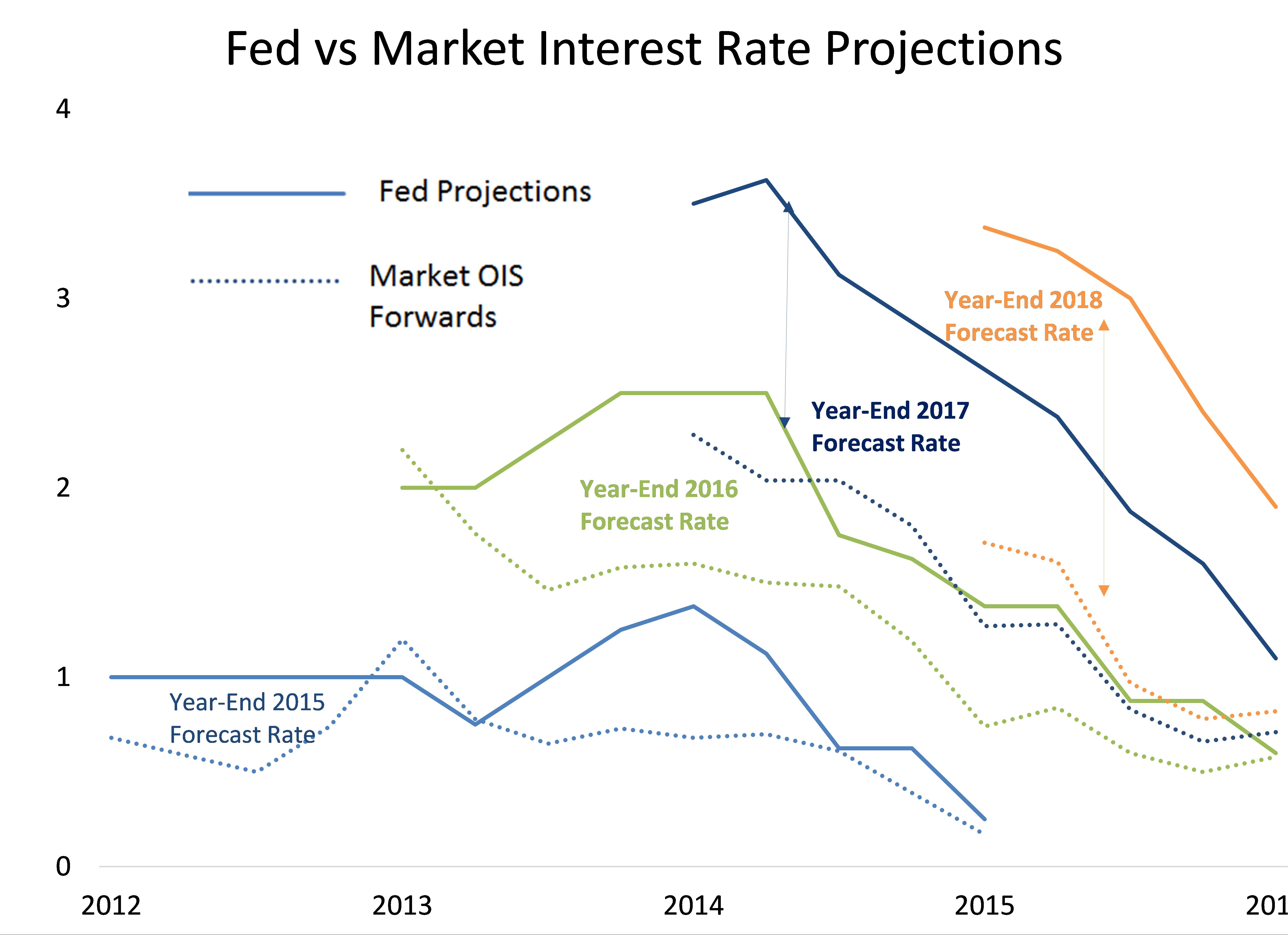
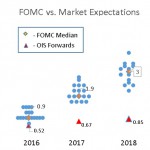
fed-vs-market-interest-rate-projections


Third, the Fed should make real the idea that its inflation target is symmetric by being clear that in the late stage of prolonged expansion with low unemployment it is comfortable with inflation rising a little bit above 2 percent with the confidence that it will decline when the next recession comes.  The Fed does not expect inflation to reach 2 percent until 2018 and the gradient is not steep.  So it should be clear that until inflation expectations look to be rising above 2 percent there is no need to restrain the economy.

Fourth, the Fed should make clear that it sees risk as asymmetric right now.  If the economy falls into recession there is a real risk of a Japan scenario in which it will be very difficult to combat deflation.  On the other hand, there is no great risk if inflation drifts above two percent.  It might as I have noted actually be desirable.  And if not, policy can be tightened to prevent the economy from overheating as has occurred many times in the past.

Eric Rosengren, in explaining his dissent on the decision not to raise rates in September, argues that the Fed has historically had a hard time tapping the brakes and that if the Fed has to cool off an overheated economy a recession is likely to result.  I am not sure what aspect of history he has in mind here.  It certainly is true that the Fed has on occasion reacted strongly to inflation in ways that caused a recession.  But on each of those occasions inflation was far beyond desired levels and the recession was the price of bringing it back to desired levels.  Rosengren’s case would be made by examples where so much extra slack was induced that the economy undershot on inflation.  I am not aware of such instances.

Governor Brainard did an excellent job in her recent speech of making the asymmetric risks argument.  It is actually a very broad one.  A recession would push millions out of work, stunt economic growth, increase inequality, balloon Federal debt and in all likelihood cause our politics to become ever more bitter and toxic.  Every prudent precaution to prevent one should be taken.

It takes a tortured argument to believe that you can prevent a car from stopping by hitting the brakes.  Much better if you want the car to keep going to keep your foot off the brake until and unless you see imminent danger.  This is no time for the Fed to be creating uncertainty by raising the specter of interest rate increases at a time when markets do not expect 2 percent inflation in this decade.

A Tribute to Shimon Peres

I have been thinking all day about Shimon Peres and how much I will miss him.  I first got to know Shimon in the mid 1990s when I was working in the International Affairs section of the Treasury.  It was a time of more optimism than we have today about the efficacy of economic assistance in supporting harmony among nations.  We were intensely engaged in supporting economic development in reform in the nations of the Former Soviet Union.

Shimon was pushing very hard for various Marshall Plan like schemes for the Middle East referencing the European Community experience in making war within Europe inconceivable after a thousand years of intermittent strife.  The White House and the State Department very much wanted to support him in any responsible way.

Treasury staff rightly saw a million problems with Shimon’s proposals.  There were corruption risks, duplication of already fragmented efforts of the existing development banks, shortages of trained personnel, and real security issues to mention just a few.  I have never seen anything like the response of Shimon and his close aide Uri Savir to these problems.   They would listen sympathetically and then explain how one could not let obstacles stand in the way of grand vision.  I called their interventions “dare to be great speeches”.  They were unlike anything I have ever heard in a diplomatic meeting.  Little wonder that they persuaded me and many others.

Tragically, politics got in the way and much of what Shimon was trying to do did not get done.  A lesser man would have been discouraged.  Shimon simply persevered looking for any daylight where hope could replace fear.  To be sure, there was nothing soft about him.  Indeed early in his career he had driven the Israeli nuclear program.  But he never stopped standing for hope.

Most people who have spent a decade in government let alone a half century become consumed with process, with prerogative, with the next task.  Not Shimon.  He was always thinking about the value of scientific truth and of beauty.  The last time I saw him maybe 9 months ago he shared with me a manuscript addressing the transcendent values that needed to guide civilization going forward.

Shimon was an immense presence on the global stage.  Most large men make others feel small.  Whenever I saw him, I always left elevated feeling there was more I could do to make the world a better place.  I am diminished by the knowledge that I will never see him again.  The world is now a harsher place.

Men Without Work

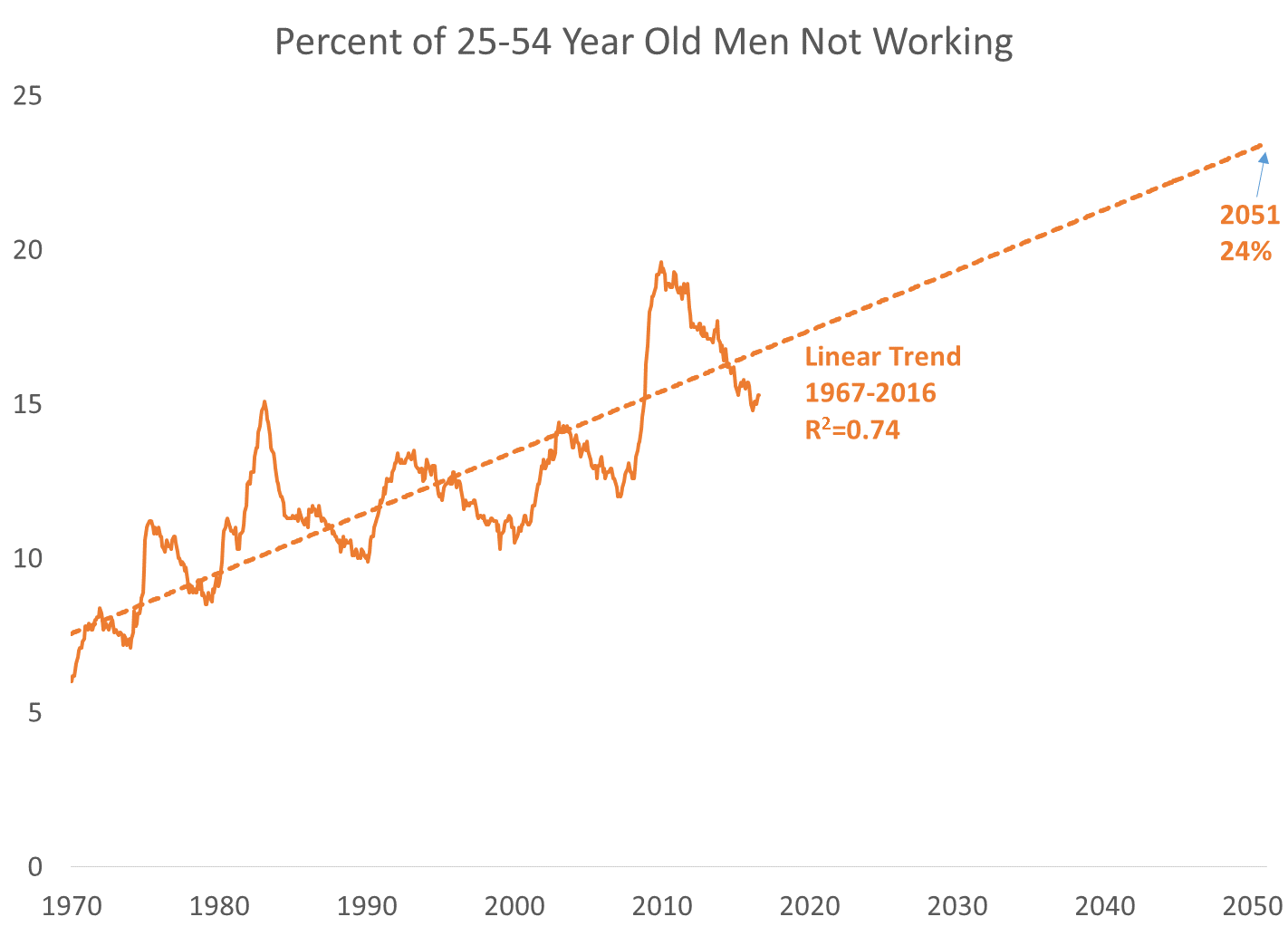
Over the weekend, the FT published my review of Nicholas Eberstadt’s important new book Men Without Work.  The core message is captured in the graph below.

men-without-work


Job destruction caused by technology is not a futuristic concern.  It is something we have been living with for two generations.  A simple linear trend suggests that by mid-century about a quarter of men between 25 and 54 will not be working at any moment.

I think this is likely a substantial underestimate unless something is done for a number of reasons.  First everything we hear and see regarding technology suggests the rate of job destruction will pick up.  Think of the elimination of drivers, and of those who work behind cash registers.  Second, the gains in average education and health of the workforce over the last 50 years are unlikely to be repeated.  Third, to the extent that non-work is contagious, it is likely to grow exponentially rather than at a linear rate.  Fourth, declining marriage rates are likely to raise rates of labor force withdrawal given that non-work is much more common for unmarried than married men.

On the basis of these factors, I expect that more than one-third of all men between 25 and 54 will be out work at mid-century.  Very likely more than half of men will experience a year of non-work at least one year out of every five.  This would be in the range of the rate of non-work for high school drop-outs and exceeds the rate of non-work for African Americans today.

Will we be able to support these people and a growing retired share of the population?  What will this mean for the American family?  For prevailing ethics of self-reliance?  For alienation and support for toxic populism? These are vital questions.  Even more vital is the question of what is to be done. These questions should preoccupy social science researchers.  They are vital to our future.


Building the case for greater infrastructure investment

September 12, 2016

The issue now is not whether the US should invest more but what the policy framework should be

There is a consensus that the US should substantially raise its level of infrastructure investment. Economists and politicians of all persuasions recognise that this can create quality jobs and provide economic stimulus without posing the risks of easy-money policies in the short run. They also see that such investment can expand the economy’s capacity in the medium term and mitigate the huge maintenance burden we would otherwise pass on to the next generation.

The case for infrastructure investment has been strong for a long time, but it gets stronger with each passing year, as government borrowing costs decline and ongoing neglect raises the return on incremental spending increases. As it becomes clearer that growth will not return to pre-financial-crisis levels on its own, the urgency of policy action rises. Just as the infrastructure failure at Chernobyl was a sign of malaise in the Soviet Union’s last years, profound questions about America’s future are raised by collapsing bridges, children losing IQ points because of lead in water and an air traffic control system that does not use GPS technology.

The issue now is not whether the US should invest more in infrastructure but what the policy framework should be. There are five key questions.

How much more do we need to invest? For the foreseeable future, there is no danger that the US will overinvest in infrastructure. An increase in investment of 1 per cent of gross domestic product over a decade would total $2.2tn and permit substantial steps both to catch up on deferred maintenance and embark on new projects.

What is the highest priority? The fastest, highest and safest returns are likely to be found where maintenance has been deferred. Maintenance outlays do not require extensive planning or regulatory approvals, so they can take place quickly. And they tend naturally to take place in areas where infrastructure is most heavily used.

How should investment be financed? There is a compelling case that infrastructure investments pay for themselves by expanding the economy and increasing the tax base. The McKinsey Global Institute has estimated a 20 per cent rate of return on such investments. If the return is only 6 per cent and the government collects about 25 cents on every dollar of GDP, it will earn 1.5 per cent on investments. This far exceeds the real cost of borrowing even over a horizon of 30 years. Debt financing of new infrastructure investment would be entirely reasonable. And if there is a desire to generate revenue to finance infrastructure investments, the best approaches would involve user fees. Thus, increased landing fees could help finance airports; tolls or taxes on miles driven could fund road improvements.

What about the private sector? Some infrastructure priorities, such as replacing coal-fired power plants with renewables, expanding broadband networks or building pipelines, are clearly the responsibility of the private sector. Policy frameworks that streamline regulatory decision-making and reduce uncertainty could spur investment in these sectors. There is a case for experimenting with mobilising private capital for use on infrastructure that has been a public-sector preserve, such as airports and roads. But, the reality that government borrowing costs are much lower than the returns demanded by private-sector infrastructure investors should lead to caution. It would be unfortunate if, in an effort to avoid deficits, large subsidies were given to private financial operators. Only when private-sector performance in building and operating infrastructure is likely to be better than what the public sector can do is there a compelling argument for privatisation.

How can we be sure investment is carried out efficiently? There is legitimate scepticism about this, and there is no silver bullet for this problem. Transparency of the type adopted for the Obama administration’s fiscal stimulus should become the norm. Additionally, progressive advocates of more investment should compromise with conservative sceptics and, in the context of increased spending, accept regulatory streamlining, as well as requirements that projects undergo cost-benefit analysis. Minimising cost should be the objective of infrastructure procurement.

Every year that we allow our infrastructure to decay raises the burden that our generation places on the next. We will not always be able to borrow for the long term at a near zero interest rate. However the election turns out, a major infrastructure investment programme should be adopted by the president and Congress in the spring of 2017.


The Fed’s complacency about its current toolbox is unwarranted

As I argued in the first blog in this series last week, I was disappointed in what came out of Jackson Hole for three reasons.   The first reason, developed in that blog, was that the Fed should have signaled a desire to exceed its two percent inflation target during periods of protracted recovery and low unemployment and in this context to signal that a rate increase was off the table for September and quite likely the rest of the year.  Friday’s employment report further strengthens the case for delay both by adding to the evidence on the absence of inflation pressures and by suggesting a less robust economy than most expected.

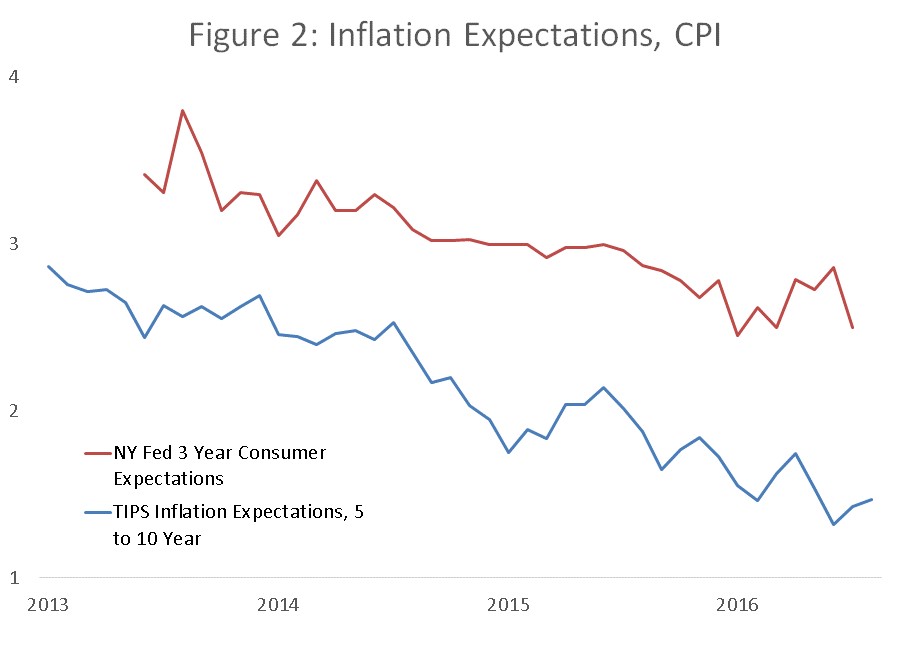
Even apart from the desirability of allowing inflation to rise above two percent in a happy economic scenario GDP, labor market and inflation expectations data all make a compelling case against a rate increase.  Private sector GDP growth for the last year has averaged 1.3 percent a level that has since the 1960s always presaged recession.  Total work hours have over the last 6 months grown at nearly their slowest rate since early 2010.   And both market and survey measures of inflation expectations continue to decline.
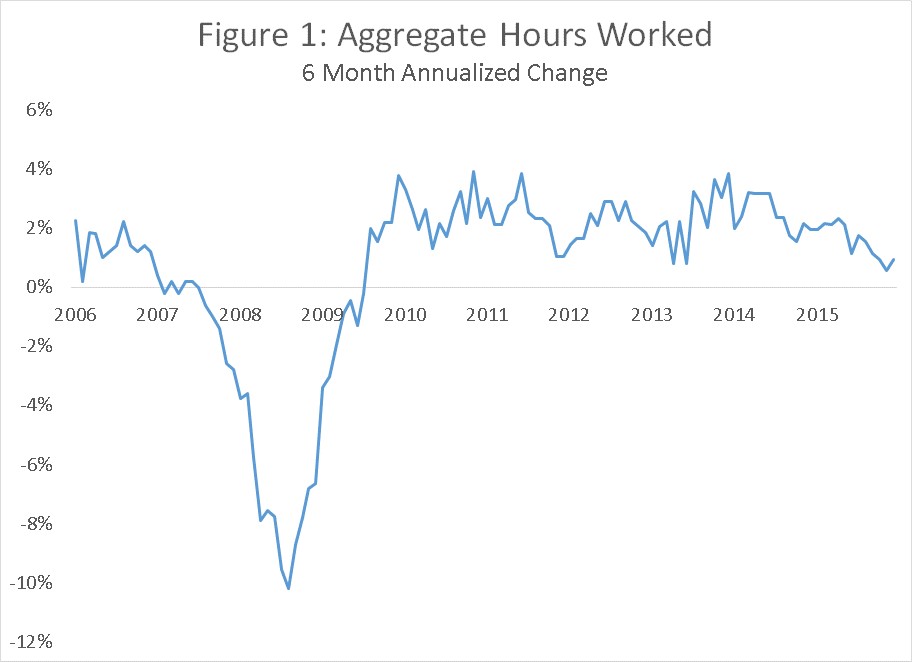
Figure 1 Aggregate Hours Worked 090616


Figure 2 Inflation Expectation CPI


My second reason for disappointment in Jackson Hole was that Chair Yellen, while very thoughtful and analytic, was too complacent to conclude that “even if average interest rates remain lower than in the past, I believe that monetary policy will, under most conditions, be able to respond effectively”.   This statement may rank with Ben Bernanke’s unfortunate observation that subprime problems would be easily contained.

Rather I believe that countering the next recession is the major monetary policy challenge before the Fed.   I have argued repeatedly that (i) it is more than 50 percent likely that we will have a recession in the next 3 years.  (ii) countering recessions requires 400 or 500 basis points of monetary easing.  (iii) we are very unlikely to have anything like that much room for easing when the next recession comes.

Chair Yellen, relying heavily on research by David Reifschneider using the FRBUS model, comes to the relatively serene conclusion that by using forward guidance and QE policies—or LSAP (Large Scale Asset Purchases) in Fed parlance, the Fed will likely able to respond adequately to the next recession with its existing tool kit.  I think this conclusion is unlikely to be right.

As Paul Krugman points out Reifschneider, working with John Williams and using the same FRBUS model, concluded that the ZLB was only a very small issue less than a decade before the financial crisis led to an 8 year stretch of zero rates.  The market has been consistently wrong for most of the last decade on the ease with which interest rates could be raised by the Fed.  And estimates of the neutral rate have been far lower for far longer than anyone would have predicted a decade ago.  All of this suggests the need for substantial humility about what the Fed’s capacities will be the next time the economy encounters difficult times.

There is an important methodological point here—distrust conclusions reached primarily on the basis of model results.  Models are estimated or parameterized on the basis of historical data.  They can be expected to go wrong whenever the world changes in important ways.  Alan Greenspan was importantly right when he ignored models and maintained easy policy in the mid 1990s because of other more anecdotal evidence that convinced him that productivity growth had accelerated.  I believe a similar skeptical attitude towards model results is appropriate today in the face of the clear evidence that the neutral real rate has fallen.  I pay attention to model results only when the essential conclusion can be justified with some calculation where I can see and follow each step.

Four more specific points deserve emphasis.  First, Reifschneider assumes in is base case that the Fed funds rate reaches 3 percent before the next recession and treats as an extreme case the possibility that rates will reach only 2 percent before the next recession.  As Jared Bernstein points out market expectations are much more pessimistic than this.  According to the OIS market (basically long term fed fund futures) fed funds are expected even in the long run to rise only to 1.5 percent. This may be a bit misleading because the expected fed funds rate in 2020 of 1 percent includes some probability that it is zero because of a recession.  Even so markets, which have been much more right than the Fed so far, are clearly signaling the likelihood that rates will be under 2 percent when the next recession comes.

I appreciate that Reifschneider takes seriously the possibility of secular stagnation by including a section on it.  However, I fear he is overly sanguine in assuming that even under secular stagnation the Fed will start the next recession with an interest rate of 2 percent, as well as a ten year rate of 3 percent.  This seems optimistic given both the market expectations discussed above and the fact that current interest rates are 0.50 percent nearly eight years after the last recession.

Second, though he downplays the significance, Reifschneider finds that the Fed will likely not have as much room to cut rates as it would like under the so-called “optimal control” method that Yellen has extolled in the past.  Under this method the Fed is attempting to minimize the amount which inflation and unemployment differ from target over a series of years.  In his simulations, the Fed is not able to use unconventional policies to fully achieve the equivalent of the nearly 12 percent rate cut it would otherwise desire.  This shortfall is in response to a recession less severe than the recent one and with the questionable assumption that the Fed should view unemployment being too low as being as harmful as being too high.

Third, I suspect that prevailing views at the Fed about the efficacy of QE and forward guidance substantially exaggerate their likely impact.  I don’t think the Fed has taken on board the lesson of the three year period since QE ended.  If longer term rates had risen after QE and forward guidance ended, this would surely have been taken as further evidence of their potency.  It follows that the fact that term spreads have fallen substantially since the end of unconventional policy as shown in Figure 3 should lead to more skepticism about their efficacy.
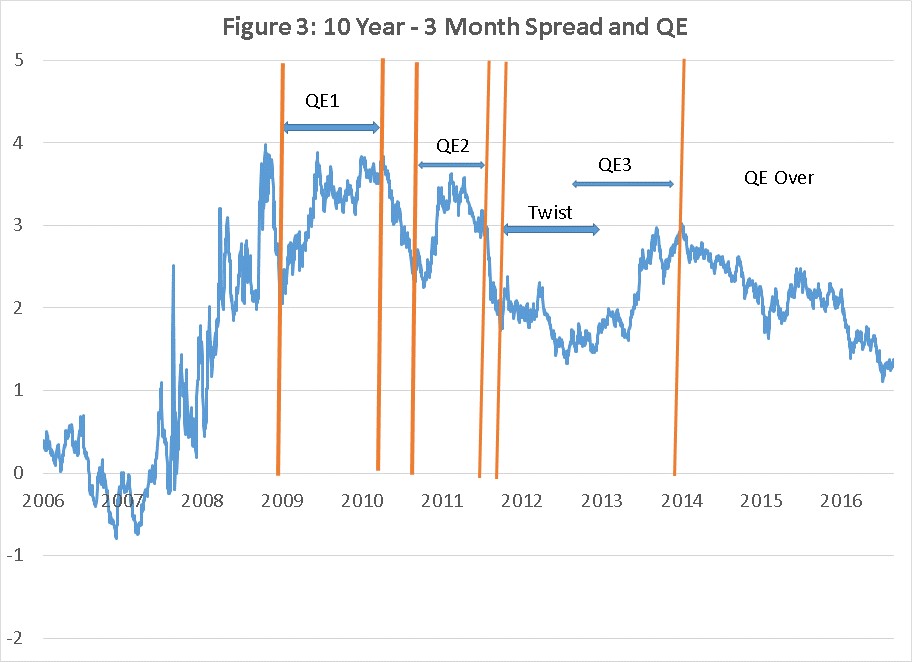
Figure 3 10 Year 3 Month Spread and QE


On the issue of QE Greenwood, Hanson, Rudolph and I show that the contrary to much of the discussion during the QE period the stock of longer term public debt that the market has to absorb went up not down.  The amount of longer term Federal debt that markets have to absorb is now as high as it has been in the last 50 years and long rates are extraordinarily low, as are term spreads.  This calls into question the idea that price pressures caused by changing relative supplies are likely to have large impacts at times like the present when markets are functioning.

I wonder what credibility Fed forward guidance is likely to have given the utter disconnect over many years between Fed and market views regarding future rate and the track record so far of the Fed being wrong and the market being right.

Fourth, even if unconventional policy could be highly efficacious in moving long term rates and even if QE induced moves in long rates were potent, there is the question of how much room there is to bring down long rates.   Reifschneider in his very careful paper shows that with a big recession rates would likely approach -6 percent, or even -9 percent, but for the zero lower bound.  I find the idea that forward guidance and QE could do the anything like the work of 600, let alone 900, basis points of rate cutting close to absurd.  Both QE and forward guidance are said to work by bringing down longer term rates.  The 10 year Treasury is now in the 1.6 percent range.  If the Fed returned Fed Funds to its lower bound level in the context of a recession, I would expect to see 10 year rates fall substantially perhaps to 1 percent without any QE or forward guidance.   How much room is there for unconventional policy to bring them down further?  Reifschneider ‘s assumption that there will be room for unconventional policy to bring down 10 year rates by hundreds of basis points seems to me very doubtful.

To put the point differently, typically in recessions the 10 year Treasury has declined from peak to trough by around 1.8 percentage points.  Even if the rate got to European or Japanese levels, surely an unappealing prospect, there may not be enough room to bring down long rates to assure prompt recovery.

On balance, I think the Fed’s complacency about its current toolbox is unwarranted.  If I am wrong in either exaggerating the risks of recession or understating the efficacy of policy, the costs of taking out insurance against a recession that cannot be met with monetary policy are relatively low.  If I my fears are justified, the costs of complacency could be very high.  The right policy in the near term should be tilting as hard as possible against recession as argued in the first blog in this series. For the longer term the Fed will have to reconsider its broad policy approach.  This will be subject of my next entry.

Disappointed by what came out of Jackson Hole

I had high hopes for the Federal Reserve’s annual Jackson Hole conference.  The conference was billed as a forum that would look at new approaches to the conduct of monetary policy—something that I have been urging as necessary given secular stagnation risks and the sharp decline in the apparent neutral rate of interest.  And Chair Yellen’s speech in a relatively academic setting provided an opportunity to signal that the Fed recognized that new realities required new approaches.

The Federal Reserve system and its Chair are to be applauded for welcoming challengers and critics into their midst.  The willingness of many senior officials to meet with the Fed Up group is also encouraging.  And its important for critics like me to remember that the policy explorations of today often become the conventional wisdom of tomorrow.   In this regard the fact that the Fed has now recognized that the decline in the neutral rate is something that is much more than a temporary reflection of the financial crisis is a very positive sign.

On balance though, I am disappointed by what came out of Jackson Hole judging by press reports since I was not there.  First, the near term policy signals were on the tightening side which I think will end up hurting both the Fed’s credibility and the economy.  Second, the longer term discussion revealed what I regard as dangerous complacency about the efficacy of the existing tool box.  Third, there was failure to seriously consider major changes in the current monetary policy framework.

I shall argue each of these points in a blog series this week.  At the outset however, it is important to recognize that the Fed has not earned the right to be intellectually complacent or to expect that others will have faith in its current policy framework.  Given the Great Recession and its forecasting record, it is not surprising that Gallup has found that public confidence in the Fed has sharply declined in recent years, though it has increased recently.

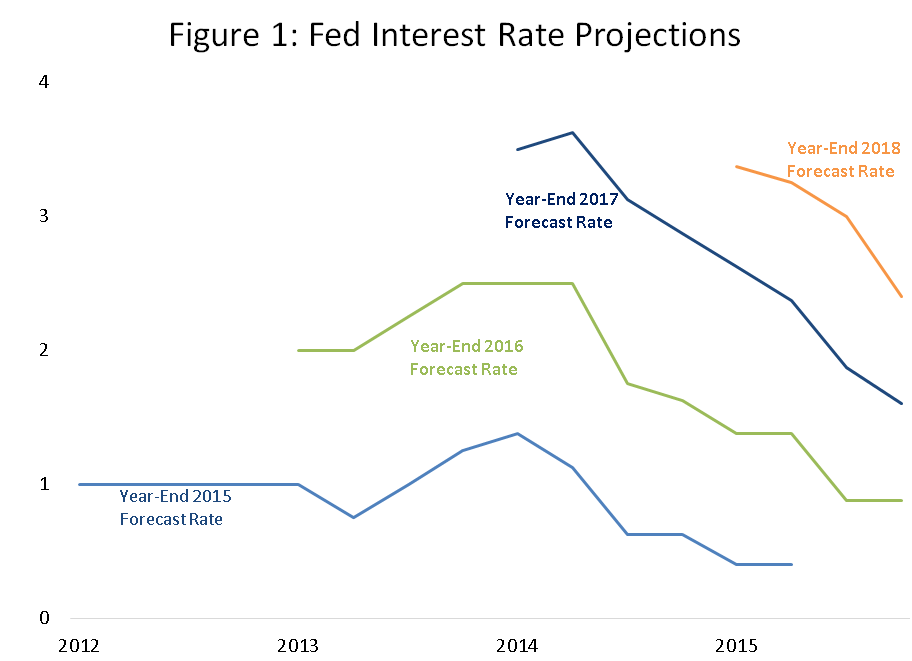
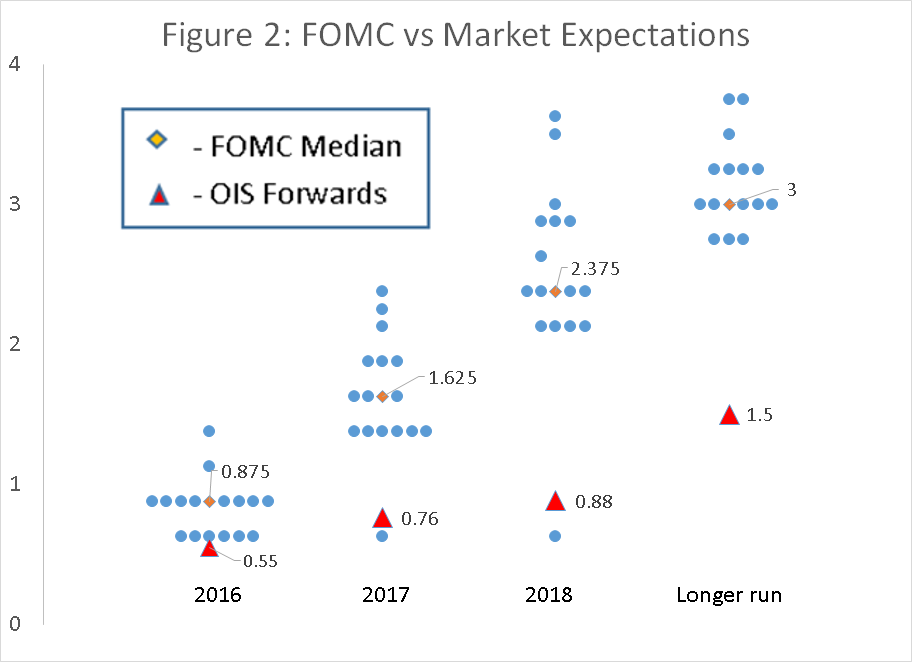
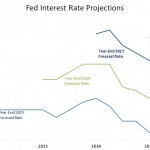
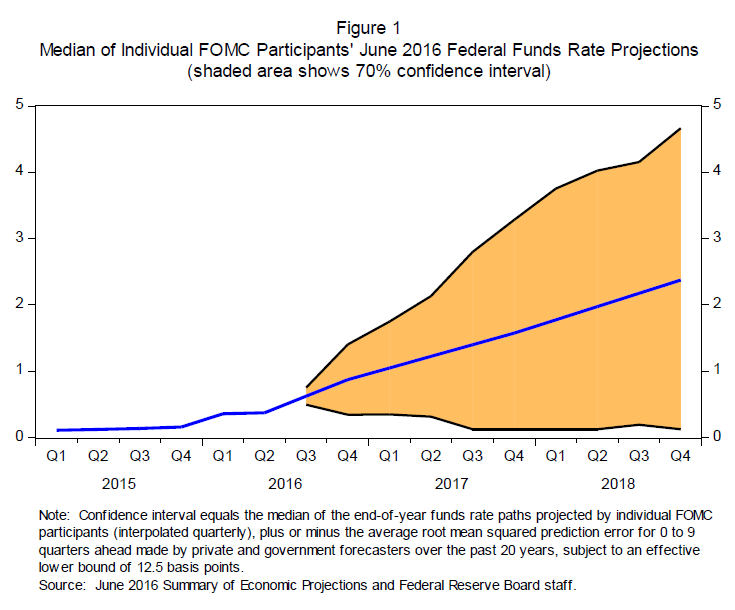
For nearly a decade, since the mid 2008 FOMC meetings where many believed that the worst had past, the Fed been too serene about the economic outlook and a return to past regularities.  When the Fed predicted last December that it would raise rates four times in 2016, market participants saw a disconnect from reality.  It has been that way for a long time.  Figure 1 shows the Fed’s forecasts of its future monetary policies since they began releasing them.  The Fed has always believed that rate increases and normalization were around the corner but never been able to deliver.  Figure 2 looks at the current situation showing the “dots” reflecting Fed forecasts and the market’s prediction of future interest rates.  The divergence between the market and even the dovish end of Fed forecasts is clear.

Figure 1 Fed Interest Rate Projections


Fig 2 FOMC vs Mkt Expectations


Near Term Policy

Chair Yellen in Jackson Hole basically repeated the existing Fed position that rates would be raised at some point when the data were clear that the economy was strong and inflation reaching two percent.  Markets took the remarks as mildly dovish until Vice Chair Fischer was seen on CNBC as interpreting the Chair as implying that two rates increases by the end of the year were possible at which point interest rates across the spectrum rose fairly sharply and stock prices fell.

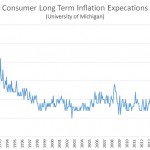
The right signal to have sent in my view was very dovish.  The Fed has emphasized that its two percent inflation target is a symmetric one.  Its current forecast is for a strong economy  that will next Spring enter its 9th year of recovery.  If inflation should not be allowed to rise a bit above two percent in such circumstances, how can it be expected to average two percent over time given that recessions and downturns at some point are inevitable? I hoped that the Fed would make clear that it would tighten only when there appeared a real risk of inflation expectations rising above two percent.  At a time when market forecasts of inflation on Fed’s preferred price index are in the range of 1.2 percent, this is very likely some time off.   Some are skeptical of market measures of inflation expectations.  Note that survey measures of long term inflation expectations for both professionals and consumers are near historical lows and if anything have declined over the last year.

Additional points that I would have thought appropriate in commenting on near term policy include: (i) With current estimates of the real neutral rate running near zero and there being a downward trend it is far from clear that current policy is highly expansionary.  (ii) It is plausible that hysteresis effects account for some of the decline in productivity growth and that if so allowing for rapid demand growth might have lasting supply side benefits.  (iii) If a two percent inflation target was appropriate when the neutral real rate was thought to be two percent and stable, surely a higher target is appropriate when the neutral real rate is zero and unstable.  (iv) In contrast to the risks of inflation exceeding two percent ,which are likely very small, the risks of a downturn are very serious. (v) The apparent rigidity of inflation expectations and insensitivity of inflation to measures of slack create extra uncertainties about the conventional idea that unemployment rates in the 4.5 percent range risk accelerating inflation.

I agree with Chair Yellen’s observation that the case for a rate increase now is stronger than it was a few months ago.  The economy certainly does appear to be gaining strength in the second half of the year,  the Brexit shock has been easily absorbed, and markets are unusually calm.  But to say that the case for a rate increase has strengthened is not to say that it has reached the point of being persuasive.

Even if the September employment report is strong, I do not see a case for a September rate increase.  There is no imminent danger of repeating the 1970s experience where inflation expectations ratcheted up leading to stagflation.  If a greater than 1/3 chance of a rate increase in September was not in markets, the cost of credit for small business would be lower and mortgage rates would decline.  Employers would be more confident about hiring.  And pressures would be removed from emerging markets.  The world economy would be more robust.


A Thought Provoking Essay from Fed President William

John Williams has written the most thoughtful piece on monetary policy that has come out of the Fed in a long time.  He recognizes more explicitly than others that r* (r-star), the neutral interest rate, is now very low and quite likely will remain very low for a long time to come.  As he recognizes, this the essence of the secular stagnation concern that I and others have been expressing for the last 3 years.

I now believe that it just as reasonable to suppose that neutral rates will fall further as it is to suppose they will revert towards historically normal levels.  First, there is a kind of hysteresis in rates in which a lower interest rate today tends to lower the neutral rate in the future.  To the extent that low rates stimulate spending by pulling forward investment, low rates today reduce neutral rates tomorrow by moving investment forward.  Second, major structural factors like rising inequality, slowing labor force  growth, lower capital goods prices, slowing productivity growth  and more capital outflows from developing countries appear to represent continuing trends.  Third, there is the prospect that the growing expectation that rates will be low for a long time decreases the spending of target savers and interferes with financial intermediation.

Wlliams rightly if rather tentatively draws the conclusions that a chronically very low neutral rate has important policy implications.  He stresses the desirability of raising r* by pursuing structural policies to raise growth and affirms the importance of fiscal policy.  I yield to no one in my enthusiasm for improved education and educational opportunity but I do not think it is plausible that it will change the neutral rate appreciably in the next decade given that the vast majority of the 2030 labor force will be unaffected.

If Williams is overenthusiastic on education, he is under enthusiastic on fiscal stimulus.  He fails to emphasize the supply side benefits of infrastructure investment that likely enable debt financed infrastructure investments to pay for themselves as suggested by DeLong and Summers and the IMF.  Nor does he note at current interest rates an increase in pay as you go social security could provide households with higher safe returns than private investments.  More generous Social Security would likely reduce the saving rate, thereby raising the neutral interest rate with no change in budget deficits.  Nor does Williams address the possibility of tax measures such as incremental investment credits or expansions in the EITC financed by tax increases on those with a high propensity to save.  The case for fiscal policy changes in the current low r*’environment seems to me overwhelming and much can be accomplished without any increase in deficits.

Williams comments on monetary policy have generated more interest.  He makes the now familiar point that if negative real rates are sometimes desirable on counter cyclical grounds there is a strong argument for an inflation target high enough that the ZLB does not bind or binds only very infrequently.  If the Fed believed that a 2 percent inflation target was appropriate at the beginning of 2012 when it believed the neutral real rate was above 2 percent, I cannot see any argument for not adjusting the target or altering the framework when the neutral real rate is very plausibly close to zero.  The benefits of a higher target have increased and so far as I can see nothing has happened to change the cost of a higher target,

I am disappointed therefore that Williams is so tentative in his recommendations on monetary policy.  I do understand the pressures on those in office to adhere to norms of prudence in what they say.  But it has been years since the Fed and the markets have been aligned on the future path of rates or since the Fed’s forecasts of future rates have been even close to right. I cannot see how policy could go badly wrong by setting a level target of 4 to 5 percent growth in nominal GDP and think that there could be substantial benefits. (I expect to return to this topic in the not too distant future)

Moreover even accepting the current framework, I find the current policy framework hard to comprehend.  If as it asserts, the Fed is serious about the 2 percent inflation target being symmetric there is an anomaly in its forecasts.   Surely if, as the Fed forecasts, the economy enters a 10th year of recovery with unemployment below five percent inflation should be expected to be above 2 percent at that point.  How else could inflation average 2 percent over time given the likelihood of downturns and recessions?

Finally there is this:  Everything we know about business cycle history suggests an overwhelming likelihood that there will be downturns in the industrial world sometime in the next several years.  Nowhere is there room to cut rates by anything like the normal 400 basis points in response to potential recession.  This is the primary monetary and indeed macroeconomic policy challenge of our generation.  I hope it will be very much in focus at Jackson Hole.

The progressive case for championing pro-growth policies

August 8, 2016

Issues of inequality, fairness, middle-class living standards and job creation have been central to the US presidential campaign.

Rightly so. For many years, the incomes of all groups tended to move together. Indeed, as a graduate student in the late 1970s, I was taught that it was a “stylised fact” that the shares of US total income going to profits and to wages, and to the rich and to the poor, was constant.
 
All of this has changed. It is totally appropriate that widening inequality and the associated stalling of middle-class living standards should become an urgent political issue.
 
What is unfortunate is that many people, in their eagerness to focus on fairness, neglect the single most important determinant of almost every aspect of economic performance: the rate of growth of total income, as reflected in the gross domestic product.
 
Because those who champion strategies that centre on business tax-cutting and deregulation and favour the wealthy have placed the most emphasis on growth over the past 35 years, the objective of increasing growth has been discredited in the minds of too many progressives.
 
The reality is that more growth means more employment. And with the college-graduate unemployment rate only 2.5 per cent, the newly employed are disproportionately less educated and more disadvantaged.
 
It can hardly be an accident that the decades of maximum growth, the 1960s and 1990s, also saw the most rapid job growth and most rapid increase in middle-class living standards.
 
Growth provides the wherewithal for increased federal revenue and so encourages the protection of vital social insurance programmes such as Social Security and Medicare. It creates headroom for new initiatives such as expansions of the Earned Income Tax Credit.
 
Tight labour markets are the best social programme, as they force employers to hire and mentor inexperienced people in order to be adequately staffed. Some years ago, I estimated that for each 1 per cent point increase in adult male employment, the employment of young black men rose 7 per cent. More recent research confirms economic growth has an outsized benefit for younger people and minorities.
 
Rising growth has other benefits, as well. It strengthens the power of the American example in the world. It obviates the need for desperation monetary policies that risk future financial stability. Greater growth also has historically operated to reduce crime, encourage environmental protection and contributes to public optimism about the country that our children will inherit.
 
The reality is that if American growth continues to have a 2 per cent ceiling, it is doubtful that we will achieve any of our major national objectives.
 
If, on the other hand, we can boost growth to 3 per cent, interest rates will normalise, middle-class wages will rise faster than inflation, debt burdens will tend to melt away and the power of the American example will be greatly enhanced.
 
How, then, can growth be accelerated? In an economy like that of the US, the vast majority of job creation and income growth comes from the private sector. If the next president is lucky enough to oversee the creation of 10m jobs from 2017-20, more than 8m of them will surely come from businesses hiring in response to profit opportunities.
 
The question is not whether business success is desirable. The question is how it can best be achieved. At a moment when capital costs are close to zero, the stock market is at a record high and businesses are earning record profit margins, we do not need to bribe businesses to make investments that now do not seem worthwhile to them.
 
There is no case for reducing already low corporate taxes or removing regulations unless it can be shown that these have costs in excess of benefits.
 
What is needed is more demand for the product of business. This is the core of the case for policy approaches to raising public investment, increasing workers’ purchasing power and promoting competitiveness.
 
That such policies also contribute to fairness is not a reason to lose sight of the central objective of promoting growth.
 
Often in economics there are trade-offs. But not always. We can and must promote both fairness and growth.
 

Two Good Men

Two longtime friends of mine, Chip Case and Michael Elliot, died within the last week after battles with long illnesses.  In different ways, they illustrated something I think is very important—that you can think superbly as an economist and act and live in an extraordinarily humane way.

Chip was a professor at Wellesley for the last forty years.  To the wide world he is best known for his collaboration with Robert Shiller on the Case-Shiller home price indices.  These indices, based on houses that are sold repeatedly, are the best tool economists have for tracking developments in the all-important housing market.

Those who know him well know that the economics profession had no more dedicated and inspiring a teacher.  Chip had time for every student and treated with equal interest the brilliant ones headed for careers as research economists and those who struggled to understand what elasticity meant.  I doubt there is any man anywhere who has done more to encourage women to pursue careers in economics than Chip did while teaching at Wellesley.

Chip’s warm optimism was an inspiration to all who had the opportunity to work with him.  I remember hi saying once that he thought his Parkinson’s had actually improved his golf swing by by weakening his right arm! And because he thought his students could do anything, they did much more than others would have thought possible.

Most economists run with the pack and do what is most rewarded by our profession.  They focus on research using existing data to fill in holes in the literature.  Chip charted his own course of total dedication to students and of doing research that involved developing primary data.  He was as content and happy as any friend I have, and he deserved every bit of the joy that was part of his life.

Michael, for most of the time that I knew him, was a journalists’ journalist.  He served in major editorial roles at The Economist, Time and Newsweek.  He was interested in everything and able to see every point of view.  Unlike so many reporters and editors, he had no axe to grind.  I have never been covered in a more fair-minded way than when Michael was in charge.  You could not predict with confidence where he would come out on any given issue.  But you could always be confident that when he came to an issue he would have something to say that was novel and worthy of serious reflection.

For the last five years Michael served as the CEO of ONE—an enormously effective advocacy group for global development founded by Bono.  As a board member it was my privilege to watch Michael lead.  He never failed to bring intellectual rigor to every question: whether it was how best to raise funds or what priorities with respect to global poverty were most important. But he also never failed to recognize how morally important and practically consequential ONE’s advocacy was.  And he always saw and brought out the best in every one of his colleagues.  Michael was truly a happy warrior as he fought global poverty.

Michael, even after his diagnosis, was always positive.   On those rare instances when he was frustrated, he channeled this energy into his journalism and his advocacy. His smile and his laughter were never forced; they reflected his genuine joy in his work.  He was proud and he should have been.  Millions of desperately poor people around the world who have never heard of Michael or even of Bono will live better lives because of the work Michael did at ONE.

I am deeply saddened by the loss of these two men, but so privileged to have known them and have learned from their great examples.

When the best umps blow a call

CBO is an American national treasure. Without the impartial objectivity it brings to the budget process our country would make much worse policy. Baseball without an umpire would be a very different game, and similarly the making of budget policy without CBO would be a very different and inferior activity. However, even the best umps occasionally blow a call and I am afraid that is what CBO has done in its recent infrastructure report.

An acknowledgment at the outset: I have been a strong advocate of infrastructure investment for years and have even argued that debt financed infrastructure is likely to reduce deb-to- GDP ratios because of the growth bump from infrastructure. This argument has been taken up by the IMF and many others. So I am not neutral on this subject.

My views come in part from a simple calculation. Imagine an infrastructure project that costs $1 and yields a modest 5 cents a year in real return forever, in terms of higher GDP. The project thus has a 5 percent social rate of return. Tax collections will rise by about 1.5 cents a year. With the indexed bond market suggesting federal real borrowing costs that are negative for 10 years and 50 basis points for 30 years, the government will come out ahead on the investment. Now, as Brad DeLong and I pointed out a few years ago, matters are more complex than this particularly because capital depreciates, and because infrastructure projects have other effects, but the basic point continues to hold.

So, I was very surprised to read the June CBO report on the consequences of federal investment. It assumes, from its reading of the literature (also here), as its central base case what it calls a 5 percent rate of return on infrastructure investment but then finds that the payback effect of infrastructure investment on the federal deficit is very small, contradicting my earlier claims and more importantly raising doubts about the desirability of a big infrastructure push.

Why the discrepancy? After carefully reading the report, and speaking at some length with CBO officials, I think I understand at least one aspect of it. CBO uses the term “rate of return” in a way that is very different than what I would regard as standard usage. They take a 5 percent rate of return to mean that one dollar more capital produces five cents more output. This turns out to be quite different from assuming that investments in public capital earn a 5 percent return.

For example, CBO does not subtract depreciation in calculating their rate of return unlike what is standard in the private sector. Nor, contrary to what I would have assumed was natural, do they suppose that rates of return are reduced by the fact that on their (questionable) assumptions it takes many years for dollars invested to turn into capital. (Think of R&D as an example here). Adjusting for these factors, CBO is actually assuming an economic return a little above 2 percent on public investment and then concluding it will not help much.

If one assumes that public investment is basically unproductive, it is no surprise that it does not yield large economic benefits. There is still the question of if the 5 percent rate of return is misdescribed, whether or not CBO has made a reasonable judgement about the productivity of public investment. I’m pretty skeptical. They rely on aggregate econometric estimates of an elasticity of GDP with respect to public capital. Such estimates are plagued by all sorts of problems of heterogeneity, simultaneity, limited variation in the exogenous variables and so forth.

I would prefer to build up from individual projects by looking for example at estimates of the return on fixing potholes, building dams, or repairing water systems. I think anyone taking this kind of ground up approach will conclude that the social return to public investment is far higher than 2 percent. This is, of course, a matter of judgement.

There are other, probably lesser, problems with CBO’s work. Much of the adverse effect of public investment on the budget in their work comes from an assumed increase in interest rates resulting from budget deficits. This assumption would have been natural once, but is much less compelling in the current liquidity trap, possible secular stagnation environment. They also haircut the return to federal investment by assuming that it crowds out state and local investment but do not recognize explicitly the benefits of less state and local borrowing. And they focus on deficit impacts rather than the more appropriate question of impacts on debt-to-GDP ratios.

On balance, I do not think anyone should change her mind about public investment based on CBO’s analysis. Great umpires never change their minds. But they do learn from their mistakes. I hope CBO will do better next time out.


Voters deserve responsible nationalism not reflex globalism

July 10, 2016

It is clear after the Brexit vote and Donald Trump’s victory in the Republican presidential primaries that voters are revolting against the relatively open economic policies that have been the norm in the US and Britain since the second world war.

Populist opposition to international integration is on the rise in much of continental Europe and has always been the norm in Latin America. The question now is what should be the guiding principles of international economic policy? How should those of us — who believe that the vastly better performance of the global system after the second world war than after the first world war is largely due to more enlightened economic policies — make our case?

The mainstream approach starts with a combination of rational argument and inflated rhetoric about the economic consequences of international integration. Studies are produced about the jobs created by trade agreements, the benefits of immigration and the costs of restrictions. In most cases the overall economic merits are clear. But there is a kind of Gresham’s Law of advocacy whereby bolder claims drive out more prudent ones. Over time this has caught up with the advocates of integration.

While there is a strong case that the US is better off than it would have been if the North American Free Trade Agreement had been rejected, the most extravagant predicted benefits have not materialised. And it is fair to say that claims that China’s accession to the World Trade Organisation would propel political liberalisation have not been borne out. The willingness of people to be intimidated by experts into supporting cosmopolitan outcomes appears for the moment to have been exhausted.

The second plank of the mainstream approach is to push for stronger policies to resist inequality, cushion disruptions and support the poor and middle class, and then argue that if domestic policies are right, the pressure to resist globalisation will reduce. The logic is right and certainly measures like government assurance of mortgages and the interstate highway system were part of the political package that permitted the US to underwrite an open global system.

But the last eight years have seen America at last adopt universal health insurance, expand a variety of support programmes for the poor and bring unemployment below 5 per cent with trade becoming ever less popular. It is not that strong domestic policies are unnecessary to undergird global integration. It is that they are insufficient.

A new approach has to start from the idea that the basic responsibility of government is to maximise the welfare of citizens, not to pursue some abstract concept of the global good. People also want to feel that they are shaping the societies in which they live. It may be inevitable that impersonal forces of technology and changing global economic circumstances have profound effects, but it adds insult to injury when governments reach agreements that further cede control to international tribunals. This is especially the case when, for reasons of law or practicality, corporations have disproportionate influence in shaping global agreements.

If Italy’s banking system is badly undercapitalised and the country’s democratically elected government wants to use taxpayer money to recapitalise it, why should some international agreement prevent it from doing so? Why should not countries that think that genetically modified crops are dangerous get to shield people from them? Why should the international community seek to prevent countries that wish to limit capital inflows from doing so? The issue in all these cases is not the merits. It is the principle that intrusions into sovereignty exact a high cost.

What is needed is a responsible nationalism — an approach where it is understood that countries are expected to pursue their citizens’ economic welfare as a primary objective but where their ability to harm the interests of citizens elsewhere is circumscribed. International agreements would be judged not by how much is harmonised or by how many barriers are torn down but whether citizens are empowered.

This does not mean less scope for international co-operation. It may mean more. For example, tax burdens on workers around the world are a trillion dollars or more greater than they would be if we had a proper system of international co-ordination that identified capital income and prevented a race to the bottom in its taxation. Taxes are only the most obvious area where races to the bottom interfere with the achievement of national objectives. Others include labour and financial regulation and environmental standards.

Reflex internationalism needs to give way to responsible nationalism or else we will only see more distressing referendums and populist demagogues contending for high office.


A Remarkable Financial Moment

The US 10 and 30 year interest rates today reached all time low levels of 1.32 percent and 2.10 percent.  Record low 10 year interest rate were also registered in Germany, France, Switzerland and Australia.  Notably Swiss 50 year interest rates are now for the first time negative.  Rates out 15 years are negative in Germany and 9 years in France.

Such rates would have seemed inconceivable a decade ago and very unlikely even a couple of years ago.  I remember my parents paying off their 30 year mortgage on the house I grew up in during 1991 and thinking that the 4.5 percent rate they paid was some kind of antique the likes of which would never be seen again.  At the beginning of this year US 10 year rates were 2.27 percent and there was a general view that they would rise sharply to perhaps 3 as the Fed began to tighten.

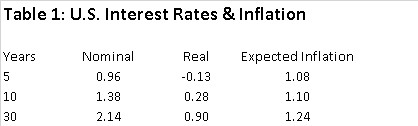
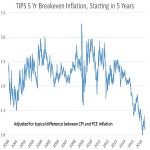
As Table 1 makes clear extraordinarily low rates reflect both subtarget expected inflation even over long horizons and very low real interest rates.  Note that the real interest rates exceed reported for TIPS because I have adjusted yields to reflect the 35 basis point average difference between the Consumer Price Index used in calculating TIPS coupons and the Personal Consumption Expenditures deflator targeted by the Fed.Table 1 US Interest Rates & Inflation

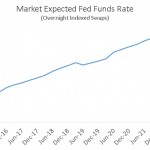
The Fed Funds futures market provides a window into market thinking regarding the likely path of monetary policy.  Remarkably the market does not now expect a full Fed tightening until early 2019.  This is despite all the Fed speeches expressing optimism about the economy and a desire to normalize interest rates.

I believe that these developments all reflect a growing awareness of the importance of the secular stagnation risks that I have highlighted over the last several years.  There is a growing sense that the world is demand short—that the real interest rates necessary to equate investment and saving at full employment are very low and may be often unattainable given the bounds on nominal interest rate reductions.  The result is very low long term real rates, sluggish growth expectations, concerns about the ability even over the fairly long term to get inflation to average 2 percent, and a sense that the Fed and the world’s major central banks will not be able to normalize financial conditions in the foreseeable future.

Unfortunately markets have been much more aggressive in responding to events than policymakers.  While there are some signs of recognition such as the Fed’s reduction in its estimated neutral rate from 4.5 percent to 3.0 percent during the last 2 years, the IMF’s explicit use of the term secular stagnation in its World Economic Outlook, ECB president Mario Draghi’s call for global coordination and greater use of fiscal policy, and Japan’s indicated interest in fiscal-monetary cooperation, policymakers still have not made sufficiently radical adjustments in their world view to reflect this new reality of a world where generating adequate nominal GDP growth is likely to be the primary macroeconomic policy challenge for the next decade.

Having the right world view is essential if there is to be a chance of making the right decisions.  Here are the necessary adjustments.

First, with differences between countries, neutral real interest rates are likely close to zero going forward.  Think about the USA, where growth has been relatively robust by recent standards.  Growth has averaged little more than potential for the last 1, 3 or 5 years while the real Federal Funds rate has been around -1 percent.  There is no good reason to think given sluggish investment expectations that the neutral rate will rise to be significantly positive in the foreseeable future.  The situation is worse in other countries with more structural issues and slower labor force growth.  Substantial continued reductions in Fed estimates of the real neutral rate lie ahead.

Second, as counterintuitive as it is to central bankers who came of age when the inflation of the 1970s defined the central banking challenge, our problem today is insufficient inflation.  In the United States, Europe and Japan markets are now expecting inflation that is below target even with full employment over the next 10 years.  This is despite a 70 percent rise in the price of oil.  Evidence from markets and some surveys suggests that inflation expectations are becoming unhinged to the downside.  The policy challenge with respect to credibility is exactly the opposite of what it has been historically—it is to convince people that prices will rise at target rates in the future.  This is likely to require some combination of very tight markets and mechanisms that give confidence that during the best times inflation will be allowed to exceed target levels so that over the long term they can average target levels.

Third, in a world where interest rates over horizons of more than a generation are far lower than even pessimistic projections of growth, traditional thinking about debt sustainability needs to be discarded.  In the United States, UK, Euro area and Japan the real cost of even 30 year debt will be negative or negligible if inflation targets are achieved.  Indeed, the conditions Brad Delong and I set out in 2012 for expansionary fiscal policy to pay for itself are much more easily satisfied today than they were at that time.

Fourth, the traditional suite of structural policies to promote flexibility are not especially likely to be successful in the current environment, though some structural policy approaches such as removal of restrictions on investment are still desirable.  Indeed in the presence of chronic excess supply structural reform has the risk of spurring disinflation rather than the contributing to a necessary increase in inflation.  There is in fact a case for strengthening entitlement benefits so as to promote current demand.  The key point is that the traditional OECD type recommendations cannot be right as both a response to inflationary pressures and deflationary pressures.  They were more right historically than they are today.

There is much more to be said about policy going forward.  But treatments without accurate diagnosis have little chance success.  We need to begin with a much clearer diagnosis of our current malaise than policymakers have today.  The level of interest rates provides a very strong clue.


Why Brexit is worse for Europe than Britain

Brexit is in train. If journalism is the rough draft of history, instant blog responses are even cruder responses to events.  Nonetheless, here are some thoughts prior to market opening in the United States.

Markets

So far given the shock value of what has happened the market response has been on the calm side.  The British pound is only a bit weaker than it was 10 days ago when the outcome looked highly uncertain.  I would not have been surprised to see the pound below 1.30, the yen below 100 and more dramatic moves in credit spreads in the European periphery.  Notably the pound which is a kind of bellwether and many other asset prices have rallied considerably from their lows during the night.

Relatively resilient markets so far probably reflect a combination of confidence that central banks will do whatever is necessary to maintain order as well as some opportunistic buying in response to opportunities created by the falling asset prices.  Notably cool heads seem to be in control for now in London and Brussels.  Fortunately authorities do not seem overly fussed with moral hazard at a time when the preoccupation needs to be maintaining liquidity and orderly markets.  Critically, the market has expressed confidence that the Fed understands the gravity of the situation by taking the probability of a Fed hike by the end of the year down to the 10 percent range.

All of this could easily change when U.S. markets open, when investors ponder the new and more volatile environment they live in, when traders decide they do not want to bear risk over the weekend, or when a weekend of pondering leads to a wave of liquidations on Monday morning.  In 1987 volatile markets with international uncertainties at the end of the preceding week presaged the Monday crash.  It is far too early for any kind of complacency.

The situation of European banks should and will receive extensive policy attention.  Even before the last 24 hours, several were selling at price-book value ratios suggesting alarm about their prospects.  And some, not only British banks are now down more than 20 percent.  Large flight to quality flows into the dollar and yen also risk bringing on alarm about emerging markets and a return to concern about currency wars.

Economics

For Britain, the economic effects are two sided.  On the one hand, a major jolt has been delivered to confidence, to future unity and down the road to trade.  On the other, the currency has become more competitive, and liquidity will be in very ample supply.  I would expect that a significant deterioration in growth and a recession beginning in the next 12 months has to be a substantial risk though short of an odds on bet.

As suggested by the fact that stock markets in Italy and Spain are down almost twice as much as in the UK, the prospects for Europe may in some ways be worse than for the UK.  There is the real risk of “populist exit contagion” in a number of countries.  A credit crunch is a serious risk.  Unlike in Britain, the trade weighted exchange rate is unlikely to decline very much.  The central bank has less room for incremental policy measures.

The effects on the rest of the world will depend heavily on psychology.  I continue to be alarmed as I wrote in this space a few days ago that this unexpected outcome in the UK will raise the spectre of “Trump risk”.  If the UK can vote for Brexit perhaps the U.S. can vote for Donald Trump.  I fear this possibility will lead to a freezing up of spending decisions particularly on the part of internationally oriented businesses.  The odds of U.S. recession beginning within the next 12 months are I think now in the 30 percent range.  Also noteworthy is that an environment of increased risk aversion and flight to quality will complicate Japan’s problem of generating inflation, and China’s challenge of attaining currency stability.

To an extent that is underestimated in some quarters and understated in others, the world economy is far more brittle than usual because of the inability almost everywhere to lower interest rates substantially.  Normally in response to incipient downturns central banks lower rates by 400 basis points or more.  Nowhere do they have that kind of room.  Nor is there large scope for reducing term and credit spreads given their very low levels.  This is no time for austerity.  Greater use of fiscal policy should be on the agenda almost everywhere and certainly with the change of government in the UK.

Brexit will rightly be taken as a signal that the political support for global integration is at best waning and at worst collapsing.  Dramatic exchange rate fluctuations tend to portend upswings in protectionist pressure.  And problems in European banks could as in 2009 lead to a drying up of trade finance.  Already global trade has lagged global growth in recent years.  A clear sense of commitment to avoid backsliding towards protection from the G20 will be essential going forward.  Specific efforts with respect to trade finance may be appropriate.

Broader Observations

After Brexit, Trump, Sanders and the misforecast British and Canadian general elections, it should be clear that the term political science is an oxymoron.  Political events cannot be reliably predicted by pollsters, pundits or punters.  All three groups should have humility going forward.  In particular no one should be confident about the outcome of the U.S. presidential election.

The political challenge in many countries going forward is to develop a “responsible nationalism”.  It is clear that there is a hunger on the part of electorates, if not the Davos set within countries, for approaches to policy that privilege local interests and local people over more cosmopolitan concerns.  Channeling this hunger constructively rather than destructively is the challenge for the next decade.  We now know that neither denying the hunger, or explaining that it is based on fallacy is a viable strategy.

Why Brexit would be a history-defining, irreversible mistake

U.K. voters will decide on Thursday whether or not the U.K will withdraw from the European Union.  At one level it is a fundamental political choice.  Does the U.K. want to face the world alone as a limited scale island nation or to remain an influential part of the European Union—the world’s largest economy? Does the U.K. want to stand apart from Europe or try to shape it at this complex hour in global affairs?  These are not questions which an American should presume to answer.

But Thursday’s choices will have immediate financial and economic consequences.  And they can be assessed by outside economists.  My judgements are I believe widely, though not universally, shared by both progressive and conservative global financial and economic analysts.

Put simply, Brexit could well be the worst self-inflicted policy wound by a G7 country since the formation of the G7 forty years ago.  It is a risk no prudent policymaker would take.  And the risk is not confined to the UK.  In the current context, Brexit would unsettle the global economy and possibly tip it into recession.  Four points are crucial.

First, unlike almost all other economic policy choices, Brexit is irreversible. Francois Mitterrand’s lurch towards socialism, Ronald Reagan’s excessive tax cuts, and Japan’s encouragement of bubbles were all egregious errors but all were reversed, albeit not before substantial damage had been done.  Divorce can be reversed by remarriage if regretted.  There is no reversing Brexit if it proves unwise.  Indeed given the EU’s very strong incentive to discourage further dissolution, it is far from clear that there would even be concerted efforts to minimize its cost.

Second, markets are likely to suffer extraordinary volatility in the wake of Brexit. A Black Friday could follow referendum Thursday.  It is likely that foreign investors in British stocks would lose 15 percent off the bat, adding together market declines and currency losses.  This is a judgement supported by the gyrations in markets induced by relatively small fluctuations in the perceived chance of Brexit and by the very high prices commanded by out of the money options.  The truth is that even with all the regulatory changes that have been put in place we do not know for sure how the financial system will respond.  A return of systemic risk as large losses lead to cascading liquidations cannot be ruled out.  At a time when central banks have far less ammunition than they did in 2008, the consequences could be grave.

Third, Brexit will undermine confidence and increase uncertainty.  No one knows what the new structure will be or how soon it will emerge.  Quite likely Brexit would lead to changes not only in Britain’s relationship with Europe but within Europe itself.  While businesses wait to see what happens, they will hold off on new investment.  Some will decide that it is much safer to base European operations outside the U.K.  Others will simply avoid hiring until matters are clear.  There exist contingency plans to move hundreds of thousands of financial sector and other workers out of the UK.  If matters play out slowly, they may be acted on.  Given adverse markets, huge uncertainty, the likely absence of either expansionary fiscal policy (because of government policy commitments) or incrementally expansionary monetary policy (because of lack of room to cut rates), I believe Brexit would likely be followed by a recession in the UK.

Fourth, Brexit would quite likely have large contagion effects.  So irrational and dangerous an act in a traditional bastion of mature democracy would prompt a global reassessment of the likelihood of dangerous populist policy. The result could be large and destabilizing asset price declines and capital flows towards assets like gold and the Swiss franc.  A vicious cycle of falling asset prices, reduced confidence and further declines could ensue.  I am reminded of the Smoot-Hawley tariff and the Depression.  No direct calculation of its impact can explain more than a tiny part of the Depression.  But it may have been a psychological tipping point. Brexit too could have global effects that dwarf its direct impacts.

None of this certain.  But prudence dictates the avoidance of needless risk. Remain is the only rational economic choice.


Groundhog Day at Fed June meeting

As the Fed meets today and tomorrow, I am increasingly convinced that while they have been making reasonable tactical judgements their current strategy is ill adapted to the realities of the moment. Exuding soundness is the task of policymakers. Provoking thought is the task of academics. So here are some not entirely formed reflections.

Japan’s essential macroeconomic problem is no longer lack out output growth. Unemployment is low. Relative to its shrinking labor force, output growth is adequate by contemporary standards. Japan’s problem is that it seems incapable of achieving a 2 percent inflation. This makes it much harder to deal with debt problems and leaves the Japanese with little spare powder if a recession comes.

I am reluctantly coming to the conclusion that the United States may be on a slow-motion trajectory towards a Japanese chronic lowflationary or even deflationary outcome. A corollary of this view is that the current hawkish inclination of the Fed, with its chronic hope and belief that conditions will soon permit interest rate increases, is misguided. The greater danger is of too little rather than too much demand. A new Fed paradigm is therefore in order.

Any consideration of macro policy has to begin with the fact that the economy is now seven years into recovery and the next recession is on at least the far horizon. While recession certainly does not appear imminent, the annual probability of recession for an economy that is not in the early stage of recovery is at least 20 percent. The fact that underlying growth is now only 2 percent, that the rest of the world has serious problems, and that the U.S. has an unusual degree of political uncertainty all tilt toward greater pessimism. With at least some perceived possibility that a demagogue will be elected as President or that policy will lurch left I would guess that from here the annual probability of recession is 25-30 percent.

This seems to me the only way to interpret the yield curve. Markets anticipate only about 65 basis point of increase in short rates over the next 3 years. Whereas the Fed dots suggest that rates will normalize at 3.3 points, the market thinks that even 5 years from now they will be about 1.25 percent.

blog graph a


blog graph b

Markets are thinking that recession will come at some point and when it does rates will go to near zero. As a rough calculation, if it is assumed rates will be raised twice a year with continued growth than the 85 basis point estimate for fed funds in December 2018 implies a 50 percent chance of recession by then.

So both history and markets are telling us that we are in the shadow of possible recession.

What does this mean? First it implies that if the Fed is serious — as it should be – about having a symmetric 2 percent inflation target then its near term target should be in excess of 2 percent. Prior to the next recession — which will presumably be deflationary — the Fed should want inflation to be above its long term target.

The point can be put in one more way. The Fed’s dots forecast refer to a modal scenario of continued recovery. They see inflation rising to 2 percent only in 2018. Why shouldn’t they prefer a path with more demand, inflation at target sooner, more stimulus as recession insurance, and a small margin of extra inflation as a buffer against the next recession? Those who think that raising rates somehow helps prepare to be counter-cyclical are confused. Given lags raising rates now would increase the chances of recession along with the likely severity. Raising inflation and inflation expectations best prevents and alleviates recession.

There is the further point that the logic that led to the adoption of the 2 percent inflation target years ago suggests that it is too low now. As brought out in a famous colloquy between Janet Yellen and Alan Greenspan[1] the case for a positive inflation target balances the benefits of stable money with the output cost of lowering inflation and two ways that positive inflation is helpful—the periodic need to have negative real rates, and inflation’s role in facilitating downward adjustment in real wages given nominal rigidities.

All of the factors pointing towards a higher inflation target have gained force in recent years. Regardless of whether they believe in secular stagnation, almost everyone agrees that neutral real rates have declined 100 basis points or more. This means there will be more frequent need for negative real rates. Slowing underlying wage growth means that there is more pressure for downward adjustments that are facilitated by inflation. Experience has proven that Yellen was correct to be skeptical of the idea very low inflation rates would improve productivity. And it is plausible that the error in price indices has increased with the introduction of new categories of innovative and often free products.

This means that if a two percent inflation target reflected a proper balance when it first came into vogue decades ago, a higher target is probably appropriate today. This is another reason to allow inflation to rise above 2 percent.

Second, the theoretical consideration that the Fed should not raise rates until inflation is clearly above target is reinforced by the current data flow. Long term inflation expectations are depressed and declining, as shown in TIPS (inflation-indexed) government bonds, which I have adjusted to the Fed’s preferred PCE price index. Note that expected inflation is back near record low levels despite oil prices having risen about 70 percent from their February levels.

Starting in 5 years graph


The Fed has in the past counterbalanced declines in market inflation expectation measures by pointing to the relative stability in surveys-based measures. This argument is much harder to make now that consumer expectations of inflation have broken decisively below their all-time lows even as gas prices have been rising.

blog graph d


There is of course the question of a possibly overheating labor market as a source of future inflation. While last month’s highly disappointing employment report was a jolt to most observers, the Fed’s summary employment conditions index has been flashing yellow since the beginning of the year. Declines in this measure have presaged recession half of the time and uniformly been followed by rate reductions rather than rate increases.


Market conditions


Embedded inflation expectations are low and declining. Comprehensive measures of the labor market are deteriorating and growth is at best mediocre. Meanwhile inflation is clearly below where the Fed should want it. The right concern for the Fed now should be to signal its commitment to accelerating growth and avoiding a return to recession, even at some cost in terms of other risks.

This is not the Fed’s policy posture. Watching the Fed over the last year there is a Groundhog Day aspect. One senses they really want to raise rates and achieve a more “normal” stance. But at the same time they do not want to tighten when the economy may be slowing or create financial turmoil. So they keep holding out the prospect of future rate increases and then find themselves unable to deliver. But they always revert to holding out the prospect of rate increases soon, partly for internal comity and partly to preserve optionality.

Blog final image


Over the last 12 months nominal GDP has risen at a rate of only 3.3 percent. We hardly seem in danger of demand running away. Today we learned that Germany has followed Japan into negative 10 year rates. We are only one recession away from joining the club. The Fed should be clear now that its priority is not preventing a small step up in inflation, which in fact should be welcomed, or returning interest rates to what would have been normal to a world gone by. Instead the Fed should focus on assuring adequate growth in both real and nominal incomes going forward.

_______________________

[1] https://www.federalreserve.gov/monetarypolicy/files/FOMC19960703meeting.pdf pp.42-50. Yellen: “As I total things up, it appears to me that a reduction of inflation from 3 percent, which I take as roughly our current level, to 2 percent, very likely, but not surely, yields net benefits. The “grease-the-wheel” argument is of minor importance at that point, and tax effects could be significant. But with further reductions in inflation below 2 percent, nominal rigidity begins to bite so that the marginal payoff declines and then turns negative. To my mind, to go below 2 percent measured inflation as currently calculated requires highly optimistic assumption about tax benefits and sacrifice ratios.”