Canadian elections proof that an anti-austerity message is a winning one

The Canadian liberal party won an overwhelming victory in yesterday’s election.  Voters decisively rejected the ruling Conservative party and placed the Liberal Party far ahead of the left wing New Democratic Party.  This is obviously important for Canada.  But there are also two lessons here for American political observers.

First, polls often get it wrong.  As in Britain, and now the Canadian election, results were much more decisive than had been expected.  A Liberal majority looked extremely unlikely two months ago.  Even three days ago, I suspect Liberals would have been thrilled if they could have counted on a clear plurality of the vote.  An era when less than 10 percent of voters respond to pollsters, and where mass opinion changes rapidly, will be one where Election Day is again a day of drama.

Second in an era of extraordinarily low interest rates and slow growth, it is becoming increasingly clear that progressives do best when they reject austerity and embrace public investment.  The British Labour party and the Canadian NDP sought to demonstrate their soundness by embracing budget balancing as an objective.  Their results were terrible.

The Canadian Liberals on the other hand were rewarded for a very different choice.  As incoming PM Justin Trudeau told the Financial Times “people keep telling me we have made a risky choice in this time when there is this political mantra of balanced budgets as a way to demonstrate responsible leadership.  I am on the side of economists who say: Why put off investing when we have an opportunity now?”

Indeed many Canadian political commentators noted the strategic importance of the Liberals’ infrastructure pledge. Martin Patriquin in Maclean’s called the infrastructure plan “the all-important wedge to isolate the NDP”; Michelle Gagnon in CBC news identified the announcement of deficit-funded infrastructure spending  as “the first turning point”; and, as  noted on Bloomberg, “Trudeau entered the campaign in third place and his numbers began to increase after he broke from his rivals to favor three years of deficit spending, in part to fund an infrastructure blitz aimed at stoking Canada’s sluggish economy”.

More infrastructure investment is not just good economics.  It is good politics.  Let us hope that American presidential candidates get the word!

Pandemic bonds have potential to be win-win-win

During the annual IMF-World Bank meetings last week in Lima, Peru, I was part of a discussion on a proposed pandemic emergency financing facility. The subject brought together two things I am very interested in. First, The Lancet Commission on Global Health 2035, which I recently chaired, argues that under-investment in health-related global public goods is a major problem–and that in particular the world is badly under-investing in epidemic and pandemic protection relative to the risks involved. Second, after all that has gone wrong in recent years, it seems incumbent on all of us involved in finance to think about how financial innovations can address the real problems of real people.

The idea under discussion is a potentially powerful one: some public entity would issue bonds to investors which would be deemed to default in the event of an epidemic, assuring the availability of resources to respond before the epidemic takes on pandemic proportions. The facility would complement the new WHO contingency fund as well as its existing financing mechanisms. Such bonds are routinely issued to mobilize resources that will trigger in the event of hurricanes or earthquakes. So called catastrophe bonds or cat-bonds offer higher yields to investors in return for taking risks that are not correlated with the normal risks of business cycle downturns.

This has the potential to be a win-win-win. The World Bank is using financial innovation to mitigate a major threat to the world, and especially the world’s poor. The vast resources of the global capital market are being tapped to provide vitally important insurance – and bring much-needed financial discipline to pandemic preparedness and response. And investors who, at this time of zero rates, are desperate for return are getting a new vehicle in which to invest. Little wonder that the session brought together health advocates, national aid agencies and leading financial firms, all of whom were very positive.

I hope 2016 will see the advent of epidemic or pandemic bonds. But there are two hurdles that will have to be overcome if this initiative is to succeed. These hurdles, amidst the happy talk of cooperation, were I thought somewhat elided in the conversation.

First, a suitable price has to be found for these bonds: a price that works for both investors and for those who will issue them. Experience with hurricane and earthquake bonds suggests that in order to accept a 1 percent chance of default, investors require about a 3 percent yield premium. The same is likely true of epidemic or pandemic bonds. In an expected value sense the bonds are expensive for issuers and attractive to investors. So the question posed is this: As an aid agency concerned with, say, health in sub-Saharan Africa, is it better to pay $3 million to support the issuance of a bond that will with 1 percent probability pay off $100 million or is it better to give the $3 million to support improvements in local health care systems?

Second, a suitable contract has to be drafted specifying when exactly the bonds will default. Investors will expect something observable that does not involve any discretion so that actuaries can make rigorous models. The health community seems to see these bonds as vehicles for driving all sorts of good things like reform of local systems and very rapid response at the first instant in an epidemic situation. A way of satisfying both constituencies needs to be found.

I think these problems are solvable. But it will take more than rhetoric of cooperation and good will. It will take good ideas and hard negotiation. We can all hope that they will be forthcoming.

Another argument for infrastructure repair

There are many compelling arguments for increasing American infrastructure investment. Capital costs are exceptionally low. Construction labor is highly available. Materials costs are low as commodity prices have fallen. Investment is low by historic standards. Investing today relieves the burden for deferred maintenance from future generations.

Here is another one. Maintaining our infrastructure directly benefits American families and businesses because with fewer potholes they have to spend less maintaining their vehicles. This effect turns out to be surprisingly large. TRIP, a transportation research group, estimates that the cost to motorists of driving on roads in need of repair in 2013 was $109 billion. [1. TRIP, Additional Vehicle Operating Cost per Motorist 2013] This includes only extra vehicle repair and operating costs, and not the delays caused by driving on poor roads, so is almost certainly an underestimate. On the other hand, even with proper polices some potholes would remain. To be very conservative assume that proper infrastructure investment policies would save motorists half the total, or $54 billion a year.

How large is this figure? It is comparable to total consumer spending of $49 billion on air transportation or $53 billion on personal computers [2. BEA National Income Table 2.4.5U: Personal Consumption Expenditures by Type of Product, 2013]. As another way of seeing its magnitude, it works out to 40 cents per gallon gasoline consumed in the United States [3. EIA SEDS Table F3: Motor Gasoline Consumption, Price, and Expenditure Estimates, 2013].

So if we were able to raise the gas tax by 40 cents and repair our highways and roads, we would create no new net burden on consumers: the benefit in reduced vehicle operating costs would at the very least offset their higher gas bills. In fact since our cost estimate is conservative, the net effect on consumers would most likely be positive. And as is fair, those who drive the most would both pay the most and benefit the most from reduced repair costs.

Even after a 40 cent gasoline tax, gas would still be only 82% as expensive as a year ago and 79% as expensive as 2 years ago [4. EIA Petroleum Data: U.S. All Grades All Formulations Retail Gasoline Prices, Monthly]. A gas tax to finance road repair is about as close to a free lunch as we can ever get in economics.

The case for expansion

Policymakers must abandon structural reform rhetoric and embrace fiscal stimulus

October 7, 2015

As the world’s financial policymakers convene for their annual meeting on Friday in Peru, the dangers facing the global economy are more severe than at any time since the bankruptcy of Lehman Brothers in 2008.

The problem of secular stagnation – the inability of the industrial world to grow at satisfactory rates even with very loose monetary policies – is growing worse in the wake of problems in most big emerging markets, starting with China.

This raises the spectre of a vicious global cycle in which slow growth in industrial countries hurts emerging markets which export capital, thereby slowing western growth further. Industrialised economies that are barely running above stall speed can ill-afford a negative global shock.

Policymakers badly underestimate the risks of both a return to recession in the west and of a global growth recession. If a recession were to occur, monetary policymakers lack the tools to respond.

There is essentially no room left for easing in the industrial world. Interest rates are expected to remain very low almost permanently in Japan and Europe and to rise only very slowly in the US.

Today’s challenges call for a clear global commitment to the acceleration of growth as the main goal of macroeconomic policy. Action cannot be confined to monetary policy.

There is an old proverb: “You do not want to know the things you can get used to.” It is all too applicable to the global economy in recent years. While the talk has been of recovery from the crisis, forecasts of future gross domestic product have been revised sharply downwards almost everywhere.

Relative to its 2012 forecasts, the International Monetary Fund has revised its estimate for the level of US GDP for 2020 downwards by 6 per cent, Europe by 3 per cent, China by 14 per cent, emerging markets by 10 per cent and 6 per cent for the world as a whole.

These dismal results assume no recessions in the industrial world and the absence of systemic crises in the developing world. Neither can be taken for granted.

We are in a new macroeconomic epoch where the risk of deflation is higher than that of inflation and we cannot rely on the self-restoring features of market economies. The effects of hysteresis – where recessions are not just costly but stunt the growth of future output – appear far stronger than anyone imagined a few years ago.

Western bond markets are sending a strong signal that there is too little, rather than too much, government debt. As always, when things go badly there is a great debate between those who believe in staying the course and those who urge a serious correction. I am convinced of the urgent need for substantial changes in the world’s economic strategy.

History tells us that markets are inefficient and often wrong in their judgments about economic fundamentals. It also teaches us that policymakers who ignore adverse market signals because they are inconsistent with their preconceptions risk serious error.

This is one of the most important lessons of the onset of the financial crisis in 2008. Had policymakers heeded the pricing signal on the US housing market from mortgage securities, or on the health of the financial system from bank stock prices, they would have reacted far more quickly to the gathering storm. There is also a lesson from Europe. Policymakers who dismissed market signals that Greek debt would not be repaid in full delayed necessary adjustments – at great cost.

Lessons from the bond market

It is instructive to consider what government bond markets in the industrialised world are implying today. These are the most liquid financial markets in the world and reflect the judgments of a very large group of highly informed traders. Two conclusions stand out.

First, the risks tilt heavily towards inflation rates that are below official targets. Nowhere in the industrial world is there an expectation that central banks will hit their 2 per cent targets in the foreseeable future. Inflation expectations are highest in the US – and even there it expects inflation of barely 1.5 per cent for the five-year period starting in 2020.

This is despite the fact that the market indicates that monetary policy will remain looser than the Federal Reserve expects: the Fed funds futures market predicts a rate around 1 per cent at the end of 2017 compared to the Fed’s most recent median forecast of 2.6 per cent. If the market believed the Fed on monetary policy it would expect even lower inflation and a risk of deflation.

Second, the prevailing expectation is of extraordinarily low real interest rates. Real rates have been on a downward trend for nearly 25 years.

The average real rate in the industrialised world over the next 10 years is expected to be zero. Even this presumably reflects some probability that it will be artificially increased by nominal rates at a zero bound and deflation. In the presence of such low real rates there is no sign that economies would overheat.

Many will argue that bond yields are artificially depressed by quantitative easing and so it is wrong to use them to draw inferences about future inflation and real rates. This cannot be ruled out. But it is noteworthy that rates are now lower in the US than their average during the period ofQE and that forecasters have been confidently – but wrongly – expecting them to rise for years.

The strongest explanation for this combination of slow growth, expected low inflation and zero real rates is the secular stagnation hypothesis.

It holds that a combination of high rates of saving, lower investment and increased risk aversion depresses the real interest rates that accompany full employment. The result is that the zero lower bound on nominal rates becomes constraining.

There are four contributing factors that lead to much lower normal real rates. First, increases in inequality – the share of income going to capital and in corporate retained earnings – raise the propensity to save.

Second, an expectation that growth will slow due to smaller labour force growth and slower increases in productivity reduces investment and boosts the incentives to save.

Third, increased friction in financial intermediation caused by more extensive regulation and increased uncertainty discourages investment.

Fourth, reductions in the price of capital goods and in the quantity of physical capital needed to operate a business – think of Facebook having over five times the market value of GM.

Emerging markets hit reverse

Until recently, a major bright spot has been the strength of emerging markets. They have been substantial recipients of capital from developed countries that could not be invested productively at home.

The result has been higher interest rates than they would otherwise obtain, greater export demand for industrial countries’ products and more competitive exchange rates for developed economies.

Gross flows of capital from industrial countries to developing countries rose from $240bn in 2002 to $1.1tn in 2014. Of particular relevance for the discussion of interest rates is that foreign currency borrowing by the private sector of developing countries rose from $1.7tn in 2008 to $4.3tn in 2015.

Developing country net capital flows fell sharply this year – marking the first such decline in almost 30 years, according to the Institute of International Finance, with the amount of private capital leaving developing countries eclipsing $1tn.

Any discussion has to start with China, which poured more concrete between 2010 and 2013 than the US did in the entire 20th century. A reading of the recent history of investment-driven economies – whether in Japan before the oil shock of the 1970s and 1980s or the Asian tigers in the late 1990s – tells us that growth does not fall off gently.

China faces many other challenges, ranging from the most rapid population ageing in the history of the planet to a slowdown in rural to urban migration. It also faces issues of political legitimacy and how to cope with unproductive investment.

Even taking an optimistic view – where China shifts smoothly to a consumption-led growth model led by services – its production mix will be much lighter, so the days when it could sustain commodity markets are over.

The problems are hardly confined to China. Russia is struggling with low oil prices, a breakdown in the rule of law and harsh sanctions. Brazil has been hit by the decline in commodity prices but even more by political dysfunction. India is a rare exception. But from central Europe to Mexico to Turkey to Southeast Asia, the combination of slowdowns in industrialised countries and dysfunctional politics is hurting growth by discouraging capital inflows and encouraging capital outflows.

Assertive stance

What does all this mean for the world’s policymakers gathered in Lima for the IMF and World Bank meetings? This is no time for complacency. The idea that slow growth is only a temporary consequence of the 2008 financial crisis is absurd. The latest data suggest growth is slowing in the US and it is already slow in Europe and Japan. A global economy near stall speed – and slowing – is one where the primary danger is recession.
The most successful recent assertion of growth policy was Mario Draghi’s famous vow that “the European Central Bank will do whatever it takes to preserve the euro”, uttered at a moment when the single currency appeared to be on the brink.

By making an unconditional commitment to providing liquidity and supporting growth, the ECB president prevented an incipient panic and helped lift European growth rates – albeit not by enough.

What is needed now is something equivalent but on a global scale – a signal that the authorities recognise that secular stagnation and its spread to the world is the dominant risk we face. After last Friday’s dismal US jobs report, the Fed must recognise what should already have been clear: that the risks to the US economy are two-sided. Rates should be increased only if there are clear and direct signs of inflation or of financial euphoria breaking out. The Fed must also state its readiness to help prevent global financial fragility from leading to a global recession.

The central banks of Europe and Japan need to be clear that their biggest risk is a further slowdown. They must indicate a willingness to be creative in the use of the tools at their disposal. With bond yields well below 1 per cent it is very doubtful that traditional QE will have much stimulative effect. They must be prepared to consider support for assets that carry risk premiums that can be meaningfully reduced. They could achieve even more by absorbing bonds to finance fiscal expansion.

Long-term low interest rates radically alter how we should think about fiscal policy. Just as homeowners can afford larger mortgages when rates are low, government can also sustain higher deficits. If the Maastricht criteria of a debt-to-GDP ratio of 60 per cent was appropriate when governments faced real borrowing costs of five percentage points, then a far higher figure is surely appropriate today when real borrowing costs are negative.

The case for more expansionary fiscal policy is especially strong when it is spent on investment or maintenance. Wherever countries print their own currency and interest rates are constrained by the zero bound there is a compelling case for fiscal expansion until demand accelerates. While the problem before 2008 was too much lending, many more of today’s problems have to do with too little lending for productive investment.

Inevitably, there will be discussion of the need for structural reform at the Lima meetings – there always is. But to emphasise it now would be to embrace the status quo. The world’s markets are telling us with increasing force that we are in a very different world now.

Traditional approaches of focusing on sound government finance, increased supply potential and the avoidance of inflation court disaster. Moreover, the world’s principal tool for dealing with contraction – monetary policy – is largely played out. It follows that policies aimed at lifting global demand are imperative.

If I am wrong about expansionary fiscal policy, the risks are that inflation will accelerate too rapidly, economies will overheat and too much capital will flow to developing countries. These outcomes seem remote. But even if they materialise, standard approaches can be used to combat them.

If I am right and policy proceeds along the current path, the risk is that the global economy will fall into a trap not unlike the one Japan has been in for 25 years where growth stagnates but little can be done to fix it. It is an irony of today’s secular stagnation that what is conventionally regarded as imprudent offers the only prudent way forward.

Pre-emptive war on inflation is error

In an interview on October 7, 2015, Summers told BloombergTV that “a pre-emptive war against inflation now would be a serious policy error.” Read more

The Importance of Global Health Investment

One of the things I am proudest of having done in Washington was having the idea as Chief Economist of the World Bank that the Bank should devote its annual World Development Report to making the case for improving both the quantity and quality of global health investment. The 1993 report produced by a team led by Dean Jamison proved more influential than I could have hoped, not least because it drew Bill Gates into the global health arena.

The Report made a strong case that the benefits of the right health investments far exceed the costs.  Indeed, I believe the moral and economic case for investments in health care–both prevention and treatment–is as or more compelling than in any other area in the developing world.  The dramatic declines in child mortality and increases in life expectancy demonstrate that policy can make an immense difference.

Dean and I chaired a commission, timed to coincide with the 20th anniversary of the initial report, under the aegis of the LANCET.   The commission took stock of the remarkable progress made over the last 20 years and emphasized what is possible over the next generation.

The primary conclusion of our commission was that our generation has the opportunity to achieve a “grand convergence” in global health reducing preventable maternal, child, and infectious diseases to universally low levels by 2035.   We further concluded that the necessary investments would have benefits that exceeded their costs by a factor of 10.  But we cautioned that grand convergence would not just happen.  It would require commitments to health system reform and to new domestic and international resources that go well beyond what is in place today.

All of this seems immensely relevant as world leaders gather in New York this week to to agree on a bold new global agenda for sustainable development.  The breadth of ambition embodied in the 17 Sustainable Development Goals and the associated 169 targets is truly inspiring and a tribute to the moral energy of many leaders in and out of government.

But there is the risk that with so many priorities, there will be insufficient focus on the most important and achievable objectives.  I was therefore excited when the Rockefeller Foundation asked me to work with them to develop a Declaration that a broad spectrum of economists could issue underscoring the importance of global health efforts.  The 266 economists who have joined our declaration come from 44 countries and at least as many political and ideological perspectives.  But they are united in their belief in the importance of expanding and improving health care globally.

Our Declaration was published in the LANCET last week and is summarized in a full page New York Times ad that is running today.  I hope the world listens.  Millions of lives are at stake.

Remarks to Congressional Medal of Honor Recipients

Harvard University
September 18, 2015

Thank you very much. I am humbled and honored by the invitation to address this gathering.

There is much talk about the word courage.  John F. Kennedy wrote a book, Profiles in Courage, about politicians who had the courage to take positions that put their re-election at risk. People in universities talk about scholars who are courageous because they take unpopular positions. The courage of those who speak truth to those in power, whether in companies or politics, is often admired.  I have been on occasion praised as courageous for challenging conventional wisdom. People are right to praise courage in all these forms.

Especially when I have been praised, it has seemed to me wrong and unfortunate that we use the same word courage to celebrate the valor of those who risk their careers, and to celebrate those – like many in this room – who put their lives on the line for comrades, conviction and country. That is courage of a different and more profound order, and it is courage that deserves, and only sometimes receives, an appropriate and far greater degree of celebration.

The term hero is used too promiscuously in today’s world to refer to anyone who has done a good and important job, or has led a team to victory in sport.  There are people in this room who are real heroes.  And looking out at the young people here, I suspect there are people who will be heroes in the future.

I am not someone who has served in the military.  And I am of a generation where most of my peers here at Harvard or when I was in Washington did not either.  So I cannot speak with knowledge and authenticity about military service, about combat or about physical courage. What I can say is that I – from my time as a citizen, from my time as Secretary of the Treasury and as Economic Adviser to the President, and from my time as President of this university – am very much aware that none of what we do would be possible without those who commit themselves to military service.

When I was President of the university, I attended each year the ROTC commissioning ceremony. I was proud to be the first Ivy League President in thirty years to do so. Each year, at that commissioning ceremony, I would say that the United States is strong because it is free, that our freedom and our traditions are central to our strength as a nation. But, I would also say that it is equally important to recognize that we are free because we are strong, and without a strong and second-to-none military, our freedom may not endure. The features of academic life that we take for granted, like the ability of any student or any professor to express any opinion, would not be part of our academic and our national tradition if we did not have people who were prepared to fight and give their lives for our freedom.

The observation that “we sleep soundly in our beds at night because rough men stand ready to visit violence on those who would do us harm” is often attributed to George Orwell.  Apparently no one has been able to find evidence that he wrote or said these words.  Little matter.  The sentiment is exactly right.  And it is one that we here in the university who sleep soundly and with serene confidence in our virtue need to always remember.

So my main message to you is a message of thanks.

But I want to use this moment also to reflect for a few minutes on the broader question of the relationship between the university and the military –or, between universities and the military, because almost all of what I am going to say, while it is rooted in my experience at Harvard, would be equally true at many other universities in our country. The good news is that there has been no moment in the last thirty-five years when the relationship between the university and the military has been as good and as strong as it is right now. No moment when members of the military have felt as welcomed and appreciated walking across the campus in their uniforms as they do today. No moment when the university administration has been as supportive of the military as it is today. That is a very good thing, and it is a thing that I believe is very important for the future of our country.

I think the question that remains is this: Is the university’s commitment to supporting those who serve in the military, and to supporting the military as an institution, a non-contingent commitment? Is it a commitment based on the reality that we could not be free without the military, and that we have an obligation as citizens to support the military, whether we agree or disagree with the decisions of our political leaders who exert civilian control over the military? Or, as I fear, is ours a contingent commitment to cooperate with and support the military when its approach, mission and strategy happen to coincide with our values?

I did not support the Don’t Ask Don’t Tell policy regarding gays in the military, and believe it should have been repealed long before it was. I believe the invasion of Iraq was a grave mistake and that the United States’ participation in Viet Nam was catastrophic. But none of those judgments led me, in any way, to back away from support for the military itself and for those who served in it. I do not believe that the support of this university, or any other university, for the military should be contingent on the political decisions of those who exert civilian control over it.

If we do not support the military, we put at risk the traditions of freedom upon which our country depends. So I am glad that we are in a current moment of rapport between the university and the military. But I have a continuing concern that that rapport is contingent and dependent on a current set of policy decisions of which members of this community approve. And I believe that that is fundamentally inconsistent with our obligations as an institutional citizen in a democracy.

I do not believe that it is for us to decide, as this university has in the recent past, that the military is not permitted to recruit on our campus. I do not believe that it is for us to decide, as this university has, that its resources cannot be extended on behalf of citizens who choose to participate in the military. I do not believe that it was moral or right, as was the case before I became president, that Harvard University students who participated in ROTC were precluded from listing their service in the college yearbook, because the college disapproved of the military’s policies as discriminatory.

What is the morality of our declining to fully support and cooperate with the national defense effort, that it enable us to sleep serene in our virtue at night while leaving others to defend us?  If we do not like the policies of our country we have plenty of ways of seeking redress.  Failing to honor and support those in our midst who are prepared to give their lives is a profound abdication of our obligation of citizenship.

I look forward to a day when the word “patriotism” will be heard more frequently on this campus. I look forward to a continuation of close and strong relations between this university and our national defense effort, including crucially this university and the military. I look forward to a day when that support is unconditional and not based on a judgment about the policies that are being currently pursued.

But let me finish where I started. It is an immense privilege for me to have the chance to be with you and to address you. From the bottom of my heart, on behalf of those who currently lead this university, on behalf of those who lead universities across the country, thank you for what you have done. Thank you, looking at the younger people in this room, for what you are going to do, to make our traditions of academic freedom long endure.

Thank you very much.

NOTE: This is an edited and slightly extended version of the remarks presented.

The relationship between Universities and the Military

I had occasion to address a gathering of Congressional Medal of Honor recipients visiting Harvard last week. It was an opportunity to reflect on the meaning of courage, and also on the relationship between universities and the military. Our freedom, including our academic freedom, depends on the existence of a strong military, and of people who are prepared to serve in it. Universities have a responsibility to support the individuals and the institutions which defend that freedom.

The good news is that ROTC is back at Harvard, and that military recruiters are allowed on campus. The bad news is that our cooperation with the military appears to be contingent.  It reflects less a sense of our obligations of citizenship than our lack of major disagreement at this moment with the country’s military policies. I did not support the Don’t Ask Don’t Tell policy, nor the invasion of Iraq, but I do not believe that support for the military should be contingent on the political decisions of those who exert civilian control over it.

Given that the harmony between universities’ values and the military’s policies is unlikely to endure permanently, I think the issue of universities and the military is profoundly important.

Declaration on Universal Health Coverage

On September 18, 2015, The Lancet published a declaration endorsing universal health coverage, signed by 267 economists in 44 countries. With the United Nations set to launch the bold sustainable development agenda, this is a crucial moment for global leaders to reflect on the financial investments needed to maximize progress by 2030. Read more

Good news from Ukraine

The Ukrainian parliament today voted to ratify Ukraine’s debt reduction deal by a massive majority embracing all major factions.  This is important positive news in several respects.  First, as I have explained elsewhere it enables Ukraine to get the various benefits of debt reduction.  Second, the unity of support for Finance Minister Natalie Jaresko is encouraging with regards to future economic reform in Ukraine.  Third, today’s action puts Ukraine in the best possible position for coming debt negotiations with Russia and for receiving the further support it requires from the international community.

What to watch on Fed day

Today the Federal Reserve will makes its most consequential announcement in years.  Much attention has rightly focused on whether the fed funds rate is increased.  Ultimately though what matters is the posture of monetary policy, which depends on both the fed funds rate tomorrow and the path of expected rates.  My views are clear; this is not the time for a tightening in monetary policy.

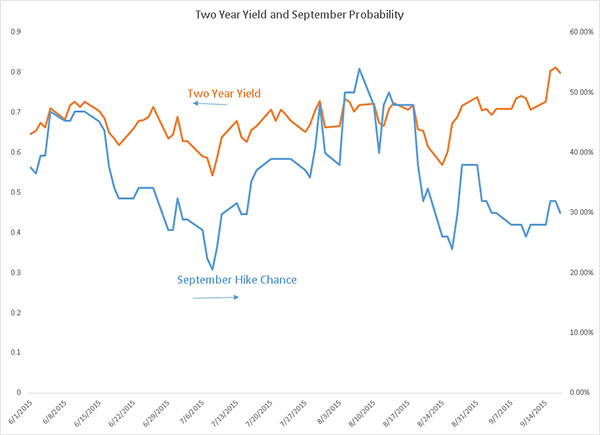
Whether the fed funds target is increased or not is obviously an indicator of monetary policy. A better reflection is the 2 year Treasury rate which is largely determined by expectations of the fed funds rate the fed will set over the next 2 years.  It is this 2 year Treasury rate that I will be watching as the market digests the Fed’s policy announcements and forecasts and Chair Yellen holds her press conference.

I think it likely that the 2 year will move contemporaneously with the fed funds rate.  If rates are not raised I’d expect the two year to fall and if they are raised, I’d expect it to rise.  But this is not certain.  A “hawkish” holding of the rate where the Fed moved towards locking in future increases could raise 2 year rates.  Conceivably but less likely a “one and done” type announcement could on balance lower expected rates and so 2 year yields.

The figure below shows that two year yields and the chance of a rate increase in September have mostly moved together but that very recently markets have started to anticipate policy tightening that is not rooted in a September fed funds hike.  I see a risk that the fed will not move this afternoon but will appease hawks with such firm language on future rate hikes that their overall impact will be contractionary.  This would be very unfortunate.

2YearVsProb

Fed faces a fork in the road over interest rates

On September 15, 2015, Summers talked with Chris Arnold of NPR’s All Thing’s Considered about the Fed’s upcoming decision on interest rates. Read more

Monetary policy should seek to avoid major surprises

In recent writings, I have laid out the strategic case against the Federal Reserve tightening this week. There is a compelling tactical case as well.

Monetary policy should seek to avoid major surprises.  Right now the fed funds futures market is assigning only a 28 percent chance to a September tightening. In the last 20 years, the Fed has never tightened without guiding the futures market to at least a 70 percent chance of a tightening.  So a move now, given how expectations have been managed, would be an extraordinary shock at a highly uncertain time.

To find a relevant precedent, one has to go back to 1994, when the Fed raised rates by 25 bps despite the market assigning only about a 30 percent chance (around what is expected now) of a tightening.  What followed was dubbed by Fortune Magazine as the Bond Market Massacre.”  Over the ensuing nine months, the interest rate on the 10-year bond rose by 2.2 percentage points — nearly twice as big an increase as any subsequently — with mortgage rates rising in tandem.   Volatility spiked dramatically across the world, and Orange County had the then-largest municipal bankruptcy in U.S. history.  Mexico and Argentina moved towards financial crisis.

There is a point here quite separate from the issue of what monetary policy should be.  Communication is a key part of the art of monetary policy.  The Fed for a generation has caused its tightening moves to be anticipated because it learned from the 1994 experience.   The same approach should be taken going forward.  Even if it were otherwise a good idea to tighten, no adequate predicate has been laid for a rate increase this week.


Why Ukraine’s debt deal is important not just for Ukraine, but for the West

I have spent the last two days in Kiev attending the Yalta European Strategy meeting, where I have had the chance to discuss Ukraine’s economic reform efforts with key officials, including the finance minister and prime minister.  I was encouraged to see a country where, despite huge challenges, including Russia’s war of aggression against Ukraine, economic reforms are being carried out and receiving support from the international community.

The Ukrainian parliament will this week vote on a historic debt reduction agreement that finance minister Natalie Jaresko negotiated with Ukraine’s private-sector creditors. The case for approval is overwhelming, both because Ukraine has made a good deal and because disapproving the deal would be catastrophic for Ukraine’s economy. But approval of the debt deal is only one component of the ambitious economic cooperation among Ukraine, Europe and the United States – cooperation that is essential to the geopolitical moment.

I have been watching debt negotiations closely for more than 30 years, since the Latin American crisis of the 1980s. Ukraine has gotten as good and fast a deal as any I have ever seen.

The deal has many virtues:

  • It reduces the principal value of Ukraine’s debt and eliminates principal payments for the next four years.
  • It unlocks substantial support from the International Monetary Fund and other international financial institutions on a large-scale.
  • It brings forward the day when Ukraine can attract significant private capital flows.
  • It establishes clear principles that will enable Ukraine to defer all principal payments on its obligation coming due to Russia.

Even if Ukraine’s economy does very well, the “value recovery instrument” issued as part of the debt deal, which aligns debt repayment with economic growth, is shrewdly designed so that the vast majority of future growth will still flow to the Ukrainian people, not to its creditors. This is because: (i) the instrument only kicks in at scale in a decade; (ii) it is subject to repurchase on the open market and to subsequent renegotiation; and (iii) it is carefully designed to ensure that only the initial benefit and not the continuing benefit of Ukraine’s growth flows to creditors.

In the unlikely event that Ukraine’s parliament disapproved the deal, all these benefits would be lost. International financial support would dry up as Ukraine would be seen as unable to carry through on commitments. Confidence in the stability of Ukraine’s currency and banking system would be put at risk. And its leverage vis-a-vis its debt to Russia would vanish.

So I hope and expect that the Ukrainian parliament will ratify the debt deal in the very near future. To paraphrase Churchill, this may not be the end, or even the beginning of the end of Ukrainian economic reform, but it may be the end of the beginning.

Make no mistake – the United States and Europe have an immense stake in Ukraine’s economic success. Our leaders rightly assert that military force is often not the right solution to international conflict. Enabling Ukraine to provide greater improvements in living standards for its citizens than Russia does would be a major triumph for the West. In this regard what we do for Ukraine is likely more important than what we do to Russia.

Support for Ukraine should not be seen as foreign assistance to a striving economic reformer, though it is that. Rather, with Ukraine invaded, support should be seen as investment in forward defense of core U.S. and European security interests. If Ukraine succeeds economically, investments will pay for themselves several times over as loans are paid back with interest, and as Russia’s government is both deterred by Ukraine’s stronger economy and pressured by its economic example.

Historians will wonder why the international community has invested more than 10 times as much money in supporting a recalcitrant Greece as in supporting a reforming Ukraine, since the start of their crisis.  Perhaps intra-European Union loans are in some special category, but as of this moment the IMF’s potential exposure to Greece is $41 billion compared to only $22 billion for Ukraine.

Now is the moment for Ukraine at long last to embrace the market and the rule of law.  It has the best, most market-oriented economic team in its history. And it is the time for global community to do whatever it takes—much more than is being done today—to provide support at a critical juncture.


Thoughts on Freeman’s Bargaining for the American Dream

Yesterday, I participated in a Center for American Progress forum where a new study on unions and social mobility was released. The study, by my Harvard colleague Richard Freeman and collaborators, showed a significant correlation across American metropolitan areas between the extent of union membership and social mobility. Freeman, who based his research on data in the famous studies of Raj Chetty and his collaborators, also showed that the children of union members earn higher wages and are healthier than other children.

This is important work. From Ted Cruz to Bernie Sanders, there is agreement across the political spectrum that equality of opportunity is an American ideal — that Thomas Jefferson was right in saying that America should be an aristocracy of talent. Yet equality of opportunity in the U.S., no matter how measured, lags behind other countries and certainly has not progressed over the last several decades.

Chetty’s celebrated “equal opportunity map,” reproduced below, shows that there are no grounds for fatalism. Different parts of the U.S. deliver very different levels of social mobility, while all in the same global economy, with the same technology, and the same increasing proclivity of able men and women to marry each other. There is nothing immutable about the existing inadequate level of equal opportunity.

Mobility

The map demonstrates that equality of opportunity is particularly bad in the old confederacy and particularly good in some of the old bastions of abolitionism. It is not therefore surprising that unions, which were concentrated in the North, turn out to be correlated with equal opportunity. More impressive is the research result that looking across families, fathers who are union members have children who earn at least 15 percent more than those who are not in union families, and that this stands up even with various control variables added. The implication is that supporting unions not only helps workers who are members themselves but also helps their children and communities as well.

Few people believe that private unions in the United States had excessive power in the 1970s. Yet the share of private sector workers in unions has fallen from over 24 percent in 1973 to under 7 percent today. Unions are surely too weak today. Their weakness most clearly shows up in workers who have difficulty maintaining a middle class lifestyle. In a more profound way, the weakness of unions leaves a broad swath of the middle class largely unrepresented in the political process, paving the way for the kind of disillusionment that has driven the Trump candidacy. After all, no society is going to remain stable and confident in its central institutions if parents do not believe their kids can lead better lives than they did.

In 2009, at the Brookings Institution, I spoke about the important role of unions in generating broadly shared growth. I said, “If we want to propel this economy forward and we want to have a sound expansion, it has to be an expansion whose benefits are more broadly shared. And that goes to the question of tax policy and progressivity, it goes to the question of education over the longer term, and it goes to the question of having a healthy and well-functioning trade union movement.”

Broadly shared prosperity is even more elusive today, so what is needed going forward? I would suggest three important steps.

First, we need serious enforcement of laws to stop employers from punishing workers seeking to engage in collective action. Enforcement has historically lagged badly as it typically takes at least four and often as many as seven years for cases to be decided. And even if employers are eventually found guilty of violating the rules, the penalty is generally under $10,000 per harmed worker. Anti-union employers can violate the law with near-impunity worrying only about slaps on the wrist years in the future. As Morris Kleiner and David Weill found: “expected costs [for being found guilty of violating labor laws] represent a fraction of the benefits to employers … from thwarting organizing drives. It is therefore not surprising that there has been a sevenfold increase in the percentage of violations of the act”.[1. Kleiner and Weill, EVALUATING THE EFFECTIVENESS OF NATIONAL LABOR RELATIONS ACT REMEDIES: ANALYSIS AND COMPARISON WITH OTHER WORKPLACE PENALTY POLICIES, NBER Working Paper 16626]

Second, the union movement needs to expand on its efforts to build models of collective action that are not rooted in traditional command and control corporation. This may include increased emphasis on profit sharing, on labor management dialogue, on industry wide bargaining, and many other ideas as well. Organized Labor needs to adapt to the pervasiveness of white collar, pink collar, and no collar work in addition to traditional blue collar work.

Third, there is a compelling case even if it does not appear politically realistic right now for labor law reform to give more scope to those seeking to organize workers. There are detailed agendas of possible reform. What is important now is that a consensus form around the idea of reducing burdens on union organizers.

Thanks to the work of Freeman and his collaborators, we now know that stronger unions are not just good for their members, they are good for our country and our descendants. Strengthening collective worker voice has to be an important component of any realistic American inclusive growth agenda.


Rate hike doesn’t seem a prudent risk to take

In an interview on CNBC’s Squawk on the Street on September 10, 2015, Summers said a rate hike isn’t a prudent risk to take. He told CNBC, the Fed can reverse course in seven weeks if it regrets its decision not to raise rates. Read more

Why the Fed must stand still on rates

Two weeks ago I  argued that a Federal Reserve decision to raise rates in September would be a serious mistake.  As I wrote my column, the market was assigning a 50 percent chance to a rate hike. The current chance is 34 percent. Having followed the debate among economists, Fed governors and bank presidents I believe the case against a rate increase has become somewhat more compelling even than it looked two weeks ago.

Five points are salient.

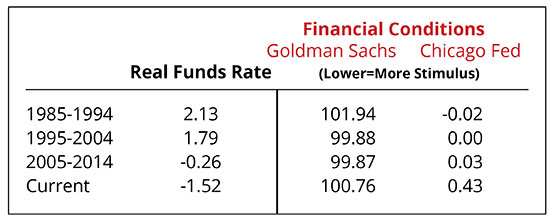
First, markets have already done the work of tightening.  The U.S. stock market is worth $700 billion less than it was 2 weeks ago and credit spreads have widened noticeably.  Financial conditions as measured by Goldman Sachs or the Chicago Fed index have tightened in the last 2 weeks by the impact equivalent of more than a 25 BP tightening.  So even if resisting inflation required a 25 BP tightening as of two weeks ago, this is no longer the case.

The figure below makes a crucial point.  It shows that even though the federal funds rate is very low (negative one and a half percent after adjusting for inflation), financial conditions are helping the economy less than in previous years when interest rates were much higher.

Conditions

Second, the data flow suggests a slowing in the U.S. and global economies and reduced inflationary pressures.   Employment growth appears to have slowed down, commodity prices have fallen further, and the general data flow has been on the soft side.  Comprehensive measures of data surprises, such as the Bloomberg Economic Surprise Index, bear out this impression and the Atlanta Fed’s GDP Now model is currently predicting only 1.5% growth in Q3.

Third, the case for concern about inflation breaking out is very weak.  Market based expectations suggest that inflation over the next decade on the Fed’s preferred core pce basis is near record lows and well below 2 percent.  The observation that 5 year inflation, 5 years from now is expected to be below target calls into question arguments that current low inflation is somehow transitory.

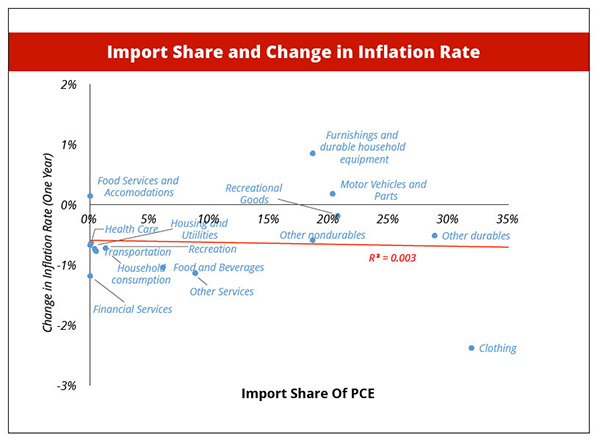
The recent analysis presented by Fed Vice Chair Stanley Fischer asserting to the contrary relies on assumptions about exchange rates and inflation.  When actual empirical estimates are used his conclusions are substantially weakened.  Indeed as the figure below shows, there is no correlation of late between deceleration in inflation and import share looking across PCE components.InflationAndImportSharePCE.xlsx

Also on inflation, it bears emphasis that (i) we have some room for inflation acceleration (ii) prices are now fully 2 percent below a 2 percent inflation path taking off from 2010, (iii)  the Phillips curve is so unstable that it provides little basis for predicting inflation acceleration.  To take just two examples — first, unemployment among college graduates is 2.5 percent yet there is no evidence that their wages are accelerating. And unemployment in Nebraska has been below 4 percent for the last 3 years and growth in average hourly earnings has been basically constant at the national average level.

Fourth, arguments of the “one and done” variety or arguments that the Fed can safely raise rates by 25 BP as long as it’s clear that there is no commitment to a series of hikes are specious. If as some suggest a 25 BP increase won’t affect the economy much at all, what is the case for an increase? And when the same people argue that 25 BP will have little impact and that it is vital to get off the zero rate floor, my head spins a bit.

In a highly uncertain world, the Fed cannot be both data dependent and predictable with respect to its future actions. Much better that it stick with data dependence than that it put its credibility at risk by seeking to mitigate a current rash action by trying to reassure with respect to future steps.

I understand the argument that zero rates are a sign of pathology and the economy is no longer diseased so policymakers have to increase rates.  The problem is that the case for hitting the brakes in an economy with sub-target inflation, employment and output is not there; regardless of whether the brakes are to going to be pressed hard or softly, singly or multiple times.

From the Vietnam War to the Euro crisis, from the Iraq war to the lessons of the Depression we surely should learn that policymakers who elevate credibility over responding to clear realities make grave errors.  The best way the Fed can maintain and enhance its credibility is to support a fully employed American economy achieving its inflation target with stable financial conditions.  The greatest damage it could do to its credibility would be to embrace central banking shibboleth disconnected from current economic reality.

Fifth, I believe that conventional wisdom substantially underestimates the risks in the current moment.  It bears emphasis that not a single post war recession was a predicted a year in advance by the Fed, the Federal government, the IMF or a consensus of forecasters.  Most were not recognized till long after they started.  And if history teaches anything it is that financial interconnections are pervasive and not apparent till it’s too late.   Russia’s 1998 default, problems in subprime lending, and the Asian financial crisis were all moments when financial dislocations had far more pervasive effects than was generally expected.

We know that the world’s largest economy, China, is in its most uncertain state since it began economic reform in 1979 and may well be experiencing a larger volume of capital flight than any economy in history.  We know that the central banks  of Japan and Europe are likely to have to double down in the months ahead on already extraordinary quantitative easing.  We know that American households, firms and markets are processing what appears to a kind of “reverse 1990s” moment of sharply decelerating productivity growth.  We know that liquidity conditions in markets have worsened and there is at least some reason to believe that “positive feedback” trading strategies where investors sell when prices go down may well have become increasingly important.  We know the current U.S. recovery is in its 7th year and that confidence in public institutions is at a low ebb.

More likely than not, these fears are overblown and 2015 and 2016 will not go down in financial history.  If so, and the Fed does not act, inflation will start to accelerate, volatility will subside and policy can step in.  Regret may come in the form of inflation a few tens of basis points too high or a bit of euphoric relief in markets.  If on the other hand, some portion of these fears are warranted and the Fed tips towards tightening, it risks catastrophic error.

Now is the time for the Fed to do what is often hardest for policymakers.  Stand still.

September 9, 2015


Larry’s new blog

Over the summer, I have expanded my website to include a new blog that will enable me to comment on economic policy issues and current events more generally.  I will continue to write my monthly Financial Times/Washington Post column, and their websites will also feature my blog content.  This blog will enable me to address issues immediately, informally, and at varying lengths and to pose questions that I think economists have inadequately considered.   It will also provide an opportunity to disseminate various commentaries and discussions that I present at conferences.

As I have often noted, policymakers in political environments are most constructive when they find approaches that are appealing from a variety of perspectives and command widespread support.  Academics, on the other hand, are most useful when they provoke thought and debate and present new approaches.  In that spirit, I will regard this venture as successful only if it incites disagreement and debate.  My goal will often be to expose fallacy or misguided opinion.  However, I shall never try to impugn the motives of those with whom I disagree.

Comments and questions are welcome, but we will only be able to select a few to post with each blog.  I may, from time to time, respond to questions or comments in a new blog posting, but will not be able to respond to each individual comment received.

I hope you will find some interesting ideas in this new blog and share it with your colleagues and friends.

Larry

Thoughts on Ukrainian Debt Restructuring

I was very glad to see Ukraine reach a deal involving reduction in the principal value of its debt with major creditors. This would not have happened without the tenacity and determination of Ukrainian finance minister, Natalie Jaresko, and Ukraine’s political leadership. Congratulations also to the IMF and the U.S. Treasury for their strong efforts. Read more

The Fed looks set to make a dangerous mistake

August 23, 2015

Raising rates this year will threaten all of the central bank’s major objectives

Will the Federal Reserve’s September meeting see US interest rates go up for the first time since 2006? Officials have held out the prospect that it might, and have suggested that — barring major unforeseen developments — rates will probably be increased by the end of the year. Conditions could change, and the Fed has been careful to avoid outright commitments. But a reasonable assessment of current conditions suggest that raising rates in the near future would be a serious error that would threaten all three of the Fed’s major objectives — price stability, full employment and financial stability.

Like most major central banks, the Fed has put its price stability objective into practice by adopting a 2 per cent inflation target. The biggest risk is that inflation will be lower than this — a risk that would be exacerbated by tightening policy. More than half the components of the consumer price index have declined in the past six months — the first time this has happened in more than a decade. CPI inflation, which excludes volatile energy and food prices and difficult-to-measure housing, is less than 1 per cent. Market-based measures of expectations suggest that, over the next 10 years, inflation will be well under 2 per cent. If the currencies of China and other emerging markets depreciate further, US inflation will be even more subdued.

Tightening policy will adversely affect employment levels because higher interest rates make holding on to cash more attractive than investing it. Higher interest rates will also increase the value of the dollar, making US producers less competitive and pressuring the economies of our trading partners.

This is especially troubling at a time of rising inequality. Studies of periods of tight labour markets like the late 1990s and 1960s make it clear that the best social programme for disadvantaged workers is an economy where employers are struggling to fill vacancies.

There may have been a financial stability case for raising rates six or nine months ago, as low interest rates were encouraging investors to take more risks and businesses to borrow money and engage in financial engineering. At the time, I believed that the economic costs of a rate increase exceeded the financial stability benefits, but there were grounds for concern. That debate is now moot. With credit becoming more expensive, the outlook for the Chinese economy clouded at best, emerging markets submerging, the US stock market in a correction, widespread concerns about liquidity, and expected volatility having increased at a near-record rate, markets are themselves dampening any euphoria or overconfidence. The Fed does not have to do the job. At this moment of fragility, raising rates risks tipping some part of the financial system into crisis, with unpredictable and dangerous results.

Why, then, do so many believe that a rate increase is necessary? I doubt that, if rates were now 4 per cent, there would be much pressure to raise them. That pressure comes from a sense that the economy has substantially normalised during six years of recovery, and so the extraordinary stimulus of zero interest rates should be withdrawn. There has been much talk of “headwinds” that require low interest rates now but this will abate before long, allowing for normal growth and normal interest rates.

Whatever merit this view had a few years ago, it is much less plausible as we approach the seventh anniversary of the collapse of Lehman Brothers. It is no longer easy to think of economic conditions that can plausibly be seen as temporary headwinds. Fiscal drag is over. Banks are well capitalised. Corporations are flush with cash. Household balance sheets are substantially repaired.

Much more plausible is the view that, for reasons rooted in technological and demographic change and reinforced by greater regulation of the financial sector, the global economy has difficulty generating demand for all that can be produced. This is the “secular stagnation” diagnosis, or the very similar idea that Ben Bernanke, former Fed chairman, has urged of a “savings glut”. Satisfactory growth, if it can be achieved, requires very low interest rates that historically we have only seen during economic crises. This is why long term bond markets are telling us that real interest rates are expected to be close to zero in the industrialised world over the next decade.

New conditions require new policies. There is much that should be done, such as steps to promote public and private investment so as to raise the level of real interest rates consistent with full employment. Unless these new policies are implemented, inflation sharply accelerates, or euphoria in markets breaks out, there is no case for the Fed to adjust policy interest rates.

The writer is the Charles W Eliot university professor at Harvard and a former US Treasury secretary