Harvard, Israel, and Academic Freedom

This past week I delivered a lecture at Columbia University on academic freedom and anti-Semitism.  I argued that it is the essence of academic freedom that all members of our community can hold whatever views they wish and express them freely. But it is equally the essence of academic freedom that universities as institutions must avoid acting in a way that suggests that they endorse any one position in a political controversy. Read more

Global economy, oil prices and innovation

On January 30, 2015, Summers talked with Maria Bartiromo on FOX’s Opening Bell about the global economy, oil prices and innovation among students.
Read more

Academic Freedom and Anti-Semitism

Summers gave a speech to inaugurate the forum on academic freedom at Columbia Center for Law and Liberty on January 29, 2015.  In his speech, he said, “Academic freedom is essential if universities are to succeed in their missions of creating and disseminating knowledge.”   Read more

Growing concerns about the sense of stagnation

In an interview on the Charlie Rose Show on January 29, 2015, Summers discussed the growing concerns about the sense of stagnation. Summers told Rose, “we are in unchartered territory in regards to the global economy, with problems with lack of demand, deflation that’s too low, central banks that have trouble being activists and too much savings.” Read more

President Obama’s economic proposals

At Davos: Challenges before the ECB

Summers discusses the challenges before the European Central Bank and explains why he sees Europe on its way to being the next Japan. He spoke to Bloomberg TV from the World Economic Forum in Davos, Switzerland on January 21, 2015. Read more

FT Video: Make the middle class a priority

Summers talked with FT editor, Lionel Barber, on January 19, 2015 about the Inclusive Prosperity report, why economic growth has been hampered and whether ECB action can lift middle-class incomes.

London School of Economics podcast

Listen to the podcast here

Focus on growth for the middle class

January 18, 2015

The most challenging economic issue ahead of us involves a group that will barely be represented at this week’s annual Davos summit: the middle classes of the world’s industrial countries. As the Center for American Progress’s Inclusive Prosperity Commission, which I co-chaired with Ed Balls, the top economic official in Britain’s Labor Party, concludes in a new report, nothing is more important to the success of industrial democracies than sustained increases in wages and living standards for working families.

Amid the focus on global finance, geopolitics and the moral imperative to help the world’s poor, no one should lose sight of the fact that without substantial changes in policy, the prospects for the middle class globally are at best highly problematic.

First, the economic growth that is a necessary condition for rising incomes is threatened by the specter of secular stagnation and deflation. In the United States, 2014 was expected to be one of rising interest rates along with acceleration of growth, the end of quantitative easing and the approach of tightened monetary policy. In Japan, prices were to start rising again. In Europe, the year was to bring continued economic reform and normalization.

In fact, 10-year Treasury rates have fallen by more than 1 percentage point in the United States and are only half as high in Germany and Japan as they were a year ago. In a number of major countries, including Germany, France and Japan, short-term interest rates are now negative, with lenders to governments forced to pay for the privilege. Such low interest rates suggest a chronic excess of saving over investment and the likely persistence of conditions that make monetary policy ineffective in Europe and Japan, along with their possible reemergence in the United States. Market indicators almost everywhere suggest that inflation is expected to be well below the target rate for a decade.

The world has largely exhausted the scope for central bank improvisation as a growth strategy. Excess demand, inflation, excessive credit and the need for monetary tightening are the least of our concerns. Central banks still have to do their part, but it is time for concerted and substantial measures to raise both public and private investment.

Second, the capacity of our economies to sustain increasing growth and provide for rising living standards is not assured on the current policy path. The United States is often held out as a model, and indeed its performance has been strong by global standards. The United States has enjoyed growth of about 11 percent over the past five years. Of this, standard economic calculations suggest that about 8 percent can be regarded as cyclical, resulting from the decline in the unemployment rate. That leaves just 3 percent over five years as attributable to growth in the economy’s capacity. Even after our recovery, the share of American men age 25 to 54 who are out of work exceeds that in Japan, France, Germany and Britain.

Demand issues aside, growth prospects are worse in Europe and Japan, where adult populations are shrinking and ageing and economic dynamism is subsiding. A significant part of the sharp downward revisions in the estimated potential of industrial economies is a consequence of the recession conditions of recent years. In many ways, strong growth is itself the best structural policy for promoting growth as investment rises, workers gain experience and so forth. But more must be done.

Third, if it is to benefit the middle class, prosperity must be inclusive, and in the current environment this is far from assured. If the United States had the same income distribution it had in 1979, the bottom 80 percent of the population would have $1 trillion — or $11,000 per family — more. The top 1 percent would have $1 trillion — or $750,000 — less. There is little prospect for maintaining international integration and cooperation if it continues to be seen as leading to local disintegration while benefiting a mobile global elite.

The focus of international cooperative efforts in the economic sphere must shift. Considerable progress has been made in trade and investment. Less has been made in preventing races to the bottom in areas such as taxation and regulation. Only with enhanced international cooperation will the maintenance of progressive taxation and adequate regulatory protection be possible. And only if ordinary citizens see benefit in an ever more open global economy will it come about.

These three concerns — secular stagnation and deflation, slow underlying economic growth and rising inequality — are real. But they are not grounds for fatalism. The experience of many countries, including Canada and Australia in this century, and many eras shows that sustained growth in middle-class living standards is attainable. But it requires elites to recognize its importance and commit themselves to its achievement. That must be the focus of this year’s Davos.

The writer is Charles W Eliot university professor at Harvard and a former US Treasury secretary


NYTimes: Trying to solve the great wage slowdown

The Upshot

By DAVID LEONHARDT

JANUARY 15, 2015

After almost 15 years of a disappointing economy, it’s easy to get pessimistic. Incomes for the middle class and poor have now been stagnating over a two-term Republican presidency and well into a two-term Democratic one. The great wage slowdown of the 21st century has frustrated Americans, polls show, and raised serious questions about what kind of policies, if any, might change the situation.

Yet if you look around the world, you can find reasons for hope.

While wages and incomes have stagnated in the United States (as well as in Japan and large parts of Europe), they have not done so everywhere. In Canada, a broad measure of incomes has risen about 10 percent since 2000, even as it’s fallen here. In Australia, it’s up 30 percent.

These aren’t just any countries, either. They’re among those most similar to the United States: far-flung, once ruled by Britain, with a frontier culture and a commitment to capitalism. Though Australia and Canada obviously are not identical to the United States, it certainly seems worth asking what they’re doing differently.

Read the full article here.

Inclusive Prosperity Commission

The Inclusive Prosperity Commission, co-chaired by Lawrence H. Summers, released a new report on January 15, 2015 that offers bold new prescriptions to reinvigorate the middle class and reduce income inequality.  Summer said, “No industrial democracy will succeed unless its middle class enjoys sustained growth in living standards. This depends not only on strong economic growth but also on assuring that its benefits are widely shared.”   Read more

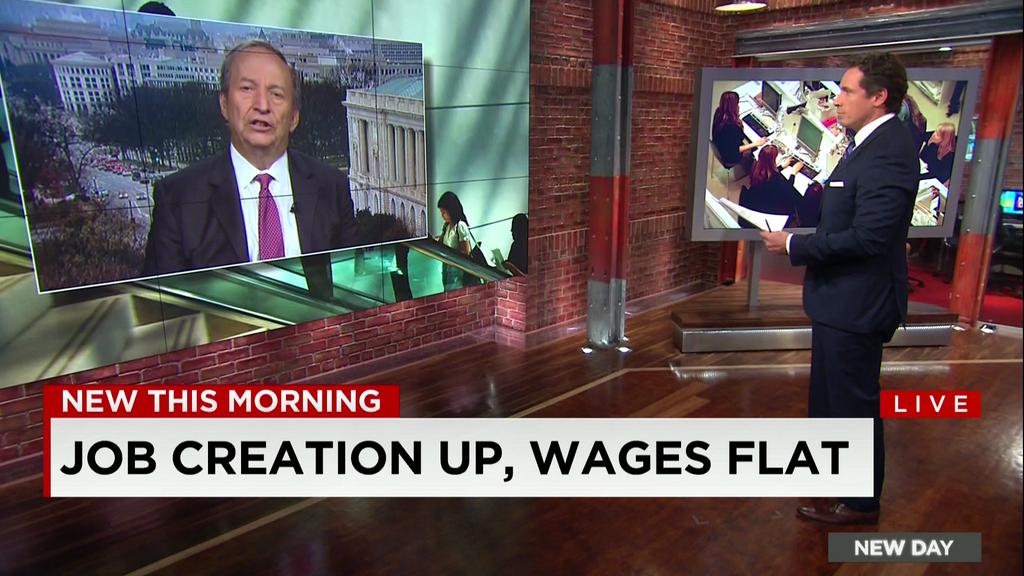
Job creation up, wages flat

Embedded image permalink

Response to Marc Andreessen on Secular Stagnation

Marc Andreessen’s thoughtful “Tweetstorm” on secular stagnation raises a number of important questions.  We are in agreement that the essence of the secular stagnation issue is not whether technology has stopped advancing; but rather whether there is a mismatch between desired saving and investment opportunities that results in low equilibrium real interest rates, precipitates financial instability, and may inhibit economic growth. Here I respond to his specific questions and criticisms regarding the secular stagnation hypothesis: Read more

U.S. economy is not growing fast enough

In an interview on January 9, 2015 with CNBC’s Squawk Box, Summers said while American economic growth is getting better and leads the rest of the world, investments need to be made to get the economy stronger. “Confidence is the cheapest form of stimulus,” he said. Read more

Let this be the year when we put a proper price on carbon

January 4, 2015

The fall in oil prices and declines in other energy prices make the case for a tax overwhelming

The case for carbon taxes has long been compelling. With the recent steep fall in oil prices and associated declines in other energy prices it is overwhelming. There is room for debate about the size of the tax and about how the proceeds should be deployed. But there should be no doubt that starting from the current zero tax rate on carbon, increased taxation would be desirable.

The core of the case for taxation is the recognition that those who use carbon-based fuels or products do not bear all the costs of their actions. Carbon emissions exacerbate the global climate change problem. In many cases they contribute to local pollution problems which immediately harm human health. Removing fossil fuels from the ground involves both accident risks and environmental challenges. And even with the substantial increases in US oil production we remain a net importer, so increases in consumption raise our dependence on Middle East producers.

When we drive our cars, heat our homes or use fossil fuels in more indirect ways, all of us create these costs without paying for them. It follows that we overuse these fuels. This is not some kind of government planning argument — it is the logic of the market: that which is not paid for is overused. Even if the government had no need or use for revenue, it could make the economy function better by levying carbon taxes and rebating the revenues to society.

While the recent decline in energy prices is a good thing in that it has on balance raised the incomes of Americans, it does exacerbate the problem of energy overuse. The benefit of imposing carbon taxes is therefore enhanced.

On the other side of the ledger, there has always been the concern that raising carbon taxes would place an unfair burden on some middle- and low-income consumers. Those who drive long distances to work, say, or who have homes that are expensive to heat would be disproportionately burdened. Now these groups have received a windfall from the drop in energy prices so it would be possible to impose substantial carbon taxes without them being burdened relative to where prices stood six months ago. As an example, the price of petrol has fallen by over $1 per gallon. A $25 a ton tax on carbon that would raise over $1tn during the next decade would lift petrol prices by only about 25 cents.

Some worry that taxing fossil fuels will hurt the competitiveness of US industry and encourage offshoring. In fact a well designed tax would be levied on the carbon content of all imports coming from countries that did not impose their own carbon levies. The US should insist that its tax is compatible with World Trade Organisation rules. It would have the virtue of encouraging countries who wished to avoid the US tax to impose carbon taxes of their own, thereby further supporting efforts to reduce global climate change.

A US carbon tax would contribute to efforts to combat climate change in other ways. It would be a hugely important symbolic step ahead of the global climate summit in Paris late this year. It would shift the debate towards harmonised measures to raise the price of carbon use and away from the complex cap-and-trade type systems that in the EU and elsewhere have proven more difficult to operate than expected.

What size levy is appropriate? Here there is more danger of doing too little than too much. Once the principle of taxation is accepted its level can be adjusted. A tax of $25 a ton would raise well over $100bn each year and seems a reasonable starting point.

How should the proceeds be used? Here too it seems more important to reach consensus on the principle of taxation. My preference would be for the proceeds to be split between investments in infrastructure and pro-work tax credits. An additional $50bn a year in infrastructure spending would be a significant contribution to closing America’s investment gap in that area. The same sum devoted to pro-work tax credits could finance a huge increase in the earned income tax credit, a meaningful reduction in the payroll tax or some combination of the two.

Progressives who are concerned about climate change should rally to a carbon tax as the most important step for mobilising against it. Conservatives who believe in the power of markets should favour carbon taxes on market principles. And Americans who want to see their country lead on the energy and climate issues that are crucial to the world this century should want to be in the vanguard on carbon taxes. Now is the time.

The writer is Charles W Eliot university professor at Harvard and a former US Treasury secretary

Asiaphoria Meets Regression to the Mean

In an NBER working paper, published with Lant Pritchett in October 2014, Summers writes, “consensus forecasts for the global economy over the medium and long term predict the world’s economic gravity will substantially shift towards Asia and especially towards the Asian Giants, China and India. While such forecasts may pan out, there are substantial reasons that China and India may grow much less rapidly than is currently anticipated.   Read more

Crumbling infrastructure is a sign of lost collective faith

December 7, 2014

The only answer is prompt and aggressive responses to failure

Take a walk from the US Air Shuttle in New York’s LaGuardia airport to ground transportation. For months you will have encountered a sign saying “New escalator coming in Spring 2015”. Or take the Charles River at a key point separating Boston and Cambridge which is little more than 100 yards wide. Traffic has been diverted to support the repair of a major bridge crossing the river for more than two years, and yet work is expected to continue into 2016.

The world is said to progress but things that would once have seemed easy now seem hard. The Rhine river is much wider than the Charles yet General George Patton needed just a day to build bridges that permitted squadrons of tanks to get across it. It will take almost half as long to fix the escalator in LaGuardia as it took to build the Empire State building 85 years ago.

Is it any wonder that the American people have lost faith in the future and in institutions of all kinds? If rudimentary tasks such as keeping escalators going and bridges repaired are too much to handle, it is little surprise that disillusionment and cynicism flourish.

Political debates are often framed in terms of the respective roles of the public and private sector with progressives stressing the importance of private market failure and conservatives stressing the dysfunctionality of the public sector. The sad truth is that there is merit in both arguments.

The escalator that will take five months to repair is privately owned. Although it is in an airport, failure cannot be blamed on public authorities. Necessary maintenance had been delayed for years — with the escalator in question even being stripped for spare parts to support other escalators. Now the new owner has many priorities; the replacement of the escalator system is only one.

On the other hand, repair of the bridge across the Charles River is the responsibility of local governments. A combination of budgetary short sightedness, excessively rigid labour practices, and a failure to take account of the costs of traffic delays appears to account for the project’s remarkably long gestation period.

While much of the political debate takes place on a macro level, focusing on large scale changes in spending, tax or regulatory policies, I suspect that much of what frustrates the public happens on a more micro scale.

A government that has to install safety nets under bridges to catch failing debris will not inspire when it aspires to rebuild other nations.

When big companies are cannibalising their machinery for spare parts, it is hardly surprising that they are not trusted to embark on voluntary long run programmes to control greenhouse gases, promote diversity or develop new technologies.

What is to be done? First, the focus of infrastructure discussions in both the public and the private sector needs to shift from major new projects whose initiation and completion can be the occasion for grand celebration to more prosaic issues of upkeep, maintenance, and project implementation.

For example, before anyone contemplates spiffy new high-speed railway systems, careful consideration should be given to repairing existing rail lines and stations.

Second, accountants in the public and private sector need to develop methodologies for capturing deferred maintenance and showing this in the financial accounts for what it is — borrowing from the future. What is counted counts and so if maintenance deferrals were made transparent they would become much more expensive for decision makers.

Third, the public and the media on their behalf need to be much less accepting of institutional failure. It has been said that we do not want to know all to which we can become accustomed. A vicious cycle in which governments perform poorly and so are starved of resources and so perform worse is serious threat to healthy democracy.

Something similar can happen to business. If owners distrust management they will insist on taking cash out rather than permitting its use for long term investment. The only answer is prompt and aggressive responses to failure that ensure that it is shortlived.

More important than any specific remedy, there is a reason beyond the media and the public’s own economic problems why there is so much disillusionment with so many institutions. They do not seem to perform as well as they once did. We see it every day.

Fixing escalators and building bridges may seem like small stuff at a time of economic crisis and geopolitical instability. But it is time we recognise the importance of what may seem small to what is ultimately important — the faith of citizens in their collective future.

The writer is Charles W Eliot university professor at Harvard and a former US Treasury secretary


TIME: What I’m Thankful For

As I am thankful for my family and its tradition of loving argument, I am thankful for the privilege of living in and serving a nation grounded in a commitment to reasoned discourse.  Read more

Why Larry Summers sees danger ahead for the economy

Like British Prime Minister David Cameron, Larry Summers sees warning lights flashing on the world’s economic dashboard. Summers, who served through 2010 as President Obama’s top economic adviser and was Treasury Secretary under Bill Clinton, said America should be acting now to shore up its economy, instead of celebrating its status as the healthiest patient in the global economic sick ward.

For starters, Summers said in an interview Tuesday: We should invest in public infrastructure, including energy infrastructure. Including oil pipelines.

Does that include the Keystone XL oil sands pipeline, a project that the Senate is voting on Tuesday — and one that has drawn little enthusiasm from the White House?

Yes, he said. “I suspect we should do the Keystone pipeline if it is still the relevant pipeline — which is very much in doubt. We certainly should not stand in the way of the Keystone pipeline,” Summers said. “We should be trying to use this moment to maximize use of our energy resources.”

Summers has voiced support for Keystone before, including in a September speech at the Brookings Institution. But building oil pipelines isn’t the only thing Summers thinks we should be doing. We should be lifting decades-old restrictions on energy exports, he said, and building up our ports to handle the traffic. We should be updating an air traffic control system that, he said, “runs on vacuum tubes.”

“There is an enormous amount of work that needs doing,” Summers said, to “put people to work in the short run and raise the efficiency of the economy in the medium and the long run.”

“What we need is a focused a growth strategy that recognizes the importance of generating healthy demand rather than a strategy that either accepts the lack of demand or tries to generate demand by driving down interest rates beyond extraordinary lows,” Summers said.

When told that he sounds frustrated with both Democratic policymakers and Republican ones, Summers said: “That was the way I intended to sound.”

For at least a year — long before Cameron warned of another looming economic disaster in Monday’s Guardian newspaper — Summers has been ringing alarm bells about the need for national governments, including the U.S. government, to prop up demand and stimulate economic activity.

With Europe stagnant, China cooling and Japan, Russia and Brazil dogged by recession, Summers — who removed himself from the running for Federal Reserve chairman last year — argues that we should forget about the national debt and start taking advantage of abnormally low interest rates to borrow and spend on worthwhile investments that will boost growth now and in the future.

That idea is unlikely to gain much traction on Capitol Hill, where resurgent Republicans are still focused on cutting spending. But Summers says we should be doing other things, too, such as promoting immigration and overhauling the business tax code, ideas with bipartisan support.

Why? Because, he warns,  if Europe falls into the same kind of prolonged slump that has plagued Japan for the past 20 years — a real possibility, economists say — America’s ability “to maintain enough demand to support the global economy will be very much in doubt.”

Japan, which slipped back into its fourth recession in six years on Monday, hasn’t had “a moment of dramatic crisis,” Summers said. Instead, it’s had a generation of “prolonged sluggish and disappointing performance. And that’s the risk that may be ahead for large blocs of the global economy.”

We play with fire if we skimp on public health

November 10, 2014

Epidemics and pandemics are like earthquakes. Tragic, inevitable and unpredictable. It starts as a random event. A virus jumps species from a bird, bat, or other animal to “Patient Zero” – who passes it on to other human beings. More likely than not, over the course of this century we will face an influenza pandemic similar to the one in 1918 that killed 50m people.

President Barack Obama’s first chief of staff, Rahm Emanuel, said in the wake of the global economic meltdown that “you never let a serious crisis go to waste”. Crises are opportunities to learn. They point to measures that will prevent the collapse of institutions when they are under extreme pressure.

While the focus is understandably on responding to the Ebola crisis, it is equally important that it serves as a wake-up call with respect to inadequacies that threaten not just tragedy on an unprecedented scale but the basic security of the US and other wealthy nations. As with climate change, no part of the world can insulate itself from the consequences of epidemic and pandemic.

The report of the Global Health 2035 commission, which I co-chaired, points up three crucial lessons. First, collective action must be taken to build strong health systems in every corner of the globe. In west Africa, Ebola was a “stress test” on national health systems, and in Sierra Leone, Liberia and Guinea the systems could not cope. There were too few trained health professionals; there was also too little equipment and too few supplies, and too little capacity for public health surveillance and control.

Nigeria’s containment of the virus after the first case was diagnosed in July is instructive. Its success, hailed by the World Health Organisation as a piece of “world class epidemiological detective work”, is explained by its aggressive, co-ordinated surveillance and control response. It already had a polio surveillance system, with skilled outbreak specialists who were quickly put to work tackling Ebola. While much of Nigeria’s health system, such as primary care services, remains very weak, on Ebola the surveillance and control system worked.  Every country needs this kind of system. Prevention is cheaper than cure and leads to better outcomes.

Building these systems takes time and money. Our research, conducted with an international team of economists and health experts, and published last year in the medical journal The Lancet, suggests that the price of this “systems strengthening” would be about $30bn a year for the next two decades. The good news is that we have the financing to pay for this through a combination of aid and domestic spending. The cost represents well under 1 per cent of the additional gross domestic product that will be available to low- and lower-middle-income countries due to increased GDP growth over the next 20 years.

The second lesson is that the lack of investment in public health is a global emergency. The WHO’s slow response to Ebola was not surprising, given its recent staff cuts. For that, we all share the blame. Since 1994, the WHO’s regular budget has declined steadily in real terms. Even before the Ebola crisis, it struggled to fund basic functions. The entire budget for influenza was just $7*7m in 2013 – less than a third of what New York City alone devotes to preparing for public health emergencies.

It takes just one infected airline passenger to introduce an infection into a country. We need the WHO more than ever. It alone has the mandate and legitimacy to serve as a health protection agency for all countries, rich and poor. Starving it of funds is reckless.

The third lesson concerns scientific innovation. When it comes to discovering and developing medicines, vaccines and diagnostic tests, we have been largely ignoring the infectious diseases that disproportionately kill the world’s poor. Consequently, we still have no medicines or vaccine for Ebola. All we can do is provide basic life support, such as fluids and blood pressure treatment . For prevention, we have to rely on old-fashioned measures such as quarantine.

Margaret Chan, WHO’s director-general, has explained the reason for this neglect. Doctors were “empty-handed”, she said, because “a profit-driven industry does not invest in products for markets that cannot pay”. Ebola affects poor African nations, so drug companies see no profit in working on it. No society will allow companies to reap huge profits when disease is spreading rapidly.

Rich governments and donors need to step up. Investing several billion dollars a year, less than 0.01 per cent of global GDP, could be decisive in preventing tragedy on the scale of world war.

Some issues are more important than recessions and elections. Ebola is a tragedy. Let us hope that it will also be a spur to taking the necessary steps to prevent the far greater one that is nearly inevitable on the current policy trajectory. The next Ebola is just around the corner.
The writer is Charles W Eliot university professor at Harvard and a former US Treasury secretary. Dr Gavin Yamey, University of California contributed to this piece.