
Fair, comprehensive tax reform is the right path forward
By Natasha Sarin and Lawrence H. Summers
March 29, 2019
Part Two
Over the last several weeks, we have paid careful attention to tax proposals by Representative Alexandria Ocasio-Cortez of New York, for a 70 percent marginal tax rate on top earners, and by Senator Elizabeth Warren of Massachusetts, for a wealth tax on those worth more than $50 million.
We share the lawmakers’ enthusiasm for progressive taxation that ensures that the wealthiest pay their fair share. But we believe that base-broadening, efficiency enhancing reforms are the right way to start raising revenue from the ultrarich. As Part One of this series illustrates, closing tax shelters alone raises more revenue than Ocasio-Cortez’s proposal. And our base-broadening reforms — rolling back President Trump’s tax plan, increasing tax compliance by the rich, closing shelters, eliminating stepped-up basis and deductions for the wealthy, and broadening the estate tax base — together raise more revenue than the wealth tax is estimated to. Most of these measures would be desirable even if they did not raise revenue, because they would improve investment efficiency and correspond to the basic notion of fairness: If two people are similarly situated economically, one of them should not be able to pay substantially less tax because of cheating or taking advantage of quirks in the law. In contrast, rate increases or wealth-tax proposals are unlikely to increase the efficiency of the economy.
Issues with using the wealth tax or rate hikes to curtail political power
Some argue for punitive taxation of the wealthy because the concentration of wealth leads to a concentration of political power. Professors Gabriel Zucman and Emmanuel Saez, who have played a major role in validating the wealth tax, advocate this view. They suggest that “high tax rates for sky-high incomes do not aim at funding Medicare for All” and instead “aim at preventing an oligarchic drift.” But framing tax policies as attacks on the wealthy rather than as ways of raising revenue is problematic on multiple levels.
We have sympathy with complaints that economic policy decision-making gives too much weight to the interests of affluent elites. But we are skeptical that large rate hikes or wealth taxes are the right way to address this problem.
First, these proposals do not get at the main ways in which the wealthy exercise influence. The whole apparatus of think tanks, research institutes, advocacy groups — organizations like the Federalist Society, which has transformed the judiciary — are supported by tax-deductible contributions that tax hikes will not discourage. Indeed, increases in tax rates or broad wealth taxation would make it cheaper in terms of forgone personal spending to support advocacy efforts or to create elite enclaves.
Second, even draconian tax hikes will not have a major impact on the ability of very wealthy Americans to be politically influential. For a few tens of million dollars, an individual or interest group can become a major political player. Even if you took away half the wealth of a billionaire, that person would still be able to invest $50 million a cycle in political activity without dipping into capital. Such an expenditure would make that billionaire the fourth largest donor in the 2018 midterms, right behind Sheldon Adelson, Michael Bloomberg, and Tom Steyer.
Third, many of the areas of special interest concern that seem most serious do not involve players who would be substantially impacted by recent tax proposals because they are not hugely wealthy. Think about the way the NRA distorts gun control debates or how community bankers resist consumer financial reform.
If the concern is with the excessive power wielded by wealthy elites, there are more effective strategies. Consideration should be given to limiting the deductibility of lobbying expenditures; restricting the ability of political organizations to have allied 50(c)(3) organizations that can receive tax-deductible contributions; and tightening the rules on donor-advised funds that enable the wealthy to get essentially all the benefits of foundations without any of the requirements to pay out resources or provide any public transparency.
Issues with respect to raising rates
Even increasing top rates to 70 percent would raise less than one third as much revenue as our base-broadening approach. Moreover, unless a base-broadening approach was adopted first, dramatic rate increasing would be quite inefficient.
An important parameter in tax analysis is the “elasticity of taxable income” — which measures how the tax base changes as tax rates change. The reported income of high-income taxpayers responds to tax changes in part because it changes how much income they generate but more so because it increases sheltering incentives. Economics literature suggests that a 1 percentage point increase in top income rates decreases reported taxable income by perhaps 0.6 percent. So more than half of the potential income from raising rates is dissipated as individuals increase their tax avoidance activities and perhaps also reduce their income earning. As a result, the ratio of economic distortion to revenue raised is likely to be very high for rates pushed up to 70 percent, especially when one recognizes that Ocasio-Cortez’s proposal would mean a top income tax rate of well over 80 percent for residents of New York City.
One benefit of the approaches we advocate is that broadening the income tax base may lead to lower elasticities by making it more difficult for the wealthy to shield income from taxation. Increasing top tax rates will have more potency in a world where the elasticity of the tax base to rate changes is lower.
Issues with respect to wealth taxation
While the idea of wealth taxation has generated popular support in some quarters, we are skeptical as to how deep this support will prove to be.
The idea that taxing only the wealth of a few thousand people can generate significant revenue seems compelling.
However, arguments of this type have long been used to justify punitive estate taxes and estate taxes more generally and tend not to have proven effective. A long time has passed, but when Senator George McGovern proposed taxing estates to limit inheritances in a speech to the United Auto Workers in 1972, he was booed off the stage. During the 1990s, the Clinton administration found it difficult to mobilize enough congressional support to uphold the president’s veto of total estate tax repeal. And progressive countries like Australia, Canada, Norway, and Sweden do not have estate taxes.
The reluctance to embrace estate taxes reflects issues that also arise with respect to wealth taxes. There is the sense, perhaps misguided, that asking people to pay significant taxes at moments when they are not generating significant cash receipts is unjust. For example, imagine if the head of a family-owned auto dealership dies. Many believe that his children should not have to sell the dealership to cover their tax burden.
Wealth taxes are estate taxes on steroids because they are collected annually rather than at the end of life and thus raise almost 10 times as much revenue. Initial polls for are broadly positive; however, the wealth tax has not yet been opposed and attacked in the way that critics have successfully gone after estate taxes. And while there is significant enthusiasm for taxing the rich, there is much less enthusiasm for redistribution. Additionally, the share of Americans who think the wealthy pay too little in taxes has actually declined since the early 1990s.
Wealth taxation also raises practical concerns — for example, issues of valuation: Is a partnership in a law firm wealth? How will illiquid assets — like football teams or newspapers — be valued? And issues of liquidity: If someone owns 1 percent of Uber — still a private company — she will owe roughly $20 million in taxes each year, but it’s unclear where she can get this money. She can’t sell shares and, if involved with the operation of the company, is likely to be barred from borrowing against the value of her stock.
There are also family unit issues: If a couple files separately or gets divorced, do they get two $50 million exemptions? And issues of gaming: There will be incentives to use legal structures to relinquish direct ownership of assets while maintaining control of them. For example, owning assets in a trust or a nonprofit to benefit from wealth while avoiding tax liability. Granting that capital income should be taxed more heavily than it now is, and that unrealized capital gains going untaxed is a serious problem, there is also a question of just how a punitive tax is appropriate.
It is important not to be misled by the 2 percent annual rate: A 50-year old who has accumulated a substantial fortune can expect to pay more than half of it in taxes before she dies.
Imagine that a wealthy person invests in 10-year treasury bonds, with a 2.4 percent return. The wealth tax would extract 2 of the 2.4 percent return. Combined with income taxes levied at a 40 percent rate, the wealth tax could make the effective tax rate on capital income well over 100 percent. And then at the end of life would come the estate tax. While we are not aware of formal estimates of the loss in economic efficiency from wealth taxes, we suspect that if levied without concomitant reductions in income tax rates or estate tax rates, the ratio of burden on the economy to revenue raised would be far higher than with the base-broadening measures we advocate.
Of course, it might be objected that the wealthy invest in assets that are riskier than Treasuries and provide higher returns. Thinking about effective tax rates in the context of risky assets is complex because it needs to be recognized that income taxes, unlike wealth taxes, share risks as the government loses tax revenue when investments yield low returns. For this reason, research by one of us with Jeremy Bulow suggests that in thinking about the burden of wealth taxation it is appropriate to assume that investments earn the safe return. There is the further point that wealth taxes are likely to be burdensome on entrepreneurial businesses in their private phase, when entrepreneurs are liquidity-constrained. Perversely, this could disincentivize transformative innovation.
Any new tax has problems, and no doubt, with further reflection, the wealth tax’s can be addressed. However, we find international experience cautionary. Twelve countries had wealth taxes in 1990, and only three still do today.
The Organization for Economic Cooperation and Development recently assessed wealth taxation and concluded that “from both an efficiency and equity perspective, there are limited arguments for having a net wealth tax.” Of the three countries with a wealth tax, two — Norway and Spain — raise an average of 0.305 percent of GDP. These taxes generate less than one-third of what the wealth tax estimates despite having a much broader base: While precise data are hard to come by, we suspect that less than 10 percent of this revenue — or 0.03 percent of GDP — comes from those in the top 0.1 percent of the wealth distribution.
Only Switzerland raises the 1 percent of GDP that the wealth tax estimates, and the differences between our tax regimes make it unclear if extrapolating from their experience is reasonable. Switzerland has no capital gains tax, very low property taxes, and in many regions no estate tax. And in some regions 30 percent of Swiss taxpayers pay a wealth tax, which is fundamentally different than the wealth tax proposal (wealth tax for 0.06 percent of US taxpayers). Overall, we are skeptical that the wealth tax will raise close to the $2.75 trillion estimated.
To be sure, as Bill Gates has recently noted, wealth taxes do respond to an important lacuna in our current tax system: Those who start businesses or invest wisely earn great wealth that is in the form of stock they do not sell. It seems wrong that such gains escape taxation.
However, the proposals for repealing stepped-up basis and reducing estate tax sheltering likely represent a sounder approach to this problem.
Ultimately, we agree with Warren and Ocasio-Cortez that there is a major need for tax increases that are borne by the most fortunate Americans. But it is important to be clear about the logic. There are essential public investments the United States needs to make and crucial safety nets that need to be preserved, and that this requires more revenue. At a time of increased inequality it seems natural to first look to those with the highest income in collecting this revenue.
Justifications for substantial increases in tax burdens as a tool to address “oligarchic drift” are problematic. First, given that most outlays to promote a political agenda are tax deductible, approaches like wealth taxation may actually increase oligarchic forces. But more broadly: If America had had more figures like Bill Gates, Warren Buffett, and Steve Jobs over the last generation, it would have been a good thing, associated with a stronger economy even if measured inequality increased. Bill Clinton was right when he said that he wanted to see an economy with more millionaires, because that meant an economy with more job-creating successful businesses. Turning the tax code into a vehicle for confronting what some call “oligarchic drift” would undermine business confidence, reduce investment, degrade economic efficiency, and punish success in ways unlikely to be good for the country or even to be appealing to most Americans.
While some may argue that a single broad stroke, like the wealth tax or the 70 percent top rate, has a better chance of political success than our broader agenda, we believe this may be a dangerous gamble. The wealth tax could well be found unconstitutional, and so substantial political effort might have gone to waste. And investing substantial political capital into a tax model that is untried in the United States and has failed internationally strikes us as unwise. We are unaware of any example where a single, clear soak-the-rich tax proposal has been successfully legislated in the United States.
The traditional tax reform approach of using the tax code to raise necessary government revenue as efficiently and progressively as possible, starting with base broadening, is the right first step forward. It may be that wealth taxes or very high-income tax rates are necessary to adequately fund appropriate government activities. But that is a conclusion should be reached carefully only after full exploitation of traditional alternatives, rather than in a spirit of joyous confrontation with the successful.
Ten Years Later: Reflections on the 2008–09 Financial Crisis
The Brookings Institute
January 10, 2019
Did we do right thing?
No. Then yes. Then no.
If you looked at what was happening to the economy in 2007, at the runup to Bear Stearns failing and what happened to after Bear Stearns failed, there was obviously a gathering storm. Nobody did much except react. Banks were allowed to continue paying dividends. Nobody was forced to recapitalize. The situation drifted along. There should have been shock and awe of capital, a recognition that maintaining demand was the most important objective of macro-economic policy. Yet nobody did much. It was an obvious mistake, even at the time.
But in the crucial period of six months between the time Lehman Brothers fell and the period after the stress test, America rose to the occasion. The banks were substantially recapitalized; significant fiscal stimulus was delivered; substantial interventions to provide liquidity to the financial markets were engineered; and the sharpest “V” in the history of the major economies was recorded between the first and second quarters of 2009. On the precipice of a truly historic economic calamity, we acted decisively, appropriately, and effectively. And this was by far the most important period to get it right.
By the end of 2009, however, driven by misguided concern about budget deficits and a desire to get to long-run agendas, we declared that the green shoots of recovery were at hand and left the battlefield. Demand was still too weak to drive a robust recovery, and as a consequence, the expansion was substantially slower than it could have been, with less capital investment and more people unemployed for a longer period of time. The lost output certainly cast a shadow forward.
So at the most important moment, we acted. But we waited too long and declared victory prematurely.
Could we have avoided a populist backlash?
There are reasons rooted in financial crises in general that serve as catalysts for populist uprisings: in particular the need to provide support to existing financial institutions, especially powerful ones, at the same time that masses of people suffer dislocation. But had we adopted more draconian policies towards the financial institutions, would it have somehow curbed the populist pressure? The best natural experiment says no. Britain nationalized two of their four major banks, yet they got “Brexited” at about the time that we got Trump.
Then there is the more extreme anti-establishment solution: the government simply stands back and allows businesses to fail. The economic fires burn themselves out, the theory goes, without taxpayers putting any money in. We have a natural experiment for that too, and it was what made the Great Depression great.
In fact, if you look at a graph of any interesting economic statistic from the beginning of the fall of 2008 to the beginning of 2009, it looks kind of just like the Great Depression did after 1929. And if you look at the subsequent five years, although our economy could have been better, it doesn’t look anything like the Depression. Unemployment peaked at 10 percent, not 25. Had we decided against government action, we would have had something like the Great Depression. And even in terms of the federal budget alone, the government would have lost 10 times as much revenue from the destruction of our economy as it would have gained from not having to spend money on bail outs—the vast majority of which came back to the government anyway.
Should we have nationalized banks?
When you nationalize an institution, the first question everyone asks is, “What happens next?” The situation is temporary, so how does it end?
Inside the bank, employees will generally make a fairly obvious calculation: If the government’s going to own and liquidate it, people who can find other jobs usually do. Talent leaves.
On the consumer side, debtors owing money to a bank that will never give them a new loan feel less pressure to pay back the old one. New customers give their business to banks that aren’t in liquidation and run by the government. For all these reasons our experience is that government intervention in banks is invariably a major destroyer of asset value. It would have been far more expensive for taxpayers had the government intervened in the banks. And those weaker banks would have been far less helpful in contributing to the recovery.
There were those who said at the time, “Well, what about the Swedish model?” But the Swedish government already owned 80 percent of the banks before the crisis started: The government putting additional capital into a bank that it already 80 percent owns really isn’t analogous to the situation we were facing. As for comparing this crisis to a standard intervention by the FTC, there certainly wasn’t anybody sitting around in the middle of the biggest financial crisis in 60 years ready to absorb a big bank as if it were a community bank.
Others simply say that banks didn’t suffer enough compared to everybody else. But if you were a shareholder in the banks that people talked about nationalizing, after we’ve had a 10-year recovery your investment is worth about 10 percent of what it was before the crisis started. To enact a harsher penalty, you would have had to destroy an enormous amount of value.
Is capitalism itself in crisis?
Many of the problems of capitalism are actually a feature of its success. It is a truism that middle-class wages have been stagnating. But we should remember how dramatically more efficient our economy has become. It takes takes about a third as many working hours to purchase a refrigerator as it did in 1973. It takes half as many hours to buy a shirt; one-sixth to buy a television. If you take the goods produced by what we think of as capitalism, there has been a massive increase in purchasing power over the last 45 years.
The challenge is how do we adapt to that increased efficiency, which is very much like what happened to agriculture. Agriculture has become so efficient that now it’s kind of irrelevant to the economy, less than two percent of our working population. And that what’s happening to traditional capitalist—particularly manufacturing—activity. Today in America only a four-and-a-half percent of workers are doing production work in manufacturing. There are more 50-year-old men on disability than doing production work in manufacturing—precisely because it’s become so productive. Fewer people are producing goods. More people are producing services.
What do we do in healthcare? What do we do in education? What do we do in housing? How do we handle social media? The difficulties and challenges come not from not the workings of capitalism but from the particular activities our workers move to as traditional capitalism succeeds. These are the economic policy challenges for the next generation. You can’t think about healthcare the way you think about the market for shirts. You can’t think about taking care of the aged the way you think about selling automobiles.
So is traditional capitalism enough? No. But rejecting traditional capitalism would not—if you look at places such as Venezuela, Cuba, and North Korea—seem to be the answer either. As for China, anyone who looks at it thoughtfully has to say that, for the most part, the reason China has done phenomenally well over the last 40 years is that there are a lot more markets, a lot more property, and a lot more openness to the rest of the world than there used to be. A broad rejection of capitalism is a poor substitute for taking on the real economic challenges that face the United States today.
Alan Krueger helped make life better for millions who will never know his name
I have had no student of whom I have been prouder than Alan Krueger. It has taken me a few days since the shock of learning of his death to think of how I wanted to pay tribute to him.
Alan was the kind of student who is the most satisfying to teach. He was not the kind of genius who grasps everything instantly, making his instructor feel unnecessary or irrelevant. Instead, he was someone with an extraordinary gift that could be unlocked through the diligent work of mastering the basic techniques of the economics field.
What made Alan perhaps the most interesting and influential labor economist of the past four decades? Although many say economics is too much applied math, it was not preternatural mathematical statistical talent. Nor was it an ability to think through hard problems at high speed.
Alan’s gift was something different — something that cannot really be taught. He had the knack of identifying important questions that he could convincingly answer with the data and data-analysis tools at his disposal. Again and again, sometimes on his own and sometimes with a range of co-authors, he shed light on the most important issues regarding labor markets. Our understanding of the economy and, equally important, how best to do economics was forever changed.
Take his celebrated work with David Card on the minimum wage. They looked at how relative hiring patterns changed when one state raised its minimum wage and one right on its border did not. Not much except the minimum wage differed between the two situations, so it was about as close to a controlled experiment as economists will ever get. Alan was a pioneer in the exploitation of such natural experiments. After Alan showed what kind of evidence can be marshaled to study a labor-market intervention, economists have raised their standard of what constitutes convincing evidence. What followed has been called a “credibility revolution” in empirical economics.
Alan’s knack seemed to include not just finding answerable important questions but sensing when the answers were likely to be new, surprising and overturning of conventional wisdom. The finding that raising the minimum wage did not reduce employment is only the most famous example. His research also has demonstrated convincingly that poverty is not a cause of terrorism, that past a certain point economic growth is good for the environment, and that even marginal increases in schooling meaningfully increase workers’ market value.
All these accomplishments could have been enough. But Alan wanted to serve more directly. And he did that with three major stints in government at the Labor Department, the Treasury Department and the White House Council of Economic Advisers. His heart and temperament were those of a professor of economics, not a political operative, but he turned that into an asset. Others in government meetings had their opinions or their agency’s position or their talking points. Alan always had a survey of the academic literature at hand, and sometimes, as in the Obama administration’s internal debate on wage subsidies, had his own specially commissioned survey to report.
It mattered. Whether in the Clinton administration’s push for higher minimum wages, the Obama administration’s emphasis on spurring hiring after the financial crash or in its focus on the problem of jobless middle-aged men, Alan was one of the rare academics in government who had a real impact on policy.
Many distinguished economists have worked in government over the years — most but not all at the Council of Economic Advisers. Alan stands out in a final respect. After he returned to academe, he did not rest on his laurels or become a commentator and consultant on all matter of economic issues. Rather, he returned to great effect to doing serious academic research on opiates, on the determinants of happiness and even on the economics of rock music. His commitment to research was an inspiration to me and many others.
Always, from the day he walked in to my office at Harvard as a first-year graduate student, Alan seemed a happy man, excited about what he was learning and teaching, intensely connected to his family, looking to his next tennis game and his next trip. He certainly enriched the lives of all those honored to count him as a friend and helped make life better for millions of people who will never know his name. Alan’s life was short, but his legacy will be long. Rest in peace, my friend.
Responding to some of the critiques of our paper on secular stagnation and fiscal policy
My paper with Lukasz Rachel on secular stagnation and fiscal policy summarized here has attracted a number of interesting responses including from Martin Wolf, David Leonhardt, Martin Sandbu and Brad DeLong and also many participants at the Brookings conference.
I’m gratified that there seems to be general acceptance of the core secular stagnation argument. “Normal” policy settings of real interest rates in the 2 percent range, balanced primary budgets and stable financial markets are a prescription for stagnation and underemployment. Such economic success as the industrial world has enjoyed in recent decades has reflected a combination of very low real rates, big budget deficits, private leveraging up and asset bubbles.
No one from whom I have heard doubts the key conclusion that a combination of meaningfully positive real interest rates and balanced budgets would likely be a prescription for sustained recession if not depression in the industrial world.
Notice that this is a much more fundamental argument than the suggestion that the some effective lower bound on interest rates may impede stabilizing the economy. The argument is that because of chronic private sector tendency towards oversaving, economies may be prone to underemployment and financial stability absent policy responses which are themselves problematic.
This is an argument much more in the spirit of Keynes, the early Keynesians, and today’s Post-Keynesians than the New Keynesians who have set the terms for much of contemporary macroeconomic discourse both in academia and in the world’s central banks.
The central feature of New Keynesian models is an idea that economies have an equilibrium to which they naturally revert independent of policies pursued. Good central bank policy achieves a desired inflation target (assumed to be feasible) while minimizing the amplitude of fluctuations around that equilibrium.
In contrast contemporary experience, where inflation has been below target almost throughout the industrial world for a decade and is expected by markets to remain below target for decades, and where output is sustained only by large budget deficits or extraordinary monetary policies, suggest that central banks acting alone cannot necessarily attain inflation targets and that misguided policy could easily not just raise the volatility of output but also reduce its average level.
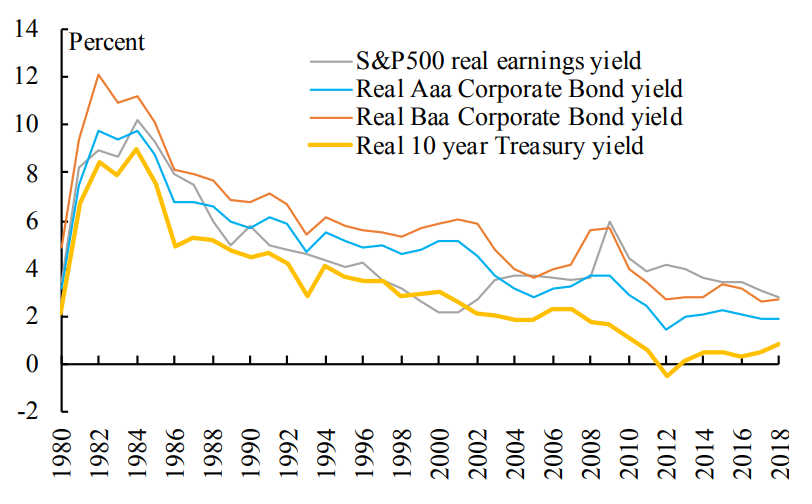
While there seems to be little doubt that real interest rates–short and long, ex ante and ex post — have declined very substantially even as (other things equal) budget deficits and expanded social security programs should have increased them, there remains debate about how to analyze these trends. Lukasz and I argue that adjustment to balance saving and investment is the best way understand declining real rates. DeLong wonders about changing risk premiums and Wolf cites BIS work arguing that low rates reflect the monetary policy regime. There is no reason why there needs to be only one cause of low real rates so these factors may enter. But as I expect we will illustrate in the revised version of the paper, the largest part of the low frequency variation in ex ante real returns is accounted for by a downward trending factor common to all asset prices. This is illustrated for the US in the figure below. So risk premiums or factors specific to Treasuries are likely not high order.
Figure: Decline in US real asset returns
Granting that secular stagnation is a problem, there is the question of policy response. The right policy response will be the one that assures that full employment is maintained with a minimum of collateral problems. Sandbu argues against the notion of secular stagnation in part because he thinks it may lead in unconstructive directions like protectionism and because he believes that stagnation issues can be feasibly and relatively easily addressed by lowering rates. Wolf, relying on the BIS, is alarmed by the toxic effects of very low rates on financial stability in the short run and economic performance in the long run, and prefers fiscal stimulus. Leonhardt prefers a broad menu of measures to absorb saving and promote investment.
I am not certain of the right approach and I wish there was more evidence to bring to bear on the question. I can certain see the logic of the “zero is just another number” view, that holds that the current environment poses no new fundamental issues but just may require technical changes to make more negative interest rates possible. I am skeptical because (i) I am not sure how large the stimulus effect of rates going more negative is because of damage to banks, reduced interest income for consumers, and because capital cost is already not the barrier to investment; (ii) I wonder about the quality of any investment that was not made at a zero rate but was made at a negative rate; and (iii) I suspect that a world of significantly negative nominal rates if sustained will be a world of leveraging, risk seeking and bubbles. I have trouble thinking about behavior in situations where people and firms are paid to borrow!
I am inclined to prefer more reliance on reasonably managed fiscal policies as a response to secular stagnation: government borrowing at negative real rates and investing seems very attractive in a world where there are many projects with high social returns. Moreover, we are accustomed to thinking in terms of debt levels but it may be more appropriate to think in terms of sustained debt service levels. With near zero rates these are below average in most industrial countries. The content of fiscal policies is crucial. Measures which run up government debt without stimulating demand like large parts of the Trump tax cut are ill advised. In contrast measures which promote investment and raise the tax base down the road are much more attractive.
There are of course other measures beyond stabilization policies like fighting monopolies, promoting a more equal income distribution, and strengthening retirement security for which the desire to maintain macroeconomic stability provides an additional rationale.
No trade deal can dictate our relationship with China
As the United States and China continue to joust over trade and technology, the U.S. policy debate contrasts two views of the primary problem.
A first view expressed often in President Trump’s tweets locates the key issue in the bilateral trade deficit that the United States chronically runs with China. On this theory of the problem, a solution is relatively easy: The Chinese could rearrange their imports of soybeans, fossil fuels and other products so more of them come from the United States, while countries now supplying China could export instead to nations now importing from the United States. This is what the Chinese keep offering since it means almost no real change in their economy. Neither levels of employment, output or total trade deficits and surpluses are likely to change much in either the United States or China.
A second view, held by more serious alarmists about the U.S.-China relationship, such as U.S. Trade Representative Robert E. Lighthizer, emphasizes problematic Chinese practices in key technological sectors. These range from theft of U.S. technologies to requirements that U.S. firms wishing to do business in China — chiefly in the development of key technologies, such as artificial intelligence — must form joint ventures with Chinese firms, especially those with connections to the Chinese government.
Such technological alarmists in and out of the administration hold that we can wall off U.S. technologies with sufficiently aggressive policies so China cannot steal them, or that we can pressure China to the point where it will give up government efforts at industrial leadership. Neither of these prospects is realistic.
In many ways, U.S. concerns over China and technology parallel concerns over the Soviet Union in the post-Sputnik missile gap period just before President John F. Kennedy’s election in 1960. Or over Japan in the late 1980s and early 1990s, when it was often joked that “the Cold War is over and Japan won.”
When atomic weapons were our most sensitive military secret, their creation required extensive sophisticated infrastructure. Yet the United States and Russia essentially had no normal interchange, so we were able to maintain a lead of three or four years with respect to both fission and fusion weapons.
Technology for artificial intelligence in development today, however, can be operated on widely available equipment. And there are hundreds of thousands of Chinese citizens studying in the United States or working for U.S. companies that develop such technology. Keeping U.S. knowledge out of Chinese hands for substantial lengths of time is impracticable short of a massive breaking of economic ties.
Nor is it likely for the Chinese government to halt its support of technology development. How would the United States react if other countries demanded that we close down DARPA, the Defense Department’s advanced research agency, because it represented unfair competition? Or if trading partners argued that U.S. support for private clean-energy companies, such as the subsidies provided by the Obama administration, was an unfair trade practice? Much of our current information technology and communications infrastructure comes directly or indirectly out of Bell Labs, which was financed out of the profits of a government-regulated and -protected monopoly. Would the United States have responded constructively to demands from other countries to dismantle the Bell system?
A focus on resisting the Chinese economic threat will likely not only be ineffective but may also be counterproductive if it diverts private and public energy from more productive pursuits. I remember well from the early Clinton administration that the great symbol of efforts to constrain unfair Japanese practices was Kodak’s case against Fuji, the Japanese photographic film company that attracted massive attention from Kodak’s senior management and U.S. policymakers. Perhaps if Kodak had instead focused on the digital photography ideas its scientists had developed, it would still be a significant company.
Where we can mobilize international support, we should, of course, push China to live up to its trade obligations and seek to modify rules in the World Trade Organization where they do not cover problematic practices. But in reality, our competitive success over the next generation will depend much more on what happens in our economy and society than at any international negotiating table.
Will our national investment in applied scientific research continue to languish to the point where even the most brilliant young scientists cannot get their first research grants until they are in their 40s? Will public officials who surely know better continue to allow creationism to be taught as serious science in U.S. public schools in a century with so much progress in life sciences? Will public policy concern itself with the strength and competitiveness of U.S. information technology companies as well as with their marketing practices? Will a national effort be made to improve the dismal performance of U.S. students at every level in international comparisons of mathematical and scientific achievement?
These questions and others like them, much more than any trade negotiation, will determine how the United States competes over the next generation. The Russian and the Japanese challenges pushed us forward as a nation in very constructive ways. So can the Chinese challenge if we seize the opportunity it represents.
February 5, 2019
NPR: What The ‘Weakened’ Case For Hiking Interest Rates Might Mean For The Economy
 The Fed on Wednesday backed off its plan to continue increasing rates this year in order to maintain U.S. economic growth.
Here & Now‘s Jeremy Hobson talks with Larry Summers, former secretary of the Treasury and president emeritus of Harvard University, about interest rates, tax rates and other economic issues.
Who’s Afraid of Budget Deficits?
How Washington Should End Its Debt Obsession
By Jason Furman and Lawrence H. Summers
The United States’ annual budget deficit is set to reach nearly $1 trillion this year, more than four percent of GDP and up from $585 billion in 2016. As a result of the continuing shortfall, over the next decade, the national debt—the total amount owed by the U.S. government—is projected to balloon from its current level of 78 percent of GDP to 105 percent of GDP. Such huge amounts of debt are unprecedented for the United States during a time of economic prosperity. Read more
Has economics failed us? Hardly
My friend Fareed Zakaria has celebrated his well-deserved recognition by Foreign Policy Magazine as one of the 10 most important foreign policy thinkers of the last decade by writing an essay entitled “The End of Economics,” doubting the relevance and utility of economics and economists. Because Fareed is so thoughtful, and echoes arguments that are frequently made, he deserves a considered response. Read more
We must prepare now for the likelihood of a recession
Excess austerity is a bigger risk than fiscal profligacy
When people are fundamentally healthy, they do not yet know what will cause their death. An economic recovery is healthy if it is not clear what will cause the next recession. By this standard, the recovery from the 2008 financial crisis, although disappointingly slow, has been healthy for most of the last decade.
This is now in serious doubt. Paul Samuelson’s quip that the stock market has predicted nine of the last five recessions cautions against overreacting to recent stock market moves. But credit spreads have widened considerably, commodity prices have softened and investors have started demanding higher yields for short-term US bonds than for those with longer terms. Unlike equity markets, “yield curve inversions” have not historically tended to produce false recession predictions. The overall judgment of financial markets is that recession is significantly more likely than not in the next two years.
Real economic indicators for the world’s largest economies, China and the US, also suggest considerable cause for concern. Almost every Chinese indicator in the last few months has come in below expectations. Beijing authorities now see the need for stimulus measures if they are to credibly report the attainment of growth targets. Revisions of economic forecasts tend to run in the same direction for protracted periods as forecasters adjust to emerging reality. This tendency is especially pronounced in China, given the extreme political sensitivity of economic statistics.
In the US, inflation is again running below the Federal Reserve’s 2 per cent target and comparisons of the yields on ordinary and inflation-adjusted bonds suggest investors expect this to continue for the next decade. While jobs growth remains strong, employment is usually a lagging statistic. Forward-looking indicators of business and consumer sentiment suggest that growth is likely to slow.
Perhaps the US economy will enjoy a soft landing: jobs growth would slow towards long run sustainable levels, and productivity growth would accelerate enough to allow continued gross domestic product growth of 2 per cent and increased wage growth without accelerating inflation. But this would require both policy skill and great luck. Given that we are starting from very high debt levels and low unemployment, a recession is the more likely outcome.
It is almost inconceivable that the global economy will remain healthy in the face of serious economic problems in both China and the US, even leaving aside their conflicts over trade and technology. Europe lacks economic energy and the uncertainties associated with Brexit, French protests, German political transition and Italian populism mean the continent is more likely to be a source of problems than a solution.
Like generals fighting the last war, too many policymakers are focused on yesterday’s problems. The global economy is much more likely to suffer from a downturn than from overheating in the next two years. There is more likely to be too little credit flow than too much, asset price deflation is more probable than a bubble and excess austerity is a bigger risk than profligacy.
The critical challenge for monetary and fiscal policy will be to maintain sufficient demand amid immense geopolitical uncertainty, increasing protectionism, high accumulated debt levels and structural and demographic factors leading to increased private saving and reduced private investment.
The Fed should signal that it is determined to avoid a downturn that would assure another decade of below target inflation. The People’s Bank of China and other central banks should also make clear that they recognise that avoiding another recession is the most important thing they can contribute to financial stability.
Fiscal policymakers should realise the very low real yield on government bonds is a signal that more debt can be absorbed. It is not too soon to begin plans to launch large-scale infrastructure projects if a downturn comes. The largest economies should try to limit trade frictions and signal that they are committed to co-operating to support global growth by assuring adequate capital flows to emerging markets and avoiding a cycle of protectionism.
Even if my recession fears are excessive, a shift towards emphasising growth will contribute to bringing inflation up to target levels and can be reversed. If I am proved right, the costs of delay in the policy response could be catastrophic. It is the irony of our moment that prudence requires the rejection of austerity.
Can anything hold back China’s economy?
Presidents Trump and Xi Jinping reached an agreement over the weekend at the Group of 20 meeting in Argentina on a framework for trade dialogue that will delay the imposition of new American tariffs. While surely better than the alternative, this step does not address any of the fundamental tensions in the economic relationship between the United States and China.
Few observers doubt that China needs to make significant changes in areas such as intellectual property, the rights of foreign investors and subsidies to state-owned companies if it is to meet international norms. Antipathy toward Chinese economic practices is hardly confined to Trump. Recent months have witnessed attacks on the existing economic relationship from members of previous U.S. administrations, noted China experts and the American business community. Indeed, it can be fairly said there are no China accommodationists left in Washington. When foreign governments get past their frustrations with the Trump administration, they acknowledge that they, too, are frustrated with Chinese commercial practices.
Yet it is also easy to sympathize with Chinese leaders who insist that China’s political system is for it to choose, and that economic negotiations should focus on the pragmatic identification of win-win opportunities, rather than on questions of ideology. At the same time, it is hard to see how anyone with a modicum of historical knowledge could fail to be concerned by a combination of increased domestic repression, centralization of power in one man, rapidly increased military spending and rhetoric about enlarging China’s role in the world.
The United States requires a viable strategy for addressing its legitimate grievances. Unfortunately, neither rage nor proclamation constitutes such a strategy. A viable approach would involve feasible objectives clearly conveyed and supported by carrots and sticks, along with a willingness to define and accept success.
At the heart of the problem in defining an economic strategy toward China is the following awkward fact: Suppose China had been fully compliant with every trade and investment rule and had been as open to the world as the most open countries at its income level. China might have grown faster because it reformed more rapidly, or it might have grown more slowly because of reduced subsidies or more foreign competition. But it is highly unlikely that its growth rate would have been altered by as much as 1 percent.
Equally, while some U.S. companies might earn more profits operating in China, and some job displacement in American manufacturing because of Chinese state subsidies may have occurred, it cannot be argued seriously that unfair Chinese trade practices have affected U.S. growth by even 0.1 percent a year.
This is not to say that China is not a threat to the international order. It is a seismic event for the United States to be overtaken after a century as the world’s largest economy. If, as is plausible though far from certain, the United States loses its lead over the next decade in information technology, artificial intelligence and biotech, the trauma will be magnified.
Can the United States imagine a viable global economic system in 2050 in which its economy is half the size of the world’s largest? Could a political leader acknowledge that reality in a way that permits negotiation over what such a world would look like? While it might be unacceptable to the United States to be so greatly surpassed in economic scale, does it have the means to stop it? Can China be held down without inviting conflict?
These are hard questions without obvious answers. But that is no excuse for ignoring them and focusing only on short-run frustrations. China appears to be willing to accommodate the United States on specific trade issues as long as the United States accepts its right to flourish and grow, knowing that sheer weight of numbers will make it the clear world’s largest economy before long.
That is a deal the United States should take while it can. It can bluster but it cannot, in an open world, suppress the Chinese economy. Trying to do so risks strengthening the most anti-American elements in Beijing.
Trump, for all his failings, has China’s attention on economic issues in a way that eluded his predecessors. The question is whether he will be able to use his leverage to accomplish something important. That will depend on his ability to convince the Chinese that the United States is capable of taking yes for an answer, and on his willingness to go beyond small-bore commercialism. We can hope, but we should not hold our breath.
December 5, 2018
Fed bashing is a fool’s game
President Trump has publicly and harshly rebuked Federal Reserve Board Chairman Jerome H. Powell for what the president regards as misguided interest-rate increases that threaten continued economic expansion. As with much of what Trump says and does, this way of doing business is counterproductive — irrespective of whatever merit his underlying position may have.
No self-respecting central banker can be seen as yielding to pressure from a politician facing a difficult election. A central bank that appears subservient to political concerns will rapidly lose credibility in the markets, resulting in increases in inflation expectations and rising long-term interest rates. As those of us at the Treasury Department used to remind White House political staff during the Clinton administration: Fed bashing is a fool’s game — the Fed doesn’t cut short rates, and the market raises long-term rates. The sense that policy is being politicized increases uncertainty, which is likely to decrease investment and ultimately slow growth.
So Trump is surely making a serious error in his rhetorical approach to the Fed. Two questions remain. First, how rapidly should the Fed raise interest rates in coming months? Second, recognizing that public Fed-bashing is wrong, what should be the nature of relations between the central bank and the executive branch? On neither question does orthodox thinking seem quite right to me.
On the first question, it seems there is considerably more danger of the Fed raising rates too fast than too slowly over the next year. Inevitably, monetary policy is a judgment about competing risks. If the Fed raises rates too slowly, inflation will increase and remain clearly above the 2 percent target for a significant interval. This does not seem like it should be a dominant worry. Inflation has been below the target level for a decade, so above-target inflation is necessary if inflation over the long term is to average 2 percent.
Even with good luck and good policy, a recession will come along at some point and pull down the inflation rate. Two months ago, it might have been reasonable to worry about complacency in asset markets, but in light of recent volatility this seems a lower order problem.
On the other hand, the risks of excessive tightening seem substantial. Monetary policies affect the real economy with lags of a year or more. It is, therefore, easy for policy to tighten past the point at which the economy is thrown toward recession because of an absence of clear signals of slowing. Indeed, on almost every occasion in the past 50 years when the Fed has tightened in a sustained way, the result has been recession. The risks of a downturn now are greater than at any point in living memory because, given the zero lower bound on interest rates, the Fed would have limited room for easing, and because of the populist and protectionist pressures that would almost certainly accompany a downturn. Caution should be the order of the day.
Second, there is a need for pragmatism regarding the independence of central banks. It is important they resist the kind of pressure for inflationary policy that Trump has recently engaged in. But it is foolish to suppose that a nation’s financial policies should be conducted entirely independently of its elected officials.
Consider some examples: During the period of quantitative easing following the financial crisis, the Treasury was pursuing a strategy of extending the duration of U.S. government debt. At the same time, to pursue stimulus, the Fed was operating in the opposite direction, in effect, issuing short-term debt and buying long-term debt. Surely a coordinated policy would have reduced transactions costs and served the public interest?
Or take exchange rates, which are objects of international diplomacy and are determined, in substantial part, by monetary and reserve management policies. Should elected governments with responsibility for foreign affairs have to be removed from exchange-rate policy in the service of central bank independence?
Occasions when interest rates are constrained by a zero or near-zero floor are likely to recur in the future. In such circumstances, coordination of fiscal and monetary policies may be necessary. This is very difficult if central bank policy is entirely independent of budget policy.
The point is not that central banks should be made more subject to political pressure. That is Trump’s bad idea. It is that, as their activities expand beyond pure monetary policy, there will be a need for coordination between the banks and elected government.
Driving across the US gave me a different perspective on the American economy
Economists like me see the world through the prism of models, fit to statistical data and tested against market realities. Economic models provide powerful perspective: I have used them to argue that, had the economy been left to itself and policymakers not heeded the lessons of history and theory, the 2008 financial crisis might have led to another depression.
But there are other ways of gaining understanding about an economy and its workers. This was brought home to me last month when I accompanied my wife on a trip different from any I had ever taken. We drove for two weeks on two-lane roads from Chicago to Portland, Ore., across the Great Plains and Rocky Mountains. The larger cities we passed through included Dubuque, Iowa; Cody, Wyo.; and Bozeman, Mont.
Driving across America, as opposed to looking down from a plane, makes clear how much of this vast country is uninhabited. Again and again, we encountered signs warning us to check our gas because it would be 50 miles to the next station. I’m sure there were moments when we were 250 miles from any place where I could have purchased an iPhone charger. Often there was no cellphone service to be had, either.
Much of the land we saw not only was uninhabited but also seemed to be put to little economic use — valleys too arid to farm or even to support ranching; mountain ranges too rugged to support year-round economic activity. We drove past some romantic ghost towns but more abandoned cafes, gas stations and hotels.
The abundance of land seemed not just a rural but also an urban phenomenon. Every attraction we visited had enough parking spaces for 10 times the number of visitors it enjoyed. We had our choice of metered spaces on main streets from Dubuque to Keystone, S.D., when we stopped for lunch.
We were also struck by how remote the concerns of the coasts seemed. Televisions in bars and restaurants were rarely turned to news channels. No one seemed terribly concerned with the controversy over then-Supreme Court nominee Brett M. Kavanaugh. We saw 15 roadside signs opposing abortion for every other political sign of any kind.
The conversations we overheard hewed close to local matters. I have always taken it for granted that broadened opportunities for young people are a good thing and that disadvantaged parents would be among the greatest champions of that idea.
Now I see more nuance. When we visited one university and spoke with some of its recruiters, they told us about the ambivalence of parents in their rural state. Many ranchers and Native Americans wanted to see their children educated but feared they would lose their attachment to the family way of life.
The phrase “way of life” is, I have come to think, an idea that those concerned with political economy could usefully ponder. It is fashionable to talk about business leaders and cosmopolitan elites who are more worried about the concerns of their conference mates in Davos, Switzerland, than those of their fellow citizens in Detroit or Düsseldorf, Germany. They are blamed for provoking a backlash against globalization. What I saw on my trip was how many profoundly different ways of life there are within the United States. I began to understand better than I had those who live as their parents did in smaller communities closer to the land.
Voters in most of the places we visited have tended to vote Republican in recent decades. In many places, signs for church suppers, hunting clubs and local fairs outnumbered political signs or even signs for commercial goods, which tells a cultural story. But the economic picture may be more complex. Starting with the federal government’s 1803 purchase of the Louisiana Territory from France, and the federally funded Lewis and Clark expedition to explore the West, the free market had little to do with the settling and economic progress of the American West. The economy of many of the places we visited was the creation of the U.S. government. Depression-era programs paid for power plants, built hiking trails and helped cut roads through mountains. Western tourist economies are based around national parks, forests and monuments, and government land grants funded many of the universities.
The United States is a remarkable place because it is an amalgam of remarkable places. Americans want to live in very different ways. Perhaps more appreciation of that on the part of those who lead our society could strengthen and unify our country at what is surely a complex and difficult moment in its history.
Bringing accountability to powerful, unelected officials
It is often said that the chair of the Federal Reserve is the second most important person in Washington. I’m not sure the statement is exactly right, but that it is plausible is, in a sense, remarkable. Why should the second most important person in Washington not be elected by the people, or at least directly accountable to and subject to dismissal by elected officials? The president cannot fire members of the Federal Reserve Board of Governors, and for the past quarter-century it has been taboo for the president or his economic team to so much as comment on the Fed’s activities. Read more
The financial crisis and the foundations for macroeconomics
A, if not the, preoccupation of macroeconomists for the last generation has been providing macroeconomics with a microeconomic foundation. At one level this totally makes sense. How can one be against establishing foundations? And it makes sense to think that macroeconomic theories of fluctuations in investment, for example, should be rooted in theories of how individual businesses makes investment decisions. Read more
Vaulting Workers Into the Middle Class With High Pay
Eduardo Porter has a thoughtful article in The New York Times on the “contractor parity” policy Harvard implemented during my Presidency. I thought at the time, and think now, that it was a good and important step for Harvard. The policy also serves as a valuable example for others, even if it’s not a panacea. Read more
Ending quarterly reports will not stop corporate short-termism
Requiring less information would favour better-connected professional investors
President Donald Trump has asked the US Securities and Exchange Commission to investigate moving public companies to a six-month rather than three-month reporting cycle to combat an excessive corporate focus on the short term.
Progressive critics and chief executives alike decry what they see as a myopic market’s pressure to cut back on investment and increase dividends and share repurchases. In her 2016 presidential campaign, Hillary Clinton proposed raising capital gains taxes for investments held for less than six years to combat short-termism.
Few ideas command such widespread support as the notion that companies should be induced to concentrate more on the long term. Unfortunately, while there are important ways in which corporate governance can be improved, the idea that a myopic market forces companies to forgo highly attractive investment opportunities is unsupported either by logic or evidence.
It is no surprise that the idea is attractive to many. Just as my students often suggest that the grading system forces them to study a particular syllabus rather than pursue their intellectual passions, managers prefer to avoid frequent accountability for results. The former chief executive of GM, Rick Wagoner, who presided over tens of billions of dollars of unsuccessful investment during the 2000s, was a leading voice against market-generated pressures for short-termism.
There is also an apparent worker interest in resisting payouts: employees at existing companies naturally prefer them to retain cash and grow, while the potential new groups that could be financed out of cash payouts do not yet have workers.
But popularity is not the same thing as validity. A variety of facts about market behaviour belie the systemic short-termism thesis. First, there are large numbers of companies, of which Amazon is only the most prominent example, that trade at huge multiples to current profits because of credible long-term plans.
There are now hundreds of unicorns — private start ups valued at more than $1bn — almost all of whom have little or no profits. This suggests that investors are happy to buy into credible, long-run corporate visions.
Second, many studies have now confirmed that companies where cash flows are highest relative to stock prices earn the highest returns. If, as the short-termism thesis suggests, these companies were over-valued, one would expect them to earn abnormally low returns rather than unusually high ones.
Third, private equity firms and venture capitalists expect companies they own to report on a monthly basis. Capable chief executives set a similar standard for divisions within their company. Otherwise they fear that problems will fester without being addressed. If companies with a sole owner in possession of a professional staff are expected to report frequently, why should not the same be true for public companies?
Fourth, companies differ greatly in their management quality. It is natural that those with better management and more opportunities will reinvest more of their profits and earn higher returns over time. To infer — as many advocates of the short-termism, including a 2017 McKinsey study, do — that this proves all companies should invest more, is to commit the obvious fallacy of confusing correlation with causation.
Reducing the frequency of corporate profit reporting would make big surprises and drastic market moves more likely. It would also allow managers to wait longer before they revealed large problems. Think of how much longer it would have taken for the issues at GE to become clear if the company reported only every six months.
Less frequent reporting would favour professional investors who are in constant touch with management over those whose information would be even more limited than it is today. In an age of big data and transparency, moving towards less would be a very odd step.
What, then, should be done? The rules limiting activists’ ability to distort corporate behaviour should be updated. More transparency on share accumulation would protect ordinary shareholders. At the same time, new restrictions should be imposed to prevent corporate activists from voting as shareholders in companies where they have divergent economic interests from other stockholders — because, for example, they used the options markets to hedge their risk.
Wise corporate leaders should give a sense of their long-term vision on at least an annual basis. Investors who insist on such information are only being reasonable.
Setting the Record Straight on Secular Stagnation
Joseph Stiglitz recently dismissed the relevance of secular stagnation to the American economy, and in the process attacked (without naming me) my work in the administrations of Presidents Bill Clinton and Barack Obama. I am not a disinterested observer, but this is not the first time that I find Stiglitz’s policy commentary as weak as his academic theoretical work is strong.
Stiglitz echoes conservatives like John Taylor in suggesting that secular stagnation was a fatalistic doctrine invented to provide an excuse for poor economic performance during the Obama years. This is simply not right. The theory of secular stagnation, as advanced by Alvin Hansen and echoed by me, holds that, left to its own devices, the private economy may not find its way back to full employment following a sharp contraction, which makes public policy essential. I think this is what Stiglitz also believes, so I don’t understand his attacks.
In all of my accounts of secular stagnation, I stressed that it was an argument not for any type of fatalism, but rather for policies to promote demand, especially through fiscal expansion. In 2012, Brad Delong and I argued that fiscal expansion would likely pay for itself. I also highlighted the role of rising inequality in increasing saving and the role of structural changes toward the demassification of the economy in reducing demand.
What about the policy record? Stiglitz condemns the Obama administration’s failure to implement a larger fiscal stimulus policy and suggests that this reflects a failure of economic understanding. He was a signatory to a November 19, 2008 letter also signed by noted progressives James K. Galbraith, Dean Baker, and Larry Mishel calling for a stimulus of $300-$400 billion – less than half of what the Obama administration proposed. So matters were less clear in prospect than in retrospect.
We on the Obama economic team believed that a stimulus of at least $800 billion – and likely more – was desirable, given the gravity of the economic situation. We were told by those on the new president’s political team to generate as much validation as possible for a large stimulus because big numbers approaching $1 trillion would generate “sticker shock” in the political system. So we worked to encourage a variety of economists, including Stiglitz, to offer larger estimates of what was appropriate, as reflected in the briefing memo I prepared for Obama.
Despite the incoming president’s popularity and an all-out political effort, the Recovery Act passed in Congress by the thinnest of margins, with doubts about its ultimate passage linger until the last moment. I cannot see the basis for the argument that a substantially larger fiscal stimulus was feasible. And the effort to seek a much larger one certainly would have meant more delay at a time when the economy was collapsing – and could have led to the defeat of fiscal expansion.
While I wish the political climate had been different, I think Obama made the right choices in approaching fiscal stimulus. It is of course also regrettable that after the initial Recovery Act, Congress refused to support a variety of Obama’s proposals for infrastructure and targeted tax credits.
Unrelated to the topic of secular stagnation, Stiglitz takes a swipe at me by saying that Obama turned to “the same individuals bearing culpability for the under-regulation of the economy in its pre-crisis days” and expected them “to fix what they had helped break.” I find this a bit rich. Under the auspices of the government-sponsored enterprise (GSE) Fannie Mae, Stiglitz published a paper in 2002 arguing that the chance that the mortgage lender’s capital would be depleted was less than one in 500,000, and in 2009 he called for nationalization of the US banking system. So I would expect Stiglitz to be well aware that hindsight is clearer than foresight.
What about the Clinton administration record on financial regulation? With hindsight, it clearly would have been better if we had foreseen the need for legislation like the 2010 Dodd-Frank reforms and had a way to enact it with a Republican-controlled Congress. Certainly we did not foresee the financial crisis that came eight years after we left office. Nor did we anticipate the ways in which credit default swaps would mushroom after 2000. We did, however, advocate for GSE reform and for measures to rein in predatory lending, which, if enacted by Congress, would have done much to forestall the accumulation of risks before 2008.
I have not seen a convincing causal argument linking the repeal of the Glass-Steagall Act and the financial crisis. The observation that most of the institutions involved – Bear Stearns, Lehman Brothers, Fannie Mae, the GSE Freddie Mac, AIG, WaMu, and Wachovia – were not covered by Glass-Steagall calls into question its centrality.
Yes, Citi and Bank of America were centrally involved, but the activities that generated major losses were fully permissible under Glass-Steagall. And, in important respects, the repeal of Glass-Steagall actually enabled the resolution of the crisis, by permitting the merger of Bear and Merrill Lynch and by allowing the US Federal Reserve to open its discount window for Morgan Stanley and Goldman when they otherwise could have been sources of systemic risk.
The other principal attack on the Clinton administration’s record targets the deregulation of derivatives in 2000. With the benefit of hindsight, I wish we had not supported this legislation. But, given the extreme deregulatory approach of President George W. Bush’s administration, it defies belief to suggest that it would have created major new rules regarding derivatives but for the 2000 act; so I am not sure how consequential our decisions were. It is also important to recall that we pursued the 2000 legislation not because we wanted to deregulate for its own sake, but rather to remove what the career lawyers at the US Treasury, the Fed, and the Securities and Exchange Commission saw as systemic risk arising from legal uncertainty surrounding derivatives contracts.
More important than litigating the past is thinking about the future. Even if we disagree about past political judgements and about the use of the term “secular stagnation,” I am glad that an eminent theorist like Stiglitz agrees with what I intended to emphasize in resurrecting that theory: We cannot rely on interest-rate policies to ensure full employment. We must think hard about fiscal policies and structural measures to support sustained and adequate aggregate demand.
Trump claims credit he is not due on the economy
President Donald Trump regularly and proudly takes credit for the US economy’s strong performance.
With rapid growth in the second quarter, the stock market strong, the unemployment rate back below 4 per cent and the midterm elections looming, his rhetoric and that of his supporters will probably escalate in the coming months.
In fact the approval the US president enjoys is boosted more by the strong economy, than the other way around. This conclusion will only be reinforced if Mr Trump’s current steps towards a trade war retard US economic performance, as is increasingly feared. A variety of observations are pertinent.
First, history suggests that presidential popularity rises with declining unemployment. It is reasonable to suppose that, if unemployment were at its long-term level of 5.5 per cent, instead of its current 3.9 per cent, Mr Trump’s approval rate would fall lower than its already anaemic level. As it is, his approval ratings are worse than those of any first-term president with an unemployment rate under 5 per cent.
Second, such acceleration of growth as we have observed is well within the normal range of growth forecast errors. Before the 2016 election, when the Trump presidency was not anticipated, consensus forecasts for the US economy were 2.2 per cent for 2017, and 2.1 per cent for 2018. The actual outcome in 2017 of 2.2 per cent and the consensus forecast of 2.8 per cent for 2018 do not represent a statistically significant fluctuation from the mean.
Third, it appears that growth has accelerated and exceeded expectations more outside the US than within the country, suggesting that whatever is driving America’s growth is a global factor, rather than something for which US policy can take credit. For 2017, the country’s growth exceeded expectations by less than for the world as a whole, or for China, Europe or Japan. For 2017 and 2018 taken together, US growth looks likely to exceed expectations by less than world growth.
Fourth, market evidence calls into question the idea that the US has become a highly attractive place to invest because of Mr Trump’s policies. Net foreign direct investment in the US in the first quarter of 2018 was down nearly two-thirds against the first quarter of 2016. Goldman Sachs analysts have demonstrated that US companies which do more business abroad have outperformed those that are more domestically focused. And there is the basic observation that before trade war fears took hold, the dollar had declined during the Trump presidency.
Fifth, the underlying reason why the US economy is strong right now is that it has been possible to run a very taut economy with unemployment below 4 per cent and not face significant inflationary pressures. No one is quite sure why this should be. It is probable that some combination of globalisation, technology, and the reduction of employee power as unions have weakened have changed the inflation process. It is hard to see why Mr Trump deserves credit for these structural changes, which have been happening for a long time.
Sixth, there is what Ben Bernanke, the former Federal Reserve chairman, has labelled the “Wile E Coyote” issue, after the accident-prone cartoon character. It may well be that an element of current success that can be attributed to Trump administration policy is borrowing prosperity from the future. This is most obvious in the case of the soyabean exports that were accelerated to avoid tariffs, but it is fairly ubiquitous.
Increasing fiscal stimulus is like a drug with tolerance effects — to keep growth constant, deficits have to keep getting larger. Some combination of gathering foreign storm clouds, the end of growing fiscal stimulus and the delayed effect of tightening monetary policies may converge to slow or end the expansion.
The choices this administration are making invite foreign retaliation against US exporters and use up fiscal capacity even as the economy is growing rapidly. Because of this, and because there is limited room for monetary policy, the country will not be in a position to respond strongly if a downturn comes. All the more reason, therefore, why we should avoid pulling demand forward.
This is all quite dangerous. The president has taken credit for far more economic success than he deserves. He will disproportionately be blamed when the downturn comes. What follows will be a test of our democracy.


